

- Form 1098-T is an informational tax form that shows how much you paid for tuition, along with how much you may have received in scholarships.
- This form is useful for claiming education tax credits and for potentially reporting taxable scholarships.
- Families still need to keep their own records to navigate tax season.
Every year, millions of families receive a tax form once they have paid their college costs. Form 1098-Tthe Tuition Statement, is issued by colleges and is intended to help taxpayers claim education tax credits. However, it often causes confusion about scholarships, taxable income and who owes what.
For families paying for college, a misunderstanding could lead to missed tax credits, unexpected student taxes or mistakes that impact health insurance subsidies and future financial aid.
Below, you’ll find out what you need to know about the 1098-T, how it works, and what families should pay close attention to, especially when it comes to college grants.

What is Form 1098-T and where does it come from?
Eligible colleges, universities, and vocational schools must send Form 1098-T to students who paid qualified education expenses during the year. Schools must send the form by post or make it available electronically January 31and they submit a copy to the IRS by February 28 (or the next business day if that falls on a weekend or public holiday).
The form is intended to help taxpayers claim education tax benefits, primarily:
- The American Opportunity Tax Credit (AOTC)
- The Lifelong learning credit
No taxes are charged. It doesn’t show what a family owes. It simply states the amounts the school has received and the grants it has processed.
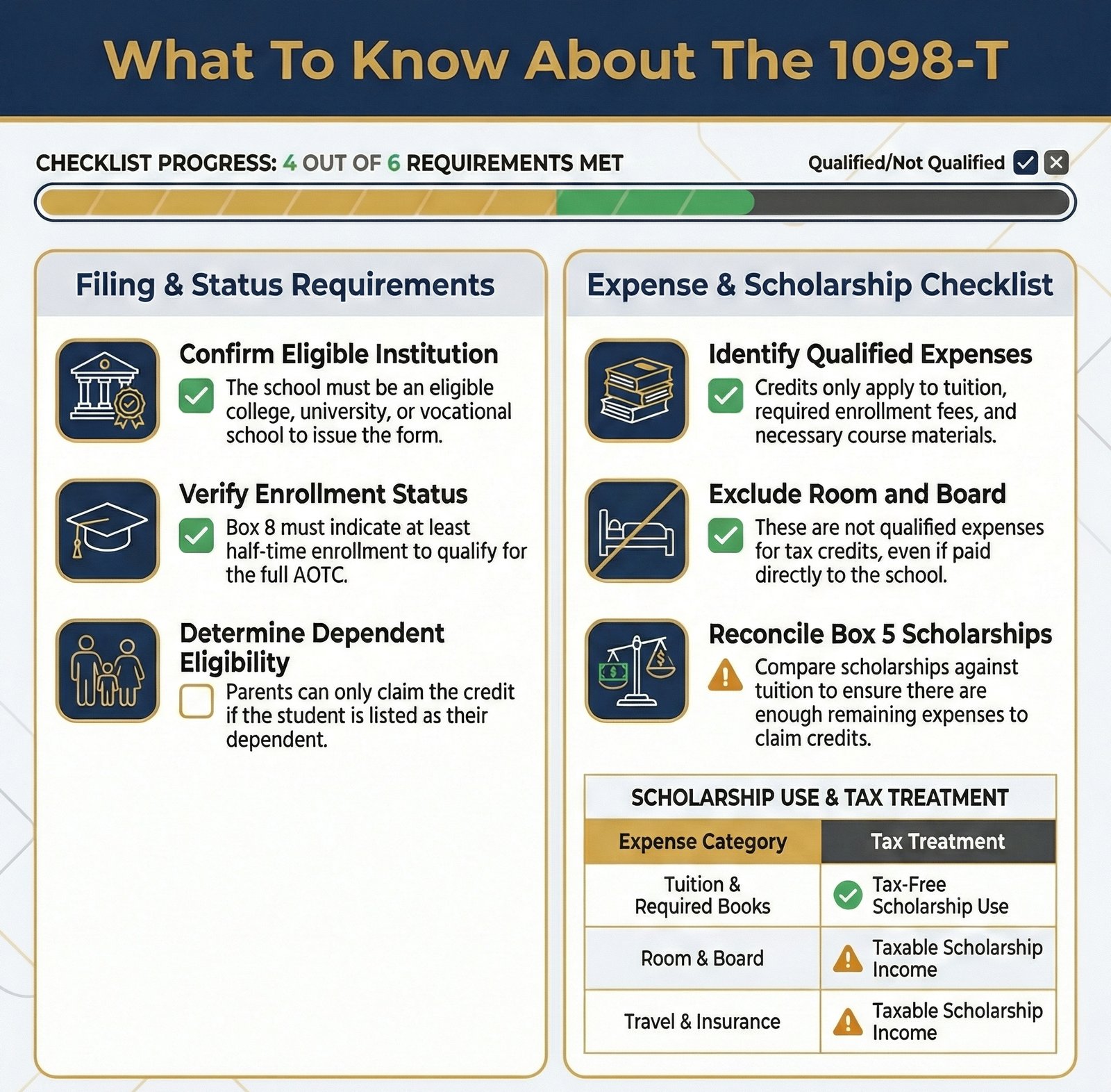
Who receives a 1098-T?
The form is issued to the studenteven if a parent paid the bill. That is important because:
- Parents only claim credits if the student is dependent on them.
- Scholarships are taxed at the studentnot the parent.
Schools must send a 1098-T when a student has paid qualified education expenses, which typically include:
- Allowance
- Mandatory registration fees
- Required course materials
Room and board are not expenses for education tax credits, even though they are often charged by the school.
Key boxes to know
Understanding a few boxes will explain most of the form.
Box 1: Payments received
This shows how much the school actually received during the year for qualified education and the associated costs. It may not correspond to the semester stated on the invoice because schools report when payments are received and not when classes take place.
Box 5: Scholarships and subsidies
This shows scholarships and grants that the school has applied to the student’s account. These amounts often reduce how much tuition money families can use to claim tax benefits.
That is crucial Box 5 does not tell you whether a grant is taxable. That depends on how the money is used.
Box 8 and Box 9
- Box 8: Student was enrolled at least half-time
- Box 9: Student was enrolled in a graduate program
These subjects are important for credit eligibility, especially the AOTC.
Financial consequences
This form can have various financial consequences.
Scholarships and taxes: what is tax-free and what is not
It is often assumed that scholarships are tax-free. That is only partly true. Sometimes scholarships are taxable.
Tax-free scholarships
The following applications are tax-free:
- Allowance
- Required costs
- Computers, books and necessary supplies
There is a simple formula:
Tax-free grant = qualified expenses
(usually Box 1 of the 1098-T, plus required books and supplies not billed by the school)
Taxable grants
Scholarships used for the following are taxable income to the student:
- Room and board
- Travel
- Insurance
- Other non-required expenses
It does not matter whether the money was paid to the school or to the student.
Coordinate with tax credits
The AOTC is worth maximum $2,500 per studentbut only if there are any $4,000 in qualified expenses available to claim.
Some families fall short because scholarships cover most or all of their tuition.
The tax rules are important here.
If the grant terms allow it, families can too treat part of a scholarship as payment for room and boardeven if the school applied this to the tuition. That portion becomes taxable income for the student, but it can free up tuition so a parent can claim the full AOTC.
The IRS explicitly allows this coordination in its education tax guidelines.
In practice:
- The student may owe a small amount of tax.
- The family may receive a much larger tax break.
For many households, the math works in their favor.
In short
The 1098-T is a starting point, not an answer sheet. It can be helpful to free up valuable tax credits and clarify when scholarships are taxable. However, it can also lead to families paying too much tax or missing out on the benefits they are entitled to.
For families who need to pay for college costs, understanding this form is less about paperwork – and more about keeping more money where it belongs.
Don’t miss these other stories:
#parents #1098T #tax #season