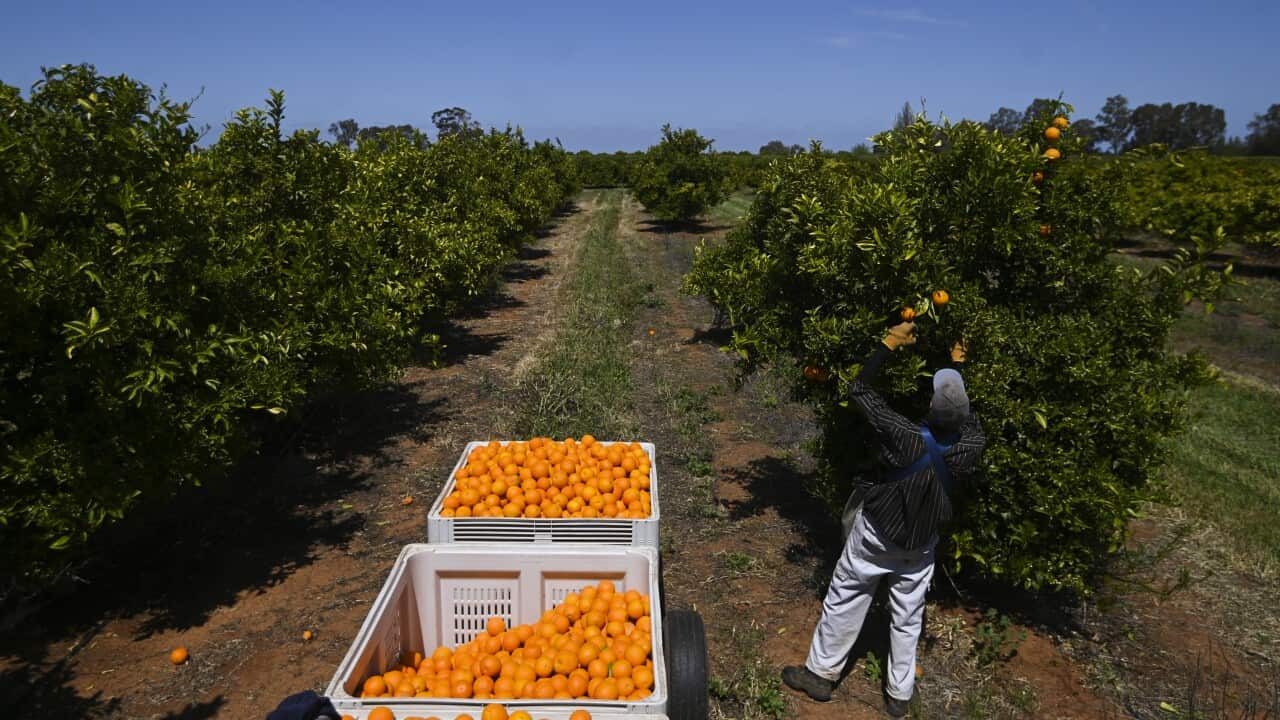

Unions have slammed the Albanian government after it quietly abandoned weekly hours guarantees for more than 14,000 workers in the Pacific.
The Pacific Australia Labor Mobility (PALM) program offers workers from across the region, including Vanuatu, Fiji and Timor-Leste, the opportunity to work in industries where there are not enough local workers available.
The vast majority work in agriculture and the meat processing industry.
In 2023, the government announced that the 14,300 temporary workers would be guaranteed 30 hours of work per week, which would be introduced in April next year.
But on Tuesday, the program’s website was quietly updated to confirm that the pledge had been withdrawn – and an existing transition requirement for an average of 120 hours of work over four weeks will be made permanent.
A fact sheet said the requirement “for employers to offer short-term employees 120 hours of work, spread over four weeks, has been established as ongoing and will no longer end on 31 March 2026”.
The document states that employers who cannot provide at least 120 hours of work during the four weeks must pay their employees an income equal to that time.
The move has drawn strong condemnation from the Australian Council of Trade Unions (ACTU), which remains concerned that many short-term workers are becoming financially vulnerable under the PALM arrangements.
“The government’s failure to deliver on its promise to protect vulnerable PALM workers from exploitation by providing minimum hours is a step backwards for workers’ rights in Australia,” said ACTU President Michele O’Neil.
“The unions are urging the government to reconsider its position and implement the promised 30-hour per week requirement so that PALM workers can be treated fairly and afford the basic necessities they need to survive.”
The PALM plan has been heavily promoted by ministers during visits across the Pacific, where Australia is trying to strengthen its diplomatic ties.
“All PALM employees and employers deserve a safe, secure and rewarding experience under the scheme,” Employment and Industrial Relations Minister Amanda Rishworth told SBS News in a statement on Wednesday.
“Retaining current arrangements will continue to ensure income security for PALM employees, while giving employers of PALM schemes the flexibility to deal with unexpected disruptions, such as natural disasters.”
“Employers have scrupulously adhered to their minimum hours obligations under the current arrangements, providing PALM employees with the income security they need.”
Farmers and employer groups had branded the proposed changes as unworkable, arguing they did not reflect the nature of seasonal work.
Richard Shannon, executive officer of the National Farmers’ Federation Horticulture Council, said farmers “planning for the worst” from April would welcome clarity on the future of the scheme, but warned the guarantees could put a “handbrake” on the scheme’s viability for employers.
“This particular setting, more than any other, is the one that causes the pain,” he told SBS News.
He called unions’ concerns about worker exploitation “unfounded,” citing government audits of employers that found “nowhere anywhere did workers receive less than 30 hours of work.”
“This has paralyzed the plan and there is no indication that they have solved a problem here,” Shannon said.
However, the measure never received the support of the opposition, which called the guarantee “unworkable” and promised during the elections to review the PALM scheme.
On Wednesday, Opposition Pacific Affairs spokesman Jason Wood said the “rigid 30-hour weekly minimum” was “doomed from the start.”
“It completely ignored the seasonal and weather-dependent nature of farm work,” he told the Australian Associated Press.
“The government must stop treating regional employers as an afterthought and start working with them to strengthen, not sabotage, the PALM program.”
#Labor #criticized #reversal #worker #visa #rule #affect #thousands #people