

Victoria Mater. The idol and the iconscheduled in the Roman Archaeological Park of Brescia, in the Capitolium, from December 4, 2025 to April 12, 2026. Installation view. Photography by Alessandra Chemollo. With thanks to © Brescia Museum Foundation
According to the official program, on January 17, the Olympic Torch will change hands at the Capitolium of Brixia, coinciding with the lighting of the brazier and in the room where the Winged Victory is held, in the new arrangement specially created by theartist Francesco Vezzoli.
Photo by Alessandra Chemollo. Courtesy of Fondazione Brescia Musei, 2025
The installation Victoria Mater. The idol and the icon, open to the public until April 12, 2026represents an opportunity to return to the theme of myth and iconography Winged victorythis time “reiterating the symbolic values associated with sporting competition through the culture that perpetuates a similar symbolic imagery”, as stated Francesca Bazoli, President of the Foundation Brescia.
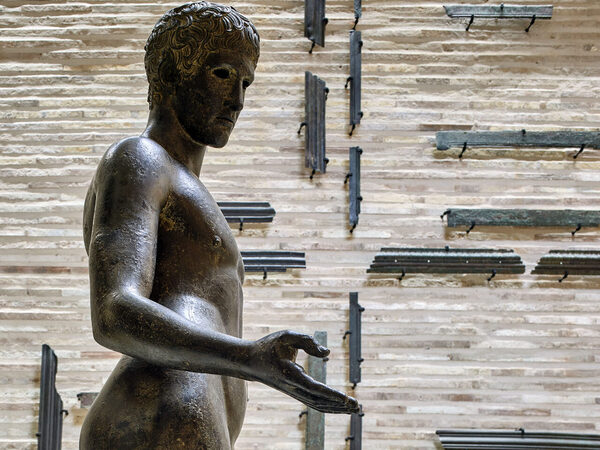
The Winged victory it is combined here withIdol of Pesaroa refined example of classical craftsmanship from the National Archaeological Museum of Florence, in a dialogue created by the artist Francesco Vezzoli who returned to his native city for the occasion.
“It was an intense experience to visit Brescia with Francesco to study the intervention he would carry out,” he says Donatieu Grau, curator of the exhibition. “He showed me his points of reference: the house of gallery owner Massimo Minini, the place where an old friend lived who collected the magazine ‘The Face’, the street where his father, the lawyer Vezzoli, has his studio and then of course the Capitolium. Therefore, the result of the installation is perhaps a mise en abîme: it is the story of Francesco’s bond with his place of origin and his mother, but it is also the story of the relationship between Brescia, the city of them all. chronologies, with its history.”
In a theatrical setting illuminated by the light of the “rosy-fingered dawn”, the audience observes from a stand the majestic Victory with polished wings and the Idol from behind, while in the background the shadow of the two figures is projected on the wall of the “cave” by Juan Navarro Baldeweg in an ideal silhouette that transforms Victory into an Alma Mater that blesses the young naked “lampholder”, transformed into the appearance of an athlete. Yes, because the Idol originally held in his left hand a vine intended to support lamps to illuminate nighttime banquets and, most likely, a tray in his right hand.
The masterpieces of antiquity therefore come into play again. There Vittoria in a “Mater” key it becomes the sum of many masterpieces from the past. “It’s paradoxical: Vezzoli’s almost religious veneration for art, even classical, leads him ceaselessly to develop new relationships. The question the artist asks himself is: ‘Why do we live together? How can we hope to live together?’ The icon from Victory and the Idol explains it well. Together they evoke past lives and create new vibrations that reinvigorate relationships with respect and a certain degree of irreverence,” says the curator.
While the hall is now illuminated by daylight, the public can walk between the two bronze statues and admire them up close. Viewed from a distance, the Idol’s eye emits a glow due to a hole in the metal. “The bronze, rediscovered in 1530, dates from the time of Augustus, but quotes the art of Polykleitos and represents iconic perfection. Created as banquet furniture, it had become an icon in the Renaissance. Today, in this new light, during the encounter with Victory, it is transformed into a human body, a symbol of hope,” he says. Daniele Federico Maras, director of the National Archaeological Museum of Florence.
Photography by Alessandra Chemollo. Courtesy of © Fondazione Brescia Musei, 2025
In exchange for the loan, the Florentine Museum is organizing the exhibition entitled Icons of strength and beauty. The review, from December 11, 2025 to April 9, 2026was conceived to present and comment on the historical development of the use of images for the presentation and transfer of power within the Roman Empire, in a phase of crisis and potential distrust such as that of the 3rd century AD. The project revolves around three gilded bronze heads of Roman emperors from the Capitolium bronze deposit, which are placed in dialogue with materials from the Medici collections.
The protocol signed ten years ago between the Brescia Musei Foundation and the Opificio delle Pietre Dure of Florence for the restoration of the Winged victoryinaugurated a systematic relationship between the two institutions that led to the restoration of the bronze heads now in Florence. “As always, every restoration is at the same time a unique opportunity for knowledge,” he says Emanuela Daffra, Chief Inspector of the Opificio. “Responsible care of the territory and cultural heritage is part of the added value.” And he concludes by recalling the famous sentence of Sallust, who defines myths not as historical stories, but as symbolic and always current truths, which speak of the soul, nature and the order of the cosmos: “myths never existed, but always existedAnd this is how Francesco Vezzoli revives Victory and the Idolin. Above all, the victory, from being a symbol of the defeat of Vitellius on the battlefield by the troops of Vespasian in 69 AD, frees itself from the shield, an element of defense in conflict situations, to tenderly embrace the figure of the Idolin, transformed into an icon of the sporting athlete.
#Brescia #Francesco #Vezzoli #revives #myth #dialogue #Winged #Victory #Idolino #Pesaro #Brescia #Arte.it