

In most cases, the number of spark plugs in a gasoline engine is usually represented by the number of cylinders. For example, it is completely normal for a V8 engine to have eight spark plugs, a V12 to have twelve spark plugs and a four-cylinder engine to have four. But in some cases engines have double the number of plugs in each cylinder. The first to do this was the Alfa 40/60 Grand Prix of 1914; the engine was so revolutionary that it made waves before the car manufacturer even became known as Alfa Romeo.
The company and its patented Twin-Spark technology are intertwined like bees and honey. The beating heart of the Alfa 40/60 Grand Prix is a 4.5-litre inline four-cylinder twin-ignition engine with two spark plugs per cylinder, bringing the total to eight. With eight spark plugs, the engine should produce more power, right?
Well, that 4.5-liter four-cylinder only produces 39 horsepower and 44 pound-feet of torque. That’s not much by 2025 standards, but in 1914 it was plentiful. They can indeed help improve performance, but dual ignition engines are more about efficiency, fuel economy and emissions.
Two sparks are better than one
Meanwhile, Honda unveiled its next-generation 1.3-liter i-DSI four-cylinder engine in 2001, and it eventually made its way into models like the 2003 Civic Hybrid. While some dual-spark designs fire the spark plugs simultaneously, Honda’s intelligent dual sequential ignition (i-DSI) engine has two spark plugs per cylinder that fire in different orders depending on engine load and engine speed.
In addition, the spark plugs are placed diagonally in the combustion chamber to burn the air-fuel mixture faster, allowing Honda to get the most out of every drop of gasoline. The design allows the engine to achieve a higher compression ratio and more intense combustion at any speed, while minimizing engine knocking. Honda’s 1.3-liter i-DSI engine produces around 85 horsepower, which is more than the vintage Alfa, but the highlight comes from fuel economy. Combined with Honda’s Multimatic S continuously variable transmission (CVT), the i-DSI engine could achieve 54 mpg without emitting many harmful emissions.
What are the advantages and disadvantages of dual ignition engines?
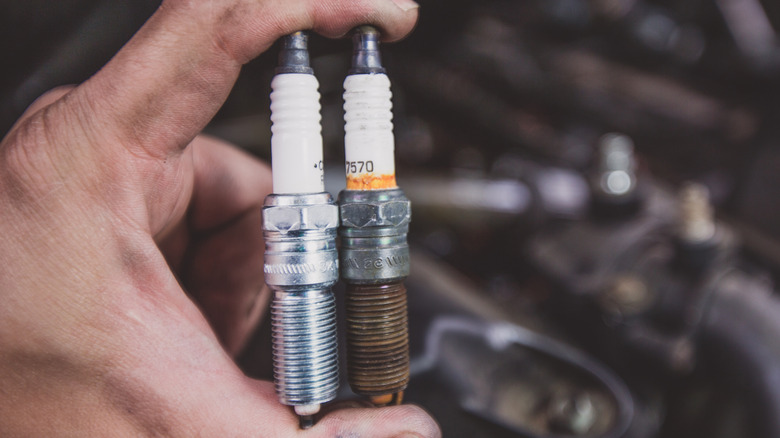
As for the disadvantages of double the number of spark plugs, the most notable disadvantage is maintenance costs. Spark plugs come in many varieties, and some iridium spark plugs will cost you around $8-$15 each. For a conventional four-cylinder engine, it could cost about $60 to replace all four spark plugs. But if you have a dual ignition engine, the cost doubles, potentially pushing it over $100.
Price isn’t much of an issue if you’re willing to replace the spark plugs yourself, but you can expect to pay almost double the labor at a professional shop for dual ignition systems. Plus, eight spark plugs means eight coil packs, and replacing them won’t be cheap. For reference, you can pay anywhere from $35 to $300 per spool, and that doesn’t include labor.
#Cylinder #Engines #Spark #Plugs #Jalopnik