

 EPA
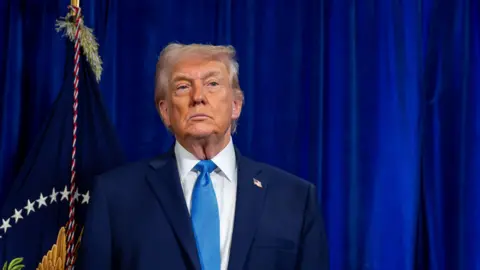
EPAWith the seizure of Venezuelan leader Nicolás Maduro, Donald Trump has demonstrated more powerfully than ever his belief in the power of his will, backed by brutal American military force. On his orders, the US put Maduro behind bars and will now ‘rule’ Venezuela.
The US president made the announcement at a remarkable press conference with enormous implications for US foreign policy worldwide at his Florida club and residence, Mar-a-Lago. Trump said the US would be in charge in Venezuela “until such time as we can achieve a safe, proper and judicious transition.”
U.S. Secretary of State Marco Rubio, he said, had spoken to Venezuelan Vice President Delcy Rodríguez, who told him “we will do whatever you need… She was, I think, very friendly, but she really has no choice.”
Trump was light on details. He said that “we are not afraid of boots on the ground when necessary [them]”.
But does he believe he can rule Venezuela remotely? Will this demonstration that he will back up his words with military action, which was effusively praised at Mar-a-Lago by both Marco Rubio and US Defense Secretary Pete Hegseth, be enough to reform Venezuela and push Latin American leaders to play by the rules?
It sounded like he believed something like that.
The evidence is that it won’t be easy or smooth.
The respected think tank, the International Crisis Group, warned in October that Maduro’s fall could lead to violence and instability in Venezuela.
The same month, The New York Times reported that defense and diplomatic officials in the first Trump administration had wondered what would happen if Maduro fell. Their conclusion was the prospect of violent chaos as armed factions struggled for power.
The removal and imprisonment of Nicolás Maduro is a remarkable assertion of American military power.
The US assembled a huge armada and achieved its objective without losing a single American life.
Maduro had ignored the will of the Venezuelan people by brushing aside his own electoral defeat, and his departure will undoubtedly be welcomed by many of its citizens.
But the implications of the American action will ripple far beyond Venezuela’s borders.
The mood was triumphalist at the Mar-a-Lago press conference as they celebrated what was undoubtedly a textbook operation carried out by highly professional US military forces.
The military operation is only the first phase.
The US record of achieving regime change by force over the past thirty years is abysmal.
The political follow-up is what makes or breaks the process.
Iraq descended into a bloody catastrophe after the US invasion in 2003. In Afghanistan, two decades and billions of dollars of nation-building efforts were wiped out in days after the US withdrawal in 2021.
Neither country was in America’s backyard.
Yet the ghosts of past interventions in Latin America – and the threat of others to come – are hardly more promising.
Trump tried a new nickname, the Donroe Doctrine, for President James Monroe’s 1823 statement warning other powers not to interfere with America’s sphere of influence in the Western Hemisphere.
“The Monroe Doctrine is a big deal, but we have made it obsolete in many ways,” Trump said at Mar-a-Lago. “Under our new national security strategy, American dominance in the Western Hemisphere will never again be questioned.”
He said Colombia’s President Gustavo Petro should “be on his guard.”
He later told Fox News that “something has to be done with Mexico.”
Cuba is undoubtedly also on the American agenda, which is driven by Rubio, whose parents are Cuban-Americans.
The US has a long track record of armed interventions in Latin America.
I was in Haiti in 1994 when President Bill Clinton sent 25,000 troops and two aircraft carriers to force regime change. Subsequently, the Haitian regime collapsed without a shot being fired. Instead of ushering in a better future, the ensuing thirty years have been a period of almost uninterrupted misery for the Haitian people. Haiti is now a failed state dominated by armed gangs.
Donald Trump talked about making Venezuela great again, but not about democracy. He rejected the idea that Venezuelan opposition leader María Corina Machado, who won the Nobel Peace Prize in 2025, should lead the country.
“I think it would be very difficult for her to be the leader, she doesn’t have the support… She doesn’t have the respect.”
He made no mention of Edmundo González, who many Venezuelans believed was the rightful winner of the 2024 elections.
Instead, the US is backing Maduro’s Vice President Delcy Rodríguez, at least for now.
Although there must have been some kind of internal conspiracy that gave the US military the inside information it needed to depose Maduro, the regime of his predecessor, Hugo Chávez, appears to be intact.
It is unlikely that the Venezuelan armed forces, despite the humiliation the generals might feel at their inability to resist the American attack, will acquiesce to the American plans.
The military and civilian supporters of the regime have enriched themselves through networks of corruption that they do not want to lose.
Civilian militias are armed by the regime, and Venezuela has other armed groups.
This includes criminal networks, but also Colombian guerrillas who supported the Maduro regime in exchange for shelter.
The US intervention in Venezuela brings into sharp focus some of the sources of Trump’s worldview.
He makes no secret of the way he covets the mineral wealth of other countries.
He has already tried to profit from Ukraine’s natural resources in exchange for military aid.
Trump does not hide his desire to control Venezuela’s vast mineral reserves, and his belief that American oil companies were robbed when the oil industry was nationalized.
“We’re going to take an enormous amount of wealth out of the ground, and that wealth is going to the people of Venezuela, and to people outside Venezuela who used to be in Venezuela, and it’s also going to the United States of America in the form of payback.”
That will increase fears in Greenland and Denmark that he will look both north and south.
The US has not abandoned its desire to absorb Greenland, because of its strategic position in the Arctic and because of the natural resources that are becoming increasingly accessible as the ice melts due to global warming.
The Maduro operation also represents another serious blow to the idea that the best way to govern the world is to follow an agreed set of rules, as enshrined in international law.
The idea was already falling apart before Donald Trump took office, but he has repeatedly demonstrated both in the US and internationally that he believes he can ignore laws he doesn’t like.
European allies, desperately trying not to anger him, including Prime Minister Keir Starmer, are struggling to find ways to say they support the idea of international law without condemning the fact that the Maduro operation is a blatant violation of the United Nations Charter.
The US justification that the military simply helped execute an arrest warrant against a drug lord posing as the president of Venezuela is thin, especially given Trump’s statements that the US will now control the country and its oil industry.
A few hours before Maduro and his wife were arrested, he met with Chinese diplomats at his palace in Caracas.
China condemned the US action. It said “US hegemonic acts seriously violate international law and Venezuela’s sovereignty and threaten peace and security in Latin America and the Caribbean.”
The US must “stop violating the sovereignty and security of other countries.”
Still, China could see a precedent in the U.S. action.
The country considers Taiwan a breakaway province and has declared that returning the country to Beijing’s control is a national priority.
In Washington, that is certainly the fear of the Democratic vice chairman of the Senate Intelligence Committee, Senator Mark Warner. He issued a statement saying Chinese leaders and others will be watching closely.
“If the United States claims the right to use military force to invade and capture foreign leaders it accuses of criminal behavior, what prevents China from claiming the same authority over Taiwan’s leadership? [Russian President] Prevent Vladimir Putin from using a similar justification to kidnap the Ukrainian president? Once this line is crossed, the rules that keep global chaos in check begin to collapse, and authoritarian regimes will be the first to exploit them.”
Donald Trump seems to believe he makes the rules, and what applies to the US under his command does not mean others can expect the same privileges.
But that’s not how the world of power works.
His actions in early 2026 point to another twelve months of global turbulence.
#Trumps #Maduro #attack #set #precedent #authoritarian #powers #world