
MELBOURNE, Australia – Wearable fitness trackers have turned heads at this year’s Australian Open, with key players Carlos Alcaraz, Jannik Sinner and Aryna Sabalenka all asked to take off their devices during matches.
The devices – which are widely used in elite sports to collect physiological data that provide insight into health and performance during training, competition, recovery and sleep – have been approved for use by the International Tennis Federation and by the men’s and women’s tours. But so far the approval has not been extended to the four Grand Slam tournaments, including the Australian Open, French Open, US Open and Wimbledon.
But that could change in future editions, with Tennis Australia saying in a statement: “Wearables are not currently permitted at Grand Slams. The Australian Open is involved in ongoing discussions about how this situation could change.”
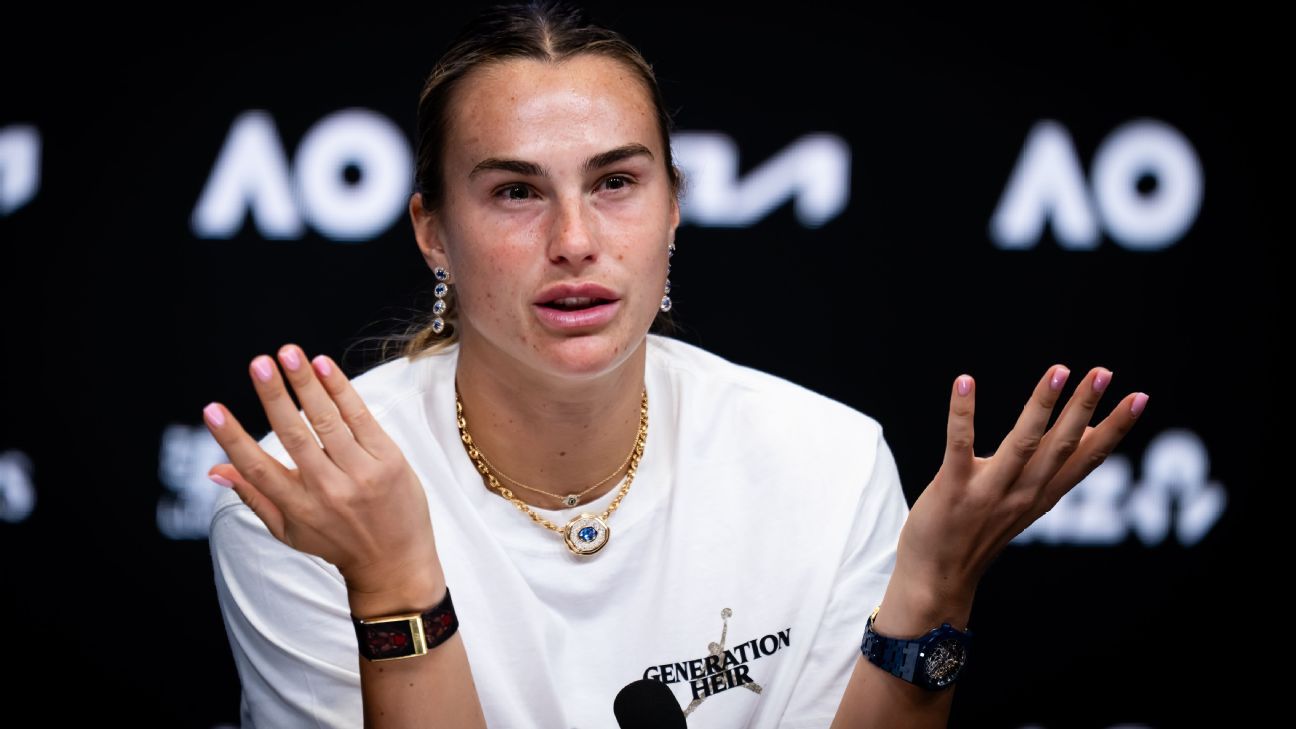
Sabalenka wants the ban to be reversed now. The top-ranked player in women’s tennis, who is aiming for a third Australian title in four years, said after her quarter-final victory on Tuesday that the Australian Open and other three majors are out of step with the rest of tennis.
Alcaraz and Sinner, who have split the past eight major men’s singles titles between them, were approached by chair umpires during the fourth round on Sunday and Monday to remove the bands they usually wear on their wrists.
Tennis Australia said some wearables give athletes an indication of internal load – measurements such as heart rate – “allowing them to get a 360-degree view of the work they are doing and how their body is responding.”
Tournament organizers said players had access to data at the Australian Open that helped them track “key external load measurements” such as distance covered, changes in direction, high acceleration events and speed and spin of shots.
The technology provider WHOOP describes it as “your 24/7 wearable coach, designed to help you improve your health, fitness and longevity.”
In a social media post, the company said the technology is “performance enhancing – by design. That’s the whole point.”
“Taking away that insight is like asking athletes to play blind.”
Sabalenka said she received an email that the devices had approval from the ITF and “I didn’t know that the Grand Slams didn’t come to the same conclusion.”
“I don’t understand why because all year round we wear them at WTA tournaments and all the tournaments I play,” she said. “I don’t understand why the Grand Slams don’t allow us to wear these and I really hope they will reconsider the decision and let their players follow their health monitor.”
Sinner, a two-time Australian Open winner, said the data collected from his wrist device during matches helps with recovery and preparation for future matches.
“There’s some data we’d like to track a little bit on the track. It’s not for live purposes,” he said. “It’s more about what you can see after the match. This is data that we would also like to use in training, because from there you can continue to practice with heart rate, how many calories you burn, things like that.”
After his fourth-round victory over compatriot Luciano Darderi, Sinner said he also immediately accepted the referee’s decision.
“It’s fine. There are other things we can use — [like] the vest. But I find it a bit uncomfortable: you feel like there’s something on your shoulders. It’s a little different,” he said. ‘But rules are rules. I understand. I won’t use it again.”
The Associated Press contributed to this report.
#Top #players #asked #remove #fitness #trackers #Australian #Open