

It is not unusual for an automaker to order the destruction of a concept car or prototype once it has served its purpose. For many concepts, that goal is to pose sweetly at countless shows, gauge public opinion on design and mechanical innovations, and then retire quietly. That was the supposed fate of the 1955 Chevrolet Biscayne concept, and in 1956, once it had achieved this goal, General Motors deposited it in the Warhoop junkyard in Sterling Heights, Michigan, and ordered its destruction. The bright, bold concept – designed to showcase GM’s then-new 265-cubic-inch V8 – was cut into eight pieces and forgotten… by seemingly everyone but one.
That man is Joe Bortz, a former restaurant and nightclub owner from Chicago. See, Bortz has a fascination with old GM concept cars and has been collecting and restoring them since the 1980s. He heard that there were a few such cars hidden in the Warhoop junkyard, went there and found and purchased not only the dismembered Biscayne Concept, but also a 1956 Cadillac Eldorado Brougham Town Car concept and two 1955 Buick LaSalle concept cars.
As determined as Bortz was, restoring a one-off car that had been dismembered and left for decades is no easy feat, so the remains remained in his care for a while. That was until some of his trusted restorers let Bortz know they had the confidence to take on the project.
Restoration of the Biscayne concept
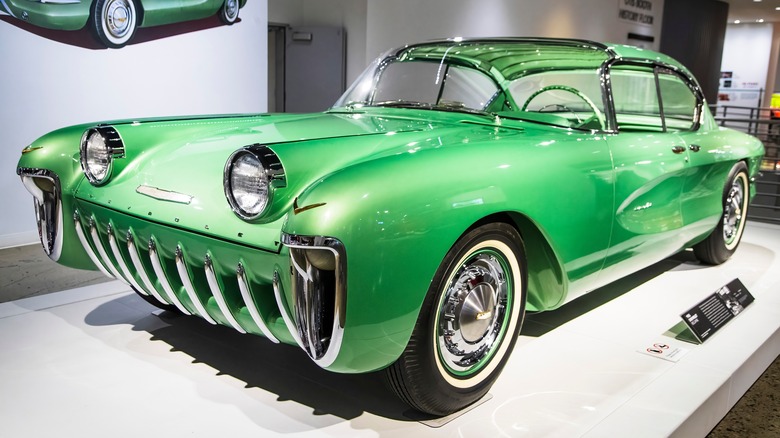
In most common cases, restoring a car involves buying some books and manuals, scouring old forums for advice, and picking the brains of others who have faced the same challenge. However, Bortz faced a unique challenge as there is only one Biscayne concept and thus no book or guide to refer to. In addition, his dismembered Chevy had no chassis and was missing many trim parts. In an attempt to complete the picture, Bortz contacted GM, which had actually retained documents referencing the Biscayne’s design, despite having ordered the model’s demise several decades earlier.
Kerry Hopperstad of Hopperstad Customs was tasked with building the chassis using the original GM blueprints, while Fran Roxas played the role of restoration consultant and Ruben Collazzo of Ruben’s Upholstery Shop took control of the interior. Mel Francis straightened the salvaged bodywork onto Hopperstad’s new frame, in addition to making a mold for the missing windshield, and fabricating many one-off trim pieces that have been lost to time.
In short, nothing was easy and experts were called in for all aspects of the incredible construction, which ultimately took years to complete. At least the powertrain was easy to come by—a run-of-the-mill 265-cubic-inch GM V8 mated to a virtually indestructible two-speed Powerglide transmission—although the outlandish output was 215 horses, a power rating not shared by any other 265-powered 1955 model.
Once completed, Bortz displayed the revived Biscayne at the prestigious Amelia Island Concours D’Elegance, where it received high praise, including from Wayne Cherry, GM’s retired vice president of design. Cherry noted the crucial influence of the Biscayne concept in shaping a number of GM models that came to market in subsequent years.
Importance of the Biscayne concept
When you look at the Biscayne’s design as a whole it can be difficult to see which models it influenced, but when you zoom into the details it becomes clear. That rear design is from an oh-so-early Corvair, and those scalloped side cutouts scream of an early Corvette – both notable Chevy models, and both owe a little bit to the Biscayne’s bold design team.
The striking design may be hard for some to love, but there’s no denying that it’s striking, especially in that green shade. And that was the whole point: to attract attention. It’s certainly no easy feat to catch the eyes of onlookers when surrounded by other beautiful creations, as this concept once was, under the bright lights of GM’s Motorama new vehicle shows. The Biscayne succeeded perfectly and stood out as one of the great designs of the Harley Earl era. A large crowd would have been drawn in and given the chance to check out the Biscayne’s real party piece – that 265 cubic inch V8 – creating excitement for future production models that would also be equipped with the new power plant.
Restoring this masterpiece from the 1950s was no easy task, but it was requested in 2011 by Motor trend if it was all worth it, Bortz simply replied “Absolutely!” He added: “There is only one, there will never be another, and it is almost lost to history” – clearly outlining the importance of his and his team’s work in restoring this forgotten hallmark of 1950s design to its original glory.
#Chevy #Biscayne #Concept #Ripped #Dumped #Jalopnik