

The piano accordion of business
Entrepreneurship is like a piano accordion. Industries and individual companies expand and grow, and then contract, necessarily becoming smaller than they once were. Keeping this metaphor in mind when investing can help you understand the life stage of the company.
There are exceptions, of course – those companies that rise above the cycle of invention, adoption, scale, saturation, disruption and destruction, but they are few and far between. Most will eventually reach a natural limit to their size, and then they sit there, churning customers for lower margins, or they get disrupted, or their customers move on to the next trend.
Table 1. Typical life cycle
| Phase | Main features |
| Invention | High R&D, negative cash flow and ‘The Pivot’. This is the spark of a new solution. |
| Adoption | Early adopters sign up. Market fit has been proven. The growth is exponential but messy. |
| Dish | The company is optimizing its activities to conquer the mass market. Efficiency and market share are the main objectives. |
| Saturation | Almost everyone who wants the product has it. Growth slows and the company often shifts to defending its position and maximizing dividends. |
| Disruption | A new invention arises that may offer a better or cheaper solution or alternative. The incumbent loses relevance. |
| Destruction | The company fails to turn around, is acquired for parts or falls into obscurity. |
Technology, luxury fashion, media and more – all these sectors have experienced the piano accordion of life.
Accordion expansion
In 2021, LVMH experienced a wave of popularity for its many (now 75) brands, including Louise Vuitton, Veuve Clicquot, Dior, Fendi, Givenchy, Rimowa, Off-White, Tiffany, Hublot, TAG Heur, Bulgari, Sephora, Ruinart, Château d’Yquem, Moncler (indirectly) and many more.
If you had walked along the Champs-Elysees in Paris towards the Arc de Triomphe in 2021, you would have passed the famous Louis Vuitton store and outside every day, in a neat line, you would see hundreds of Chinese nationals patiently waiting to enter.
While many lined up to avoid the ‘fakes’ at home, 2021 was also a time when conspicuous consumption of luxury goods among wealthy Chinese saw a sharp increase.
At the time, the luxury sector was expected to show organic sales growth of 24 percent, implying a full recovery to 2019 levels thanks to the rise of the “Global Affluent” – those with more than $62,000 in annual disposable household income, and the “Affluent” – those with $46,000 to $62,000.
By 2021, the number of ‘Affluents’ and ‘Affluents’ in China was expected to increase fifteenfold, from 4 million in 2010 to 60 million in 2030. And with high barriers to entry, few digital threats and loss-making retail rents, it was concluded that the strong brands were likely to become stronger.
As a result, LVMH’s share price rose 117 percent between the end of 2019 and mid-2023.
But having a store on every street corner isn’t a luxury, and eventually, as LVMH scaled up and rolled out an ever-expanding parade of luxury boutiques, customers stuck with it.
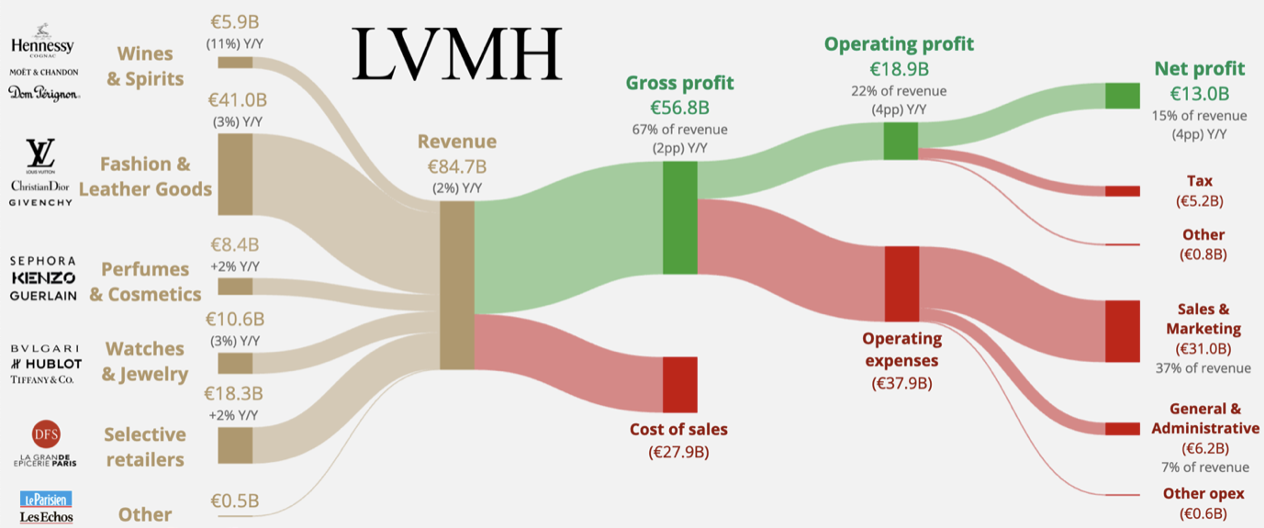
Figure 1. History: LVMH income statement 2024
Source: App Economy Insights
LVMH’s customers can be divided into three segments. The first is the entry-level or occasional customer. They buy one product, usually cosmetics, perfumes or small leather goods. This is LVMH’s highest volume customer segment.
The next segment buys 2-3 products. They form a smaller segment that combines a “classic” garment with accessories or items from another LVMH brand.
The third category is the very important customers: the customers who spend a lot and buy four or more products.
Each category is populated by fewer and fewer people. There are plenty of people who own one Ferrari, there are a few who have collected twenty or more.
Of course, LVMH segments its customers based on a much broader range of characteristics, including demographic (wealth and age), psychographic (icon collectors and stealth wealthy), behavioral (frequent and occasional/gift buyers), and geographic, but the important thing to note is that every customer eventually reaches a saturation point, or they grow older and simply spend less.
At some point, a company reaches a ceiling on the number of customers it will ever reach. Sure, younger generations are coming along, but unless there are more of them than in the previous demographic group, the total number of customers remains stable and the company is forced to spend more to attract the next customer or keep the existing one.
Meanwhile, trends are changing.
In 2024, LVMH’s revenues fell by €1.5 billion from €86.2 billion to €84.7 billion. In 2025, turnover fell another €4.7 billion to €80.8 billion.
Accordion contraction
This year, many news outlets are reporting that China’s decade-long era of explosive, logo-driven luxury growth has come to an end.
Instead, a sophisticated “pingti” (replacement/dupe) culture has developed among Gen Z consumers there. And it doesn’t appear that the shift is temporary or a response to economic belt-tightening. Instead, it appears to be a cultural shift where smart shopping becomes the new status symbol, replacing brand prestige.
The consequences for global luxury conglomerates are already being felt. China’s luxury market – once a third of global sales – is reported to shrink by 18 to 20 percent by 2024.
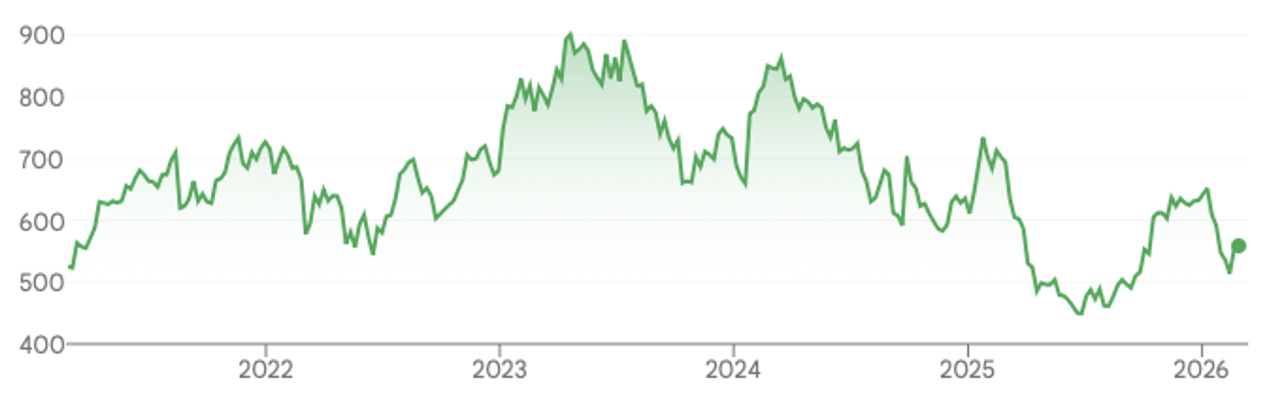
Figure 2. LVMH share price (€)
Source: Google Finance
Main impact on the share price:
- LVMH: Shares down ~30 percent from 2023 peak.
- Kering (Gucci): Shares are down about 60 cents since 2021.
- Burberry: Brand value dropped by $2.0 billion by 2024; removed from the FTSE 100.
- Estée Lauder: Stocks fell 70 percent as sales hit 2020 lows.
The social media-driven ‘Pingti’ phenomenon is different from the traditional ‘trading down’. Instead, for example, the movement is driven by consumers actively researching Original Equipment Manufacturers (OEMs) to find products made in the same factories as luxury brands (for example, the Sitoy Group, which produces $100 bags identical to Prada/Michael Kors items for $1,000). Meanwhile, domestic brands are using a “performance benchmarking” strategy to offer high-end specs at a fraction of the price (for example, Laifen hairdryers costing 20 percent of Dyson’s retail price), and for many Chinese Gen Zers, the social media celebrities are not the ones unboxing an iconic Louis Vuitton bag for the world to see, but the ones finding a high-end Chinese alternative, manufactured and marketed by brands like Florasis, Li Ning, Anta and Laopu Gold.
Call it disruption, call it a cycle, or call it structural, but either way, I wonder if the accordion for LVMH and its peers has completed its contraction. Will LVMH investors regret the company’s expansion in China? When the contraction is over, the stock could be cheap, but if LVMH has already reached its maximum customer base, it may have already reached its maximum market cap.

He is also the author of the best-selling investing guide to the stock market, Value.able – how to value and buy the best stocks for less than they are worth.
Roger regularly appears on television and radio, and in the press, including ABC radio and TV, The Australian and Ausbiz. View upcoming media appearances.
This post was contributed by a representative of Montgomery Investment Management Pty Limited (AFSL No. 354564). The main purpose of this message is to provide factual information and not advice about financial products. Furthermore, the information provided is not intended as a recommendation or opinion about any financial product. However, any comments and statements of opinion should contain general advice only, prepared without taking into account your personal objectives, financial circumstances or needs. Therefore, before acting on any information provided, you should always consider its suitability in the light of your personal objectives, financial circumstances and needs and, if necessary, seek independent advice from a financial advisor before making any decision. Personal advice is expressly excluded in this message.
#piano #accordion #business