

September 21, 2025
9:37 AM
US President Donald Trump signed on September 19, 2025 an enforcement schemeThat will shake the entire technological world. From September 21, companies have to pay $ 100,000 a year (almost $ 35 million) for every employee with an H-1B visa that they want to use. This enormous jump will also be particularly seriously affected by the crypto sector compared to the current fee of $ 1,400-4500 (ie up to $ 1.5 million). The new rule affects one of the most important methods of technology companies to bring trained employees to America.
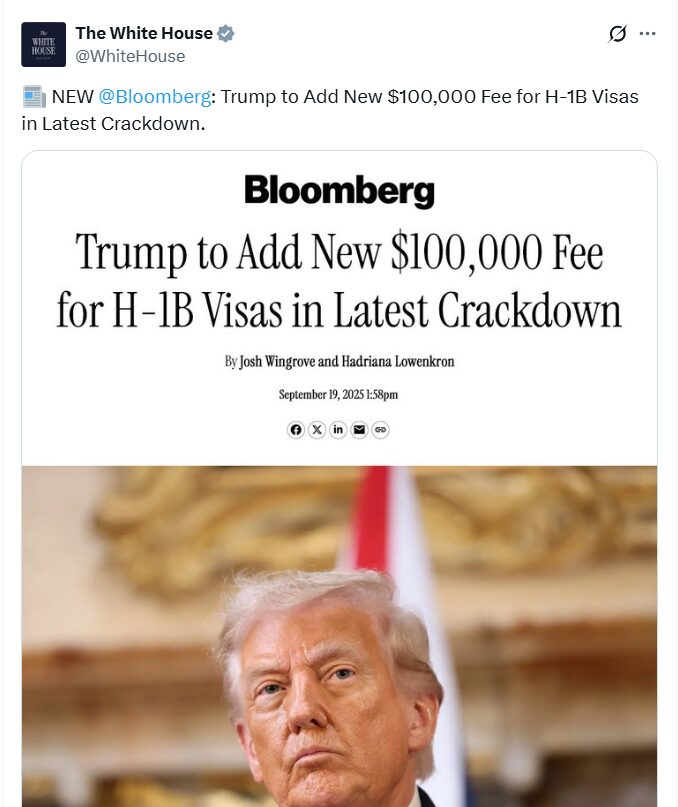
About 85,000 H-1B-VISA are issued in a lottery system every year. Most of these employees – about two -thirds – work in a computer assignment. For crypto companies that are largely based on international talents, this change can have catastrophic consequences. The blockchain sector needs high specialized expertise that is not always easy to find locally. Companies need developers who understand smart contracts, cryptocurrency protocols and decentralized financial systems. Most of these experts come from countries such as India and China under the H-1B program.
Changes in H-1B visa can have a negative influence on American innovation
The employer must initiate the H-1B employee visa. You must prove that you need an employee and not an American citizen or a person with a stay in America. In the case of H1B these are usually graduated professions. The data shows that crypto companies use these visas very massively. Between 2022 and 2024, Blockchain technologies 204 applied for H-1B employees. Even smaller companies trust foreign talents and submit different applications every year. Paying huge visa also actively does not use -U’s crypto developers who have blockchain experience.
The annual reimbursement of $ 100,000 will now be a huge problem for smaller companies. A crypto startup with only 10 international developers must now expect $ 1 million in visa costs. This does not include salaries, benefits or other operating costs. Many of these startups work with scarce budgets and rely on risk capital financing. Some companies will therefore have to choose between the best talents and the preservation of financial stability. According to commercial minister Howard Lutnick, companies have to decide whether employees are valuable enough to earn this amount it is worth to collect.
Many more people will work on distant work
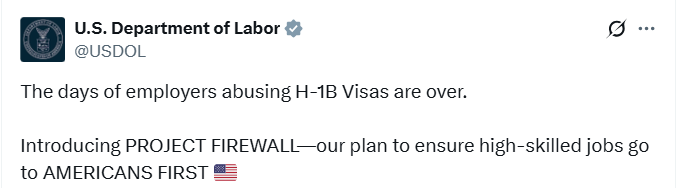
Large companies responded quickly after Trump, who also built the cryptos in his family shops, announced the new rule. Microsoft, Amazon and JPMorgan sent an urgent message to employees with an H-1B visa. Employees were asked to stay in America or to return immediately when they were abroad. The panic reaction of Amazon shows that even large companies were not prepared for this sudden change. If Amazon also finds it difficult to tackle the new rules, you can see the serious challenges that smaller companies are confronted with. The price of the shares of technology companies with many foreign employees fell by 2-5%after the announcement. This market reaction shows that investors are aware of the serious impact that this policy will have on the technological sector.
Other countries can try to attract the talents from America in the blockchain world. Salvador offers Bitcoin-based citizenship for $ 1 million. Portugal and the United Arab Emirates have drawn up special visa programs for those who were planning to set up a technology company. Canada’s Global Talent Stream program -Processes Work permits for trained professionals in about two weeks. That is probably the most likely reaction to crypto companies to hire employees with external work instead of bringing them to the United States. A competent blockchain developer in India or Europe can work on most projects from their own country. This approach completely avoids visa costs, but also means that America loses the economic benefits that these employees were in the US.
Research has shown that 20%of the startups that are financed with risk capital, founders of immigrants and 75%of these founders first came to America with a student visa. Many of them later worked with an H-1B visa before they founded their own business. Significantly expensive H-1B-VISA can reduce the future number of such startups. America partly leads to blockchain technology because it attracts good professionals from all over the world. This advantage can disappear if other countries offer better opportunities. The implementing regulation remains in force for 12 months, unless it is extended. So in the following period it will be revealed how the move will be.
#Plag #crypto #Trump #closes #path #international #talent #America