

This audio is generated automatically. Please let us know if you have any feedback.
Do you want to make LinkedIn a bigger focus in 2026?
This will help.
LinkedIn’s vice president of product management Gyanda Sachdeva has shared some new insights into the top engagement trends in the app, as well as tips on how users can lean on them, to improve their content performance.
And LinkedIn is getting more and more attention. Sachdeva says that oOver the past year, content sharing in the app has increased by 15%, while comments in the feed have increased by 24%.
A double-digit increase in engagement signals expanded opportunity, and these tips can send you on the right path to improving your LinkedIn performance.
First, Sachdeva says users should share their expertise and experience on the app.
According to Sachdeva:
“People want to hear from other people, and they want to hear real, lived experiences and insights. We consistently see that the content that drives the strongest engagement falls into a few key themes – and our members tell us they want more of that.”
Those themes are:
- Industry news and your view on it, product announcements or trends shaping your field
- Informative content, especially about work, business or the economy
- Career stories and advice from your own experiences, with insightful lessons and stories only you can tell
So your own professional insights, guided by your own experiences, that no one else has. That’s valuable, and if you can capture your learnings in concise summaries, they should do well on LinkedIn.
But don’t use AI to generate it for you.
LinkedIn has added AI tools to every part of its app, including message creation, although even Sachdeva notes that relying too much on AI is not the way to go:
“One thing I want to reiterate is that while I encourage you to use AI as a tool to brainstorm or sharpen your thinking, professionals want to hear from real professionals about real experiences. AI is best used to enhance your expression. Think of AI as a tool, not a crutch: members, not AI, drive the best engagement on LinkedIn.”
So why would LinkedIn add this as a post-generation option?
I don’t know, but I would encourage users, especially on LinkedIn, not to use AI as a substitute for their own thoughts and insights.
On a related note, LinkedIn also continues to expand its actions to address fake engagement in-stream.
As we reported earlier this year, many LinkedIn users have reported seeing examples of automated engagement and engagement pod activity in the app.
LinkedIn told us in July that it plans to pay more attention to this, and in a separate messageLinkedIn’s VP of Product Oscar Rodriguez provided an update on its efforts to address this:
“In recent months we have taken important steps to address this problem. We’ve removed LinkedIn groups that show signs of engagement pod behavior. We also reached out to thousands of members whose actions showed signs of participating in engagement pods or using automated commenting tools, reminding them of our policies and warning them of potential account restrictions and removals from LinkedIn programs, including Top Voices.”
LinkedIn therefore wants to tackle platform abuse in a targeted manner, and you can expect more action on this front in 2026.
As for posting frequency, Sachdeva says users should strive for it publish between 2 and 5 LinkedIn posts per week for optimal impact, with members who post twice per week seeing up to 5x more profile views on average.
“For best results, focus on quality and consider spacing out posts to give you breathing room when they’re on very similar topics. Keep in mind that posting more than once a day won’t hurt your overall reach, but people want to see content from different voices. If you share multiple posts close together, members are likely to see the one that’s most relevant to them.”
Sachdeva also answered recent questions about algorithm changes and the relative impact on post reach:
“Distribution and reach obviously vary based on what you post, things like subject matter, timing, format, and even what your audience is doing that day. And as more people post and participate in conversations on LinkedIn, there’s simply more activity in the feed overall. That obviously means more competition, but also more opportunities for both makers and viewers.”
So more people posting could mean less reach for each user, while Sachdeva also responded to recent questions about possible gender bias in LinkedIn’s algorithm:
“There are many signals that can influence the distribution of your message, such as the usefulness and uniqueness of the content, the topicality of the topic, its relevance to the viewer, the frequency of posting, the use of media, whether you have context in the video post captions, and whether the language feels promotional or generic. These and many other factors determine what is distributed and to whom. Importantly, however, we do not consider poster gender, age, or other demographics when determining content rankings.”
Many users have conducted their own experiments with this and are not satisfied with LinkedIn’s response, which is simply that such biases do not occur. But this is based on official advice from LinkedIn is not a factor in content ranking.
Sachdeva further notes this users should do that focus on creating relevant, timely posts that spark conversations for your audience.
“A strong first sentence, a clear point of view and a simple story that engages people can go a long way in helping your content land.”
The same advice is included LinkedIn’s creation tips page:
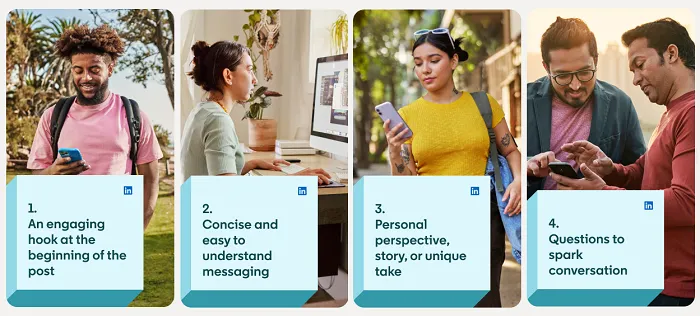
Sachdeva also reiterates that hashtags are not important:
“Hashtags do not affect distribution, so there is no need to include them. If you still want to include them for other reasons, such as your own tracking or to help members search for them because they are clickable, you can continue to do so.”
While video posts also generate a lot of comments in the app:
“Video is an important part of LinkedIn’s content ecosystem and one of many powerful ways to share your voice. Through video, we unlock access to shared experiences and wisdom from other professionals to help members make their professional journey more meaningful.”
LinkedIn also reported this earlier videos are 20x more likely to be shared in the appwhile video content also generates 1.4x more engagement than other post types.
As such, it’s definitely worth considering, and Sachdeva says a strong hook, emphasized in text form, is key to driving video engagement.
Some valuable tips from one of the people responsible for overseeing the operation of LinkedIn’s systems and as such has in-depth knowledge of its content focus, as well as usage trends.
Worth noting for your approach to 2026.
#LinkedIn #shares #tips #improve #inapp #performance