

Story one
X402 use is taking off
x402 is a protocol developed by Coinbase in collaboration with Cloudflare to bring something to the Internet that the Internet desperately needs: a native way to transfer value. Now you might be tempted to point out that crypto would fill that niche, but crypto payment systems, like the financial rails, are designed with humans in mind.
At a time when at least 50% of traffic already consists of bots, it is not future-proof to only think about us humans. Instead, x402 is explicitly designed with APIs, apps, and AI agents in mind, allowing them to pay directly with USDC. The name was inspired by the HTTP 402 payment code, introduced in 1997 to facilitate digital money transfers, but remained unused due to high transaction fees.
With the x402 protocol, things look different, which could explain how usage of the protocol has exploded: growing 10,780% in one week in October, reaching almost 500,000 payments.
If you are wondering how you can benefit from this, here is a showcase of an AI agent which allows you to chat, using x402 on the back end to pay for API calls to the Nansen database to provide accurate onchain insights.
Takeaway: Before everyone gets too excited about the arrival of autonomous agents who will all make money, let’s remember that every agent created needs money from someone.
Story two
Another bites the dust
Things aren’t looking good for journalism in general, and haven’t been since the big switch to advertising as the main source of revenue and the inability of most media outlets to support themselves on subscription. Certainly, the audience’s desire for entertainment, rather than the pursuit of truth, certainly contributes to this downward spiral.
Of course, crypto, despite occasional projects that journalists want to save or the media, is not spared from the same dynamics. Since Bullish bought Coindesk, eroding editorial freedom, the crypto media as a whole has been somewhat disappointing. Last week, Blockworks announced it would close its news section to focus on something more profitable (the subtext I read).
Instead of news, Blockworks will focus on its data and reporting business, selling institutions and individuals expensive access plans useful insights derived from on- and off-chain data.
While some found the news devastating, others took it with more humor.

Takeaway: The journalism that kills original sin has little to do with crypto; it is the model of journalism as a public good that must somehow remain commercially viable. Still, I had some hope that we could reimagine it, but that doesn’t seem to be the case.
Story three
Not just any hack
Balancer, one of the longest-standing DeFi projects, has been operated for around $120 million, further emphasizing that security is just an illusion in DeFi land. For Balancer, it is the third attack this year, following a stablecoin exploit in August caused by a vulnerability in its liquidity pool contracts and a front-end attack that cost users $238,000 in September.
Even though the hack isn’t in the top 3, crypto Twitter still wonders if we can ever trust anything. That is of course a very funny question to ask yourself in a supposedly ‘trustless’ space.
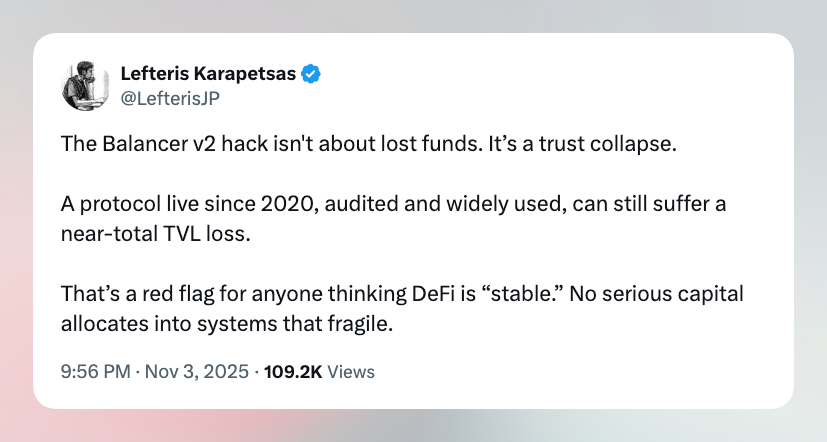
Despite numerous audits by reputable bodies, a vulnerability remained for the exploiter to bypass security measures and transfer millions to his own account. Balancer’s composable design amplified the flaw by allowing the attacker to use the same access point for pools on chains other than Ethereum, increasing the damage.
The full details have yet to be revealed, but somehow this doesn’t bode well for crypto’s ambitions for institutional adoption.
Takeaway: Not only are smart contracts not smart, they also seem almost impossible to code without bugs.
Fact of the week: Since we are in the first week of a new month, you may have wondered why November contains the Latin word Novem, which means nine, even though it is the eleventh month. It used to be the ninth month on the calendar until January and February were added. Instead of changing it, people decided to keep the name. By the way, December is not derived from the Latin word for twelve either. The more you know 😉
Naomi for CoinJar
#dark