

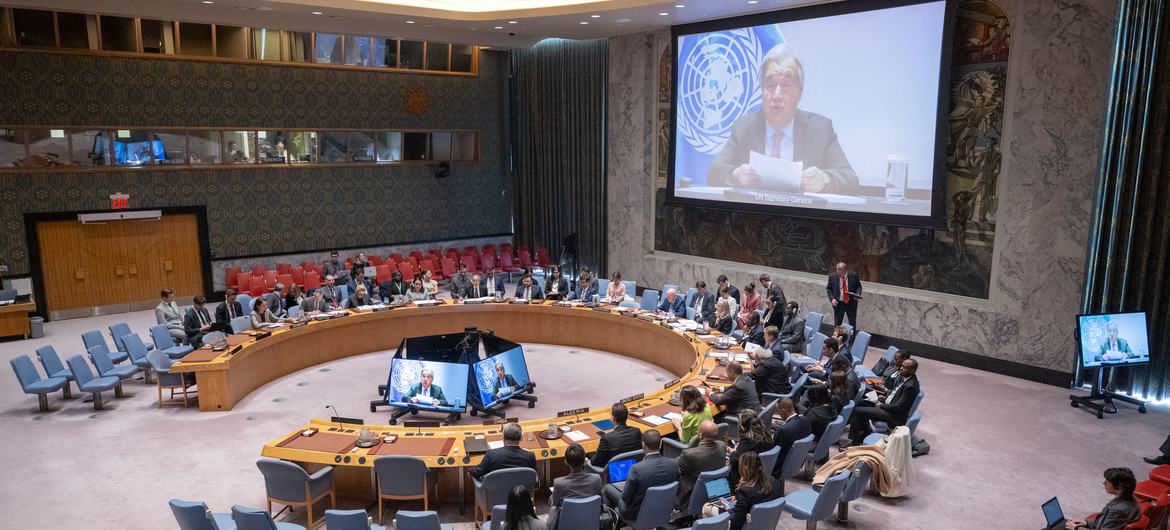
Mr Guterres addressed ambassadors in the iconic room in New York United Nations Dayon the occasion of 80 years since its founding. He spoke via video link from Vietnam’s capital Hanoi during a robust open debate on how the UN is navigating an uncertain future.
As the UN’s primary body for maintaining international peace and security, the council has significant power, including the authority to impose sanctions and authorize military action.
Five of the fifteen members have a permanent seat and were given veto power under the law UN Charter.
Although the Council has played a central role in peacekeeping, conflict resolution and enforcement of international law, its veto system has often prevented action and led to criticism.
The body’s structure is considered unrepresentative by many countries and top officials, leaving regions such as Africa and Latin America without a permanent voice.
Mr. Guterres called on those who have looked to the council for 80 years to end wars, saying that “the privilege of sitting at this table carries with it, above all, a duty to honor the faith of those people,” he said. “Without one Security Council fit for purpose, the world is in grave danger.”
Debate on fundamental issues
Russia praised the UN Council for October, praising the UN’s achievements but criticizing the actions of Western governments, while elected (non-permanent) member Guyana said the body was unrepresentative and called for greater and meaningful global representation.
Focusing on operational reforms and accountability, the United States called for a merit-based selection of the next Secretary General – who takes over in January 2027 – emphasizing the primacy of national sovereignty and transparency in the selection process.
The US representative called for an end to a selection process where regions take turns, arguing that it was time to choose from a global list of candidates.
UN photo/Manuel Elias
Secretary-General António Guterres (on screen) addresses the members of the Security Council.
A UN for the weak, not the powerful
The UN chief painted a vivid picture of how Council decisions can affect citizens worldwide:
“The Security Council is not about hegemony and empires. It is about parents who have lost their children, about refugees who have been thrown far from home, about soldiers who have sacrificed their limbs.
“In every shadow of this Chamber you are surrounded by the spirits of the dead. But next to them stands something else: the hope of the living.”
He called on Council members to listen to that hope.
“Listen closely and you will hear the cries of your citizens committed to peace; the whispers of families longing for safety…The emblem of the United Nations does not bear the laurel wreath of a victor, but the olive crown of a peacemaker.”
But its legitimacy is fragile
Mr Guterres highlighted the Council’s successes over eight decades, from helping Cambodia emerge from genocide to supporting South Africa’s transition from apartheid and deploying missions to Sierra Leone, East Timor and Liberia.
Yet its legitimacy remains fragile, he stressed, noting that violations of the UN Charter undermine confidence by some Member States and endanger global stability.
He called for and expanded membership to better reflect the world’s demography, including permanent representation for Africa, Latin America and the Caribbean.
Mr. Guterres also encouraged discussions on proposals to limit the use of the veto.
UN photo/Manuel Elias
A broad view of the Security Council as Secretary General António Guterres (on screen) addresses the members.
Russia: divisive Western powers
Russian Ambassador Vassily Nebenzia praised the UN’s achievements but warned against the actions of Western powers.
“In an effort to maintain its declining influence, the West has divided the world into ‘us’ and ‘them’ – ‘democracies’ and ‘autocracies’ – a group of those who are elected, and those who violate their imposed order,” he said.
As a result, many of the principles of the UN Charter remain concepts and not reality. “Adventures” – from the invasion of Iraq and the color revolutions to the recent invasion of Iran – have led only to tragedies, he said.
Guyana: Reform now
Guyanese Ambassador Carolyn Rodrigues-Birkett echoed calls for reform, describing the current configuration of the Council as unrepresentative.
“The Security Council needs reform. Despite the enormous scope of the UN’s work, the reality is that this success or failure of the United Nations as a whole will be judged largely by the action, or lack thereof, of the Security Council,” she said.
She called for permanent seats for Africa and Latin America and a rotating seat for small island developing states, emphasizing that national interests and international cooperation are complementary.
US: UN ‘has lost its way’
The United States, represented by Ambassador Dorothy Shea, focused on accountability. She said the UN has become a “bloated bureaucracy” that has lost its way, calling for mandates with clear political objectives and measurable benchmarks.
“The UN should serve its member states instead of making member states dependent on an unaccountable bureaucracy,” she said.
On the next Secretary General, Ambassador Shea said the US is looking for a leader who will restore the UN to its original purpose, respecting state sovereignty and prioritizing accountability and transparency.
She added that the selection process should be merit-based, with candidates drawn from all regional groupings, and that the next Secretary General should “bring the UN back to basics and thereby help realize the bold vision of peace and prosperity to which we are all committed.”
A modest ballot box
A photo
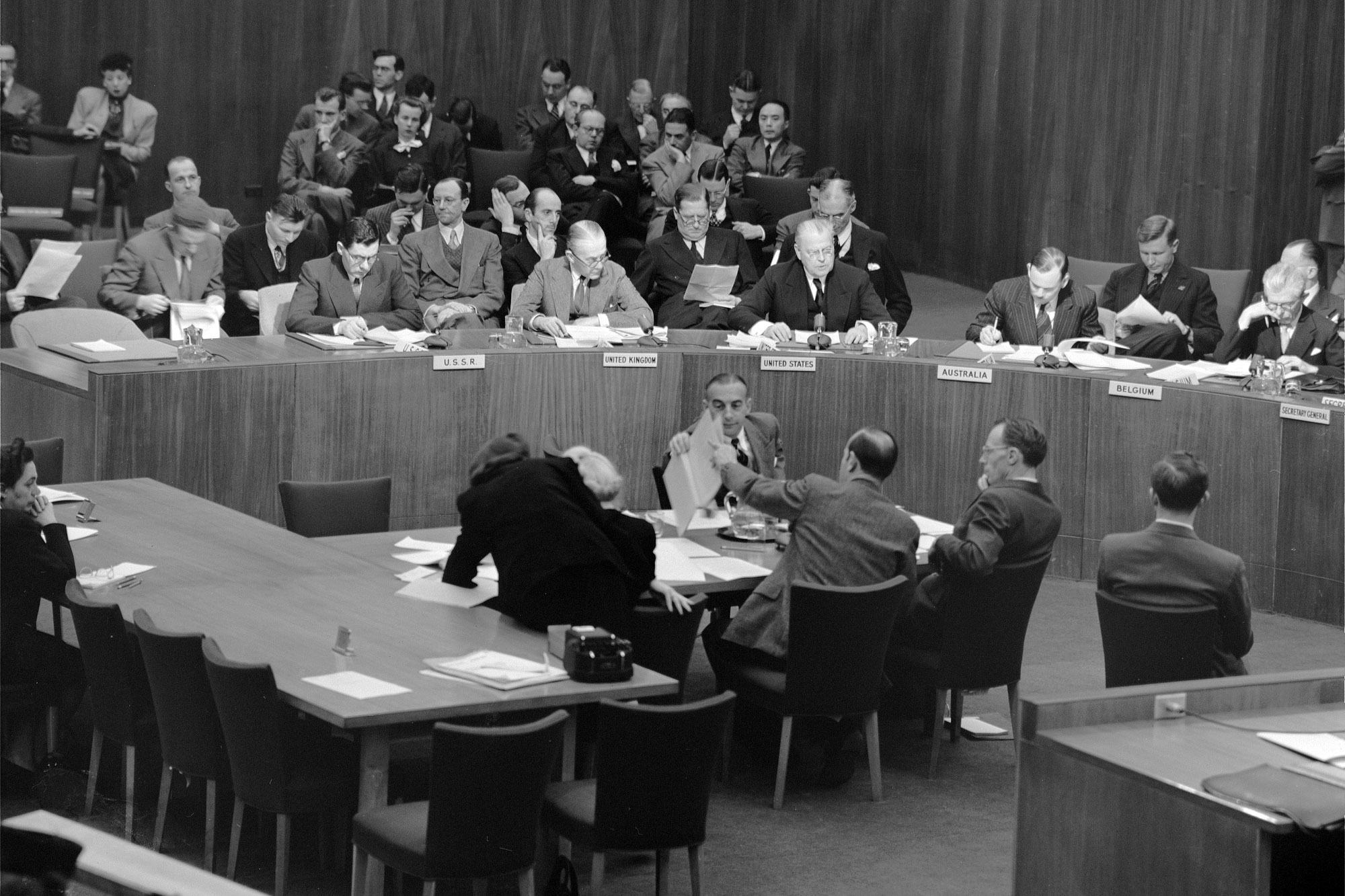
A photo of a UN Security Council meeting on atomic energy in 1947.
As the meeting began, the UN chief recalled a remarkable moment from the early days of the UN: the first Security Council ballot box in 1946. To everyone’s surprise, there was already a piece of paper inside: a note from Paul Antonio, a local New York mechanic who had made the box.
“May I, who have had the privilege of inventing this ballot box, cast the first vote? May God be with every member of the United Nations and through your noble efforts bring lasting peace to us all – around the world,” Mr Antonio wrote.
“Paul Antonio – the mechanic has never sat at this table. He has never made a speech or signed a treaty,” Mr Guterres told the ambassadors.
“But he believed in everyone here. He believed in you. I urge you: Respect that trust. Make this room worthy of the hope of every man, woman and child.”
#Guterres #calls #urgent #reform #Security #Council