

Leading up to the height of the muscle car era, automakers like Ford and Pontiac were locked in a battle for one-upmanship. Although smaller, higher-revving engines were popular among hot rodders, there was something special about the raw power of large-displacement engines. Pontiac and Ford 428s were among the most powerful, ruling streets and drag strips from the late 1960s to the early 1970s.
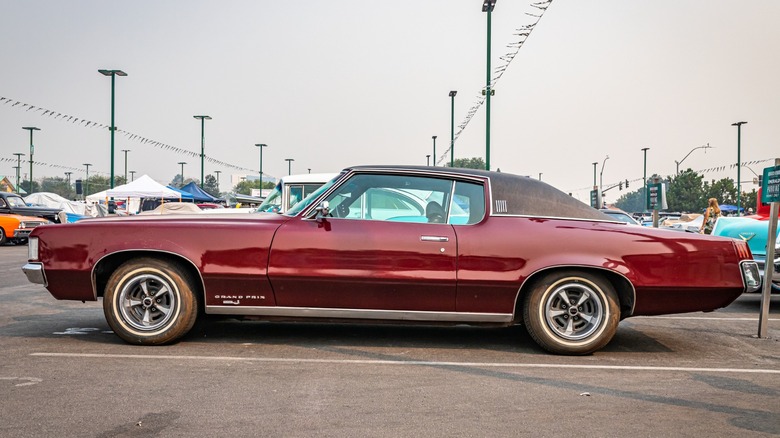
Ford put the 428 in its full-size, midsize, and pony cars of the era, with availability in models like the Galaxie, Torino, and Shelby GT500. While horsepower figures are not always accurate from the factory for various reasons, they indicate that the Ford 428 has slightly less power than its Pontiac competitor. Pontiac models with the 428 include full-size cars such as the Catalina and Bonneville, the mid-size Grand Prix, and some GTO and Firebird models, mainly as a dealer option.
At the height of muscle car popularity, it was common to see 428-equipped Ford and Pontiac cars facing off against each other at the local drag strip, or cruising side by side on the main drag through town.
Ford and Pontiac 428 timeline
Ford debuted its 428 in 1966 as part of its FE engine series, a descendant of Ford’s unique but short-lived Y-block engine. The early 428 received a factory power of 345 hp.
The 428 Cobra Jet, as seen at the 1968 Winternationals drag race, became available for road cars the same year. Although it had a power of 335 hp, Hot rod registered a 428CJ making 365.1 hp on the dyno and predicted it would increase to about 375 hp after a break-in, and would probably reach about 400 hp with headers. Ford discontinued the 428CJ in its midsize cars in 1970 and in the pony car line in 1971.
Pontiac introduced its 428 in the 1967 Bonneville (and other full-size Pontiacs) with two engine variants, the 360-hp standard model and the 376-hp High Output. Pontiac upped the ante in 1968, increasing the power of its 428 offering to 375 and 390 horsepower. In 1969, the Bonneville’s stock 428 was downgraded to 360 hp, while the 1969 Grand Prix’s stock 428 mill produced 370 hp. HO 428s with 390 hp were still available for select Pontiacs. 1969 was the last year for Pontiac’s 428; for the 1970 model year it was replaced by the 455.
Ford and Pontiac 428 cubic inch engines share a dirty secret

While Ford and Pontiac took some creative liberties in branding their 428 cubic-inch engines in the 1960s, it’s certainly not the most cringe-inducing car marketing you’ve ever seen. It’s probably more accurately described as a white lie. We might even call it a mistake, if it weren’t for the fact that the engine designers of both car manufacturers knew the truth and presented the facts as self-evident.
The secret is that neither the Ford nor the Pontiac 428 actually displaced 428 cubic inches. At first you’ll think we’re nitpicking the facts, and both automakers have simply rounded the actual engine displacement to a more palatable number. While that’s probably the excuse they’d use if cornered, you’d think they’d at least follow the accepted rounding rules we were all taught in grade school.
The facts are that when calculating cubic inches (P * r² * height * 8 cylinders) using the published 4.12 inch bore and 4.0 inch stroke of the Pontiac 428, we get 426.613 cubic inches. Ford’s 428 is closer with its 4.132-inch bore and 3.984-inch stroke, coming in at 427.386. According to the rules of rounding to the nearest whole cubic inch, both 428 engines are actually 427 cubic inches.
When it debuted, Ford already had a 427 (although it was actually a 426) and apparently didn’t care about having another one. Pontiac, which arrived a year later, probably didn’t want to introduce a 427 to compete with Ford’s 428. Besides, how many car enthusiasts in those days would put pencil to paper and find out it was all a lie?
#Ford #Pontiac #engines #compare #Jalopnik