

In an exclusive interview with UN newsOleg describes his work as a security officer and the challenges he faces in delivering food aid to vulnerable communities.
Even away from the front there is little peace, he notes, with cities including the capital Kiev having been repeatedly shelled and plunged into darkness – as was the case just before we spoke to him. His conversation with Daniel Johnson has been edited for length and clarity:
Oleg Kemin: “Every night like this, with the shelling, it’s quite difficult for us; Ukraine’s energy infrastructure is under attack, so any attack could mean new power outages across the country. There are also new casualties, adding to tensions.”
Let’s just say that people who spend sleepless nights in the shelters cannot be as productive as usual. As a Security Operations Officer for the UN, my job is to follow up on those constant air raid warnings, trying to keep our employees safe and alerting them to the warnings.
UN news: How do you deal with the constant threat of attack?
Oleg Kemin: Next month will be four years since the war started. I still remember the first attacks, I still remember the first air raid siren and it was very scary. It’s impossible to get used to it, especially when you can see the damage and destruction, but people somehow get used to everything.
But every now and then, when you’re at work and tired, you don’t hear the air raid siren on your phone app, or the air raid siren on the street. Other times you wake up to the first explosion and it’s impossible to get to the shelter because an attack is already happening.
You create mechanisms – not to cope – but to better understand the situation, and you follow emergency procedures. For example, once the attack is over, should we start counting personnel and assessing needs?
All over the country, people who work at energy companies and water companies are doing their best to maintain normal life as much as possible, to restore electricity. In the capital we have more opportunities to make repairs very quickly, but in some cities – even the Left Bank of Kiev – there was no electricity for quite some time.
UN news: Where are the needs greatest in Ukraine today?
Oleg Kemin: Some of the most vulnerable communities are in Pokrovsk, Kupyansk, Konstantynivka and Dobropillya – they are all in the news today. We used to send relief convoys to these locations. It is really sad to see how with the gradual movement of the front lines, life is starting to escape from these cities.
On your first trip it’s a normal town, but then the shops start to close, more buildings get damaged and there are fewer people on the streets. During the last mission you only see an empty and closed city and people with nowhere else to go.
UN news: How do relief teams protect themselves against drone attacks?
Oleg Kemin: Currently, there is a high presence of first-person view (remotely piloted) drones in frontline areas. They are relatively small and are usually all controlled by an operator. When one of our humanitarian convoys moves towards such an area, we inform both parties to the conflict of their GPS coordinates using standard Humanitarian Notification Systems (HNS) so that they can reach their destination safely.
But that only applies to UN vehicles; The rest of the civilian and military vehicles in the convoy could be vulnerable. To deter drones, the Ukrainian army is building corridors of nets on both sides of the road, over a distance of ten to fifteen kilometers.
The small drones don’t have enough speed to penetrate the mesh, so they get stuck in it, and that can provide some protection. Let’s just say it’s the very last hope, but at least it exists. You feel safer in such a corridor, because there is at least a layer of protection around your vehicle.
Of course, wars are constantly developing and there are already ways to penetrate these nets, or drones look for holes in the net, especially in autumn and winter, when strong winds can tear the canopy. This is a double risk because if the net wraps around a wheel, the vehicle will come to a stop and become unusable.
©WFP/Sayed Asif Mahmud
A WFP vehicle passes under drone protection nets in Kherson, Ukraine
UN news: What can you tell us about the people who need WFP’s help?
Oleg Kemin: Last summer we went on a mission to remote communities in the Kharkov region (in northeastern Ukraine, close to the Russian border). There are villages we assessed that are now impossible to reach because it is a very active combat zone, but people still live there.
In one of those villages, when I had the opportunity to ask one of the inhabitants, an elderly woman, why she did not leave the village, she said: ‘Here is the grave of my husband, of my children, I have nowhere else to go; all I can do is take care of their graves.”
There are still people living in these communities, and reaching them was impossible with a truck. So we removed the back seats of our armored vehicles, filled them to the brim with food parcels and literally drove through the mud.
Our partners’ vehicles got stuck, so we had to pull them out. People lived so close to the fighting – they were only 4.5 kilometers from the Russian border and drone activity from both sides was very high there – so sometimes with such communities we bring them double the amount of food parcels, because we never know if we will be able to reach them in the coming months.
UN news: What else can you tell us about the Ukrainian communities you have reached?
Oleg Kemin: They are elderly, mainly retirees. A few times people who live there have said to us, “It’s our land, it’s the house I grew up in, it’s a house built by my great-grandparents, it’s my land and I don’t want to leave!”
Other times we met people who told us they had tried to go to European countries or western Ukraine, but because of their age they could not find a job to earn enough income to rent a house, so they had to return to their war-fought communities. It is also not that easy for people with disabilities and their family members to move out of those communities.
The state is offering evacuation and assistance, but many people still plan to stay there. And they are among those we help in the communities closest to the front lines, where shops are closed and no one brings food. Further afield, when markets are open, our donors provide a little cash assistance so people can choose what to add to their food basket.
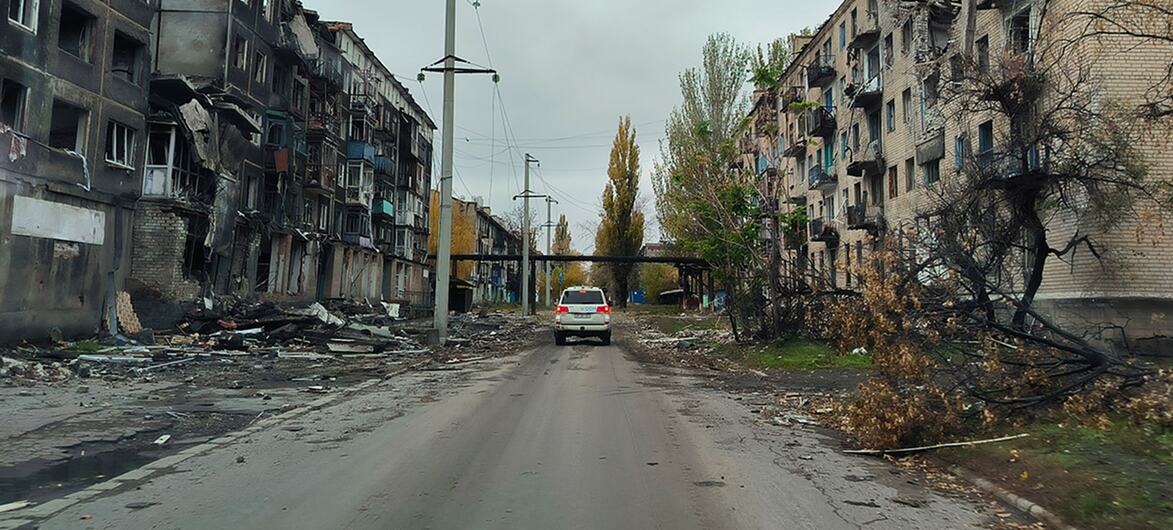
©WFP/Sayed Asif Mahmud
A UN vehicle drives through a destroyed city in Ukraine.
UN newsAnother important part of WFP’s mission is making agricultural land safe again so that Ukrainians can farm their land. What else can you tell us?
Oleg Kemin: Yes, we are involved in demining work. Ukraine is a huge agricultural country and a huge amount of land – up to 25 to 30 percent – is contaminated with unexploded ordnance and explosive remnants of war.
So the WFP is working on demining to make land available for agricultural work again. As you know, grain from Ukraine helps feed countries in Africa and almost the whole world, so one of the goals for us is to participate in that activity to make it possible to fight hunger, not only in Ukraine, but by using, let’s say, Ukrainian grain also all over the world.
#Drones #fear #exhaustion #daily #reality #providing #aid #Ukraine