China Up, US down: Why Australian travelers leave old favorites

China Up, US down: Why Australian travelers leave old favorites

5 minutes, 22 seconds Read

Australians switch about where they are traveling, according to the last annual report of the Australian Bureau of Statistics.
The top five destination countries in 2024-25 were Indonesia, New Zealand, Japan, the US and China.

Indonesia – in particular Bali – remained at the top, good for 14 percent, or 1,741,370 of Australian journeys.

Japan also continued his rise and stepped in third place with 910,640 visitors. The number of trips to Japan has tripled compared to data from 2014-15.
It caught up with the US, which fell to fourth place with 746,220 Visits-down of third place in 2023-24. The US was the only country in the top five where travel volumes were lower than 10 years ago, with 253,220 fewer journeys in 2024-25 than 2014-15, a decrease of 25 percent.
China moved two places to become Australia’s fifth most popular travel destination.

Ten years ago, in 2014-15, the top five countries were New Zealand, Indonesia, the US, the UK and Thailand.

Indonesia was again at the top of the list of the most popular travel destinations of Australians, thanks to the island paradise of Bali. In the meantime, the United States have dropped one place. Source: SBS News

Japan Up, Us Down

According to Sara Dolnicar, professor at the Business School of the University of Queensland, the increase in interest in Japan is versatile – including a strong exchange rate, more affordable and shorter direct flights and cultural motives such as dishes, landscape and traditions.

Skyscanner’s 2025 Travel Trends Report has shown that the top factors that influence the choice of destination choice were the weather (66 percent), attractions (65 percent), food (63 percent) and culture (59 percent).
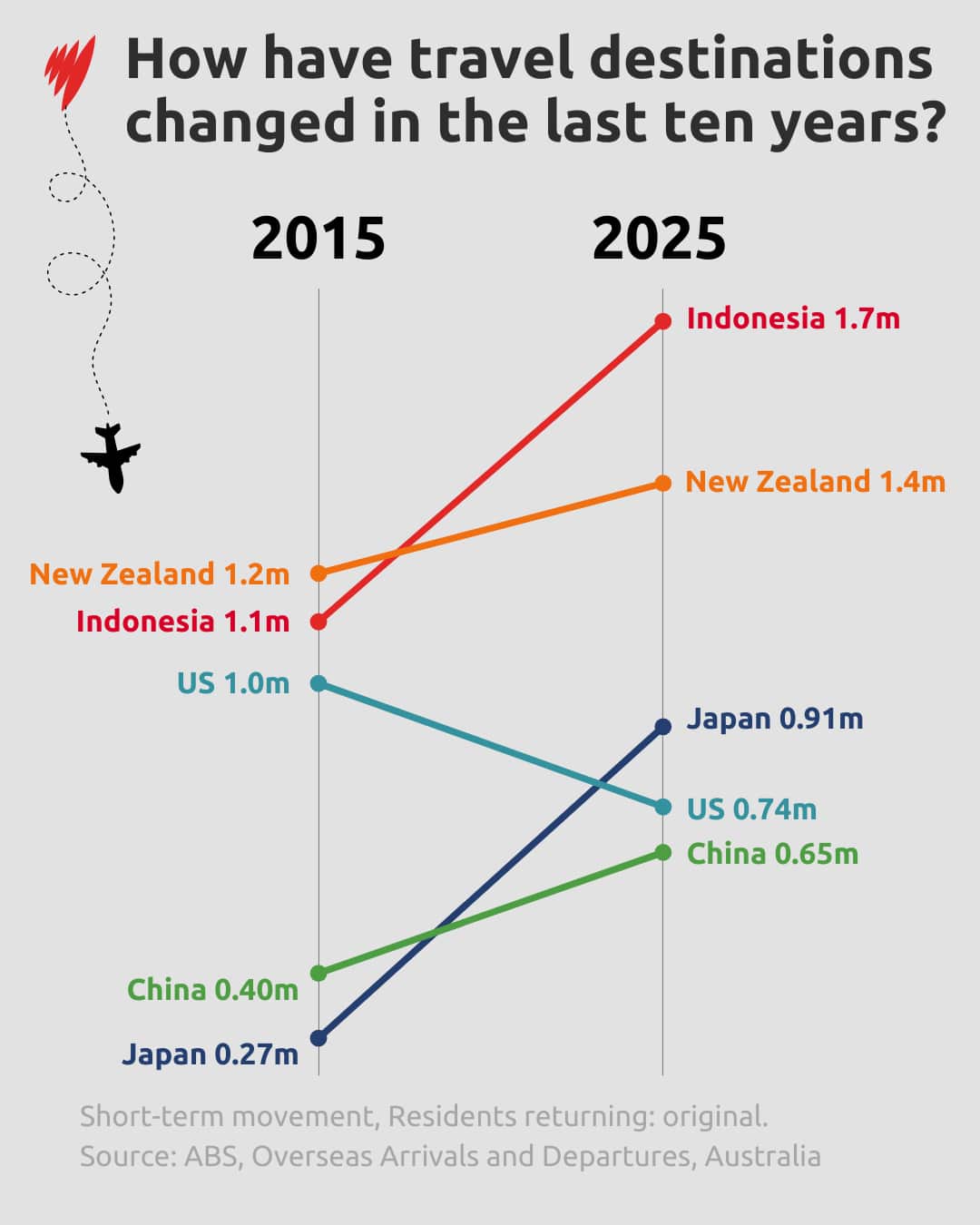
The 10 -year trends of travel destinations.

Traveling to the United States is 25 percent lower than 10 years ago, while the number of trips to Japan has tripled compared to data from 2014-15. Source: SBS News

On the other hand, Dolnicar says that the United States might see a dip in travel, partly due to political uncertainty.

“I don’t know if it is specifically the Trump government or whether it is the observed volatility of decision-making, but there is absolutely no doubt that this has influenced the international trips to the US,” said Dolnicar.
“I think there is a bit of discomfort for Australians. But I would not say that people feel the fear in their bones.”

“The way consumers work in their behavior is that they still want to go to New York, but they will say,” Maybe I’ll just wait a few years. “

An increase in trips to China is also not necessarily politically motivated, Dolnicar said. Instead, it is more likely to be linked to the new policy introduced in November 2024, so that Australian passport holders can travel for 30 days without a visa in China, she said.
“Being able to walk in and get a stamp for 30 days – that would have had a big effect [on the figures]. “

“With the US, people can say they love it, but now it’s not a good time. And now with China they may have always wanted to view it and they have made it easier to come in – so why not?”

The larger forces that travel

Although destination-specific factors matter, Dolnicar says that five broader troops influence that Australians are going: exchange rates, political uncertainties (including safety), natural disasters, the costs of living and the post-known wish for international travel.
Costs are often the first consideration, especially in a crisis of the costs of living. “If you have seen that your disposable income is not enough, you will simply say that you cannot travel that year,” she said.
Margy Osmond, CEO of Peak Industry Group Tourism and Transport Forum Australia, said their data indicated that two -thirds of the nation were planting a journey, but there was still a “noticeable decrease” in those who actually took a vacation.

“That suggests that although the desire to explore remain a strong, cost-of-life pressure and economic uncertainty, influence how and when people travel,” Osmond told SBS News.

Exchange rates also have an effect. Dolnicar points to an increase of around 25 percent in the value of the Australian dollar compared to the Japanese yen in the past decade: “It’s huge. Now for a dollar you get 25 percent more vacation than before.”
On the other side of the coin, the exchange rate of the Australian dollar with the US dollar has fallen by almost 9 percent in the last five years.

OSMOND added: “While the US remains a destination for Bucket list for many Australians, higher costs, a weaker exchange rate and the rising costs of long-distance flights have stamped demand.”

What is the next hotspot?

Osmond predicts that Australians can increasingly choose the destinations that are closer to home, especially in Southeast Asia and the Pacific.
“Many travelers are now attracted to destinations that offer better value and shorter travel times, especially in Asia and the Pacific Ocean, which has appeared part of the American market share elsewhere,” she said.
“Although traditional favorites such as the US and Europe remain ambitious, emerging destinations in Asia and the Pacific can enter the top five, and the industry will have to navigate to navigate challenges such as affordability, sustainability and seamless border experiences to meet the expectations of travelers.”
The Reart Trends Report of the Australian Travel Industry Association (ATIA) May 2025 discovered that Japan had the largest percentage increase on an annual basis, with an increase of 38.4 percent, followed by China (+35 percent) and Vietnam (+26.2 percent).

“The whole of Asia is very attractive. It is close and it is affordable,” said Dolnicar. “Vietnam is a kind of alternative to Indonesia … it’s a bit more outside the beaten track.”

But climate change is also set to have a major influence on where and how Australians travel in the future – possibly make some destinations less viable and increase ticket prices.
“Some popular ski resorts will no longer have snow,” said Dolnicar. “That sunny and blue-shocked destination can now have rainfall.”
She warns that measures such as carbon limits or a mandatory use of biofuels – a more expensive fuel made from renewable sources – can make overseas travel less affordable.
“If the flight to Bali is suddenly very expensive, you’re not going to go,” she said.
“There is a real chance that we will have to go back to more local journeys because the CO2 emissions that we generate with the way we are currently traveling is out of hand.”

#China #Australian #travelers #leave #favorites

Similar Posts

Leave a Reply

Your email address will not be published. Required fields are marked *