

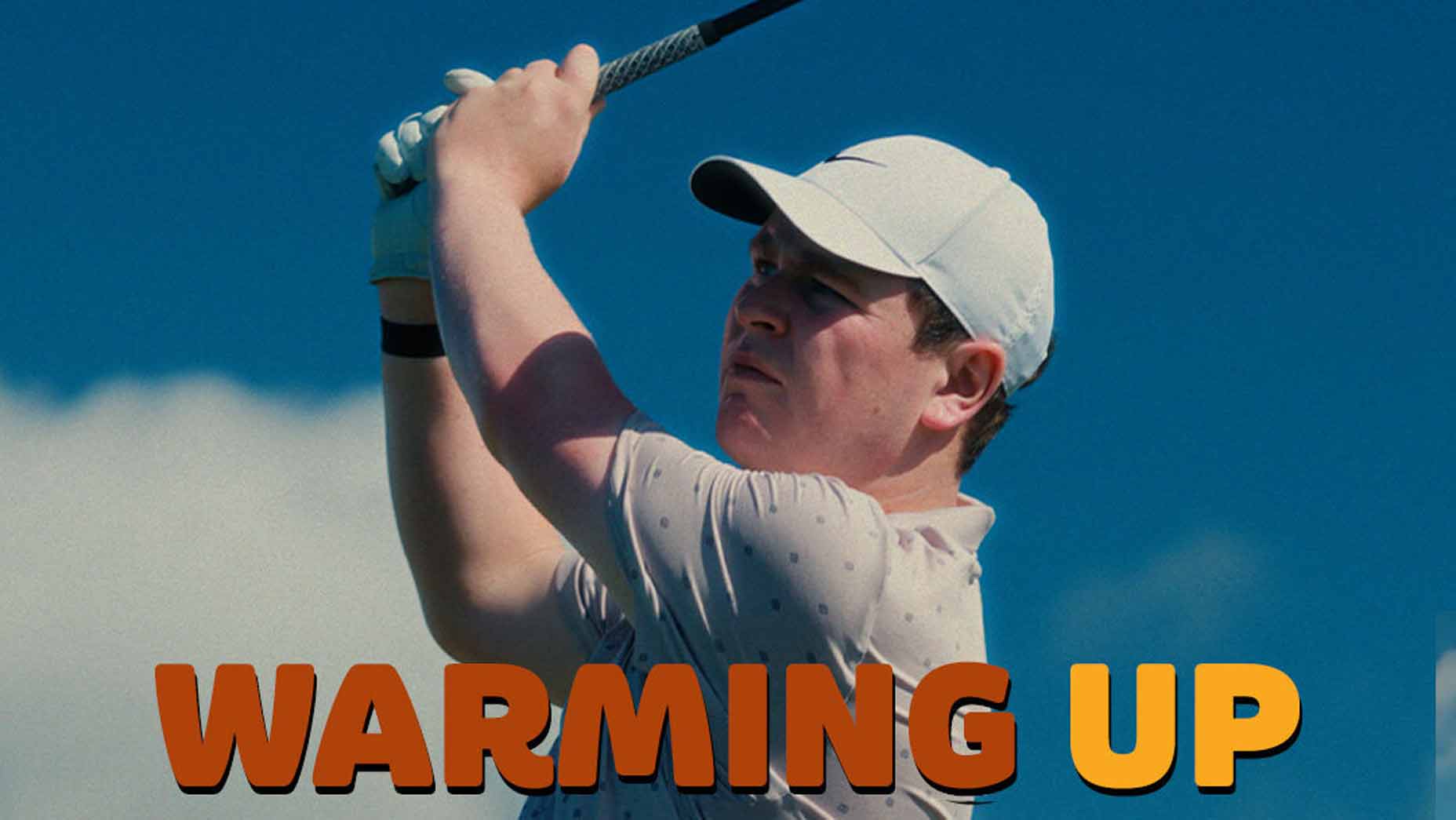
Earlier this year, the world’s top-ranked Scotsman, top-ranked southpaw and best-golfer-who-moonlights-as-a-shinty-player joined me on the practice tee to run through his warm-up routine. He revealed a few things about how he sees the world.
This is what I learned from it Robert MacIntyre in the latest episode of Warming Up.
Watch belowor read on. . . or better yet, do both!
“>
1. The gym is no longer his enemy
“When I first came out, I was against it,” MacIntyre says as he begins his session. “I was like, I’m not doing that. I’m young enough. But I had a few injuries, lower back, like most golfers, and I think that was because I wasn’t strong enough to withstand the speed and the travel, and secondly, when I get on the range, I can just hook it up to the driver. I do that sometimes when I’m at home in the simulator, no warm-up – and then I get hurt.”
MacIntyre says he and his team noticed his scoring average going up in the morning rounds and believed this was partly due to his body struggling to wake up. They’ve reversed that with a more diligent pre-round routine.
“A warm-up has been important,” he adds, somewhat reluctantly.
I think that’s a good tagline for the show.
2. He has a “wedge chart”
MacIntyre starts with his 60 degrees and varies his specific wedge warm-up, but with the same goal: dialing in a specific wedge feel.
“I have a graph of how far I hit my wedges. So a sense of 9 o’clock, which is normally 99 yards, give or take,” he says.
What does a 9 o’clock feeling mean? MacIntyre takes his lead arm back until it is parallel to the ground – like the hand striking nine on a clock – “and then he goes forward at full speed.”
3. He likes to use the simulator to ‘reset’
MacIntyre’s home base is Scotland – more on that later – but that doesn’t mean he’s grinding away in all kinds of windy linksland conditions. Instead, he prefers the tranquility of the simulator when he’s at home.
“My technique comes off with something like, after that [a] week of playing in the wind,” says MacIntyre. “I know the tendencies, I’m going to anticipate it, I’m going to trap it, so I feel like the simulator is great for resetting, no wind, no interference, flat surface and I can just work on technique.”
4. Still, keeping his wedges low is second nature
You can take Bob out of the Scottish wind, but you can’t take the Scottish wind out of Bob, or something like that.
“I grew up in the wind, so it’s pretty easy,” MacIntyre says of keeping his wedges low in the wind. ‘Open up [my stance] a little bit. Your body will open naturally. The ball goes back [in my stance] and then I just wave it, just drive through it.
“One thing I don’t have a problem with is keeping it down.”
What’s interesting is that MacIntyre says these two things are related; the more time he spends playing in the wind, the more he leans forward and the further back the ball goes in his stance – hence the need for a reset.
5. He needs a different routine than Tiger Woods
When Tiger Woods turned pro, he moved to Isleworth, a club in the Orlando area, and the rest was history. As for MacIntyre?
“I remember the first year here on the PGA Tour, I was at this place in Orlando, practicing at Isleworth, but I almost overdid it. I thought, I’m going to practice, I’m going to practice, and then it was like my game got worse. And I think part of it was motivation, like, why am I practicing?” [In the offseason] it’s hard to be motivated because after a Ryder Cup and the Race to Dubai are over you try to slow down.”
This has been an important part of MacIntyre’s story over the years: discovering what energizes him, what drains him, what helps him best.
“When I’m at home I like to spend time with family and friends and don’t touch the clubs too much unless Mike [his caddie] sends me a message and says, okay, match in the simulator, then I’ll join in and play,” he says.
As for Woods’ routine?
“I’m not built the same as Tiger,” he says. “But look, everyone does it differently. I mean, look at Alex Noren. If I spent a day with Alex, the next day my hands would be in pieces… for me, the biggest change in the last two years has been the mental side, and the happier I am off the golf course, I can bring that to the golf course. So yeah. Pretty simple.”
6. His shot form? Depends on the club
What is MacIntyre’s favorite shot shape? It changes throughout the bag.
“I’m more draw-biased with the shorter clubs,” he says, holding his 9-iron. “And then more fade-biased with the longer irons.”
As for his forest?
“I’m a more neutral guy with the driver. I don’t like to shape the driver, like my stock shot would be very neutral and then let me maneuver.”
7. On the range he finds “zero”
Although MacIntyre has his preferred shot shapes (see above), he generally tries to hit the ball fairly straight during his pre-round range sessions.
“For me, it’s all about finding zero, finding neutral on the distance, and then when I go to play, I just go and play and don’t think about anything,” MacIntyre says. “But on the range I think about it a little more, I try to get the club in a good spot… when I warm up I try to hit everything straight so that when I go out on the golf course I know if it’s straight. [pointing to ball position]if I want to draw it, the ball goes back [in my stance]if I want to fade it, the ball goes up.
“I try to keep it as simple as possible.”
8. When he bends the ball, he thinks about one thing…
…where it will end.
“I’m not a big technique guy… I’ve played golf long enough now, I know the club has to go this way for it to fade away,” MacIntyre says, making an outside-in, side-to-side motion. “I don’t worry about how much it fades. Mike will always tell me where he wants me to finish it, he never tells me where to start it.”
“Because I don’t even know where this thing is going to start. As long as I put the shape on it and get the distance.”
9. He’s looking at three numbers on a launch monitor
“Path, face angle, face-to-path. Those are my control points,” says MacIntyre.
“Path” measures the direction the club head moves in relation to the target line.
“Face Angle” measures the direction the face is pointing at impact, including relative to the target line.
And face-to-path measures the relationship between the above two numbers, which tell you something about curvature, sidespin and ball flight.
So is MacIntyre more of an artist or a scientist?
“I would say I’m more of an artist, but I don’t shy away from the scientific side of it,” he says. “I like to make sure everything is in order, make sure the clubs are right, make sure that… there’s so much in it now that it’s not just golf anymore.”
10. “Life Goes On”
It came out a few years back that MacIntyre continued to play other sports, especially shinty, which he describes as “field hockey without rules.” This implied that I would understand hockey and its rules, which I don’t, but I did pick up on the general feeling of lawlessness that comes with it. So why would he continue to play other sports if his livelihood depends on his physical well-being?
“Life goes on,” he says with a grin. “For example, this is my job. Playing other sports is my hobby.
“I remember being asked in an interview at the Dunhill a few years ago, when it first came out, when people realized, ‘He’s still playing sloppy, what is he doing? A bit crazy.’
“But I remember the reporter, I know the exact man, I remember his face, saying, ‘Why are you still playing shinty?’
“He says, ‘I play golf.’ I thought, ‘Exactly. Well, my job is golf, so if I have two weeks off, what do I do in my spare time? I have to do something.’
“At that time I didn’t like the gym. I didn’t like doing things. So I thought, ‘Well, I’ll play shinty in my spare time, or do other sports, whether it’s squash, tennis or indoor football. Live my life. I don’t worry too much about the consequences. We’ll worry about that when we have to.’
That is the Tao of MacIntyre: Live my life. Don’t worry about the consequences. Just worry about that when you have to.
Not a bad way to go about it.
“>
#Bob #MacIntyre #taught #lessons #minutes