

Such was the madness that in faraway Bengaluru, on the sidelines of the World Tennis League exhibition tournament, an enthusiastic writer asked maverick Aussie Nick Kyrgios about it.
The 2022 Wimbledon finalist, who hadn’t even heard the news until then, said: “I hope they’re doing well… I hope they’re doing well,” as he held his head down and moved it vigorously back and forth. The tennis world and its most famous practitioners were both shocked and moved.
Surprising divorces
In the days that followed, events were discussed in threadbare fashion, sides were taken, loyalties were questioned, and judgments were made. There have been surprising divorces before, such as those between Novak Djokovic and Goran Ivanisevic, Naomi Osaka and Wim Fissette, Garbine Muguruza and Conchita Martinez, and Andy Murray and Ivan Lendl. But none led to the feverish reactions that the rift between Alcaraz and Ferrero provoked.
It could be a sign of the times as social media engagement expands reach, increases visibility and seeks to make maximum impact. It could also be because Alcaraz is arguably the most popular player in the world and a bona fide tennis legend in the making, ensuring that his every move is dissected and every action amplified.
READ ALSO | The rivalry between Alcaraz and Sinner is similar to Federer-Rafa, Woodbridge says
But most of all, it can be the maturation of the player-coach relationship in one of the most individualistic sports. Tennis has long prided itself on being one of the torchbearers of the one-on-one competition. Coaches have always been seen as mere side players rather than protagonists. But not anymore.
Tipping point: Raven Klaasen, a coach with the Doubles Dream of India project, believes that in-match instruction has profoundly changed the way players value coaches. | Photo credit: K. Murali Kumar
Coaches are now spoken of in the same breath as the player, and because giving real-time on-court instructions has been fully legal at all levels since early 2025 – the Australian Open even had a coaching pod where Murray sat within earshot of Djokovic when they were colleagues – they are no longer just part of the backroom, but very much at the center.
They even provide standalone media briefings. At last year’s Wimbledon, the coaches of Jannik Sinner, Darren Cahill and Simone Vagnozzi – who helped him win four Slams – arrived at the press conference before the champion and spoke for as long as the Italian ultimately did.
And the ATP, since 2016, and the WTA, since 2018, have established the Coach of the Year awards, with Ferrero and Cahill winning the award in three of the past four years.
South African Raven Klaasen, a former top-10 doubles player and Major finalist, who is now traveling with a bunch of Indians as part of the Doubles Dream of India project, believes that in-match coaching has played a big role in the rapidly changing coach-player dynamic.
“I think it has created more value for the coaches because the main thing you want is to influence a match in real time,” he told The Hindu. “If you are not allowed to communicate and you have a good idea afterwards, it is of no value to anyone. It probably encourages players to invest more in coaches because you get the result while you are actively working.”
Fundamental conflict
For the purists, this mutation in the mentor-mentee equation argues against the sport’s fundamental ethos of mano-a-mano combat. Combating loneliness on the job, solving problems independently and coming up with ideas without external help are considered the basic principles. Tennis that resembles a team discipline is not for them.
But according to Klaasen the game still retained sufficient individualism. “It’s more limited than you think,” the 43-year-old responded when asked if on-field coaching was ubiquitous. “Players are only on your side of the field half the time. You are not allowed to delay play at all and you are not allowed to speak when the opponent is taking a bathroom break.”
“So you’re talking about small chunks of time. For example, you have ten seconds and if you have a great idea, the chances of you being able to convey it to your player and have a positive impact are quite slim. It’s not like cricket or rugby, where you stand in a timeout and have a conversation.”
To be fair, hiring star advisors is not new to the game, and a space has been created for several reasons. For some the guide is a sounding board, for others a father figure and for many just a person who helps with tailor-made skills.
For example, the kind of instructors Djokovic has had – Boris Becker, Ivanisevic, Andre Agassi and Murray – show that in addition to help with strategy and tactics, he also needed someone of similar stature.
In contrast, Aryna Sabalenka, along with her regular teachers Jason Stacy and Anton Dubrov, sought the help of Gavin MacMillan, a biomechanics expert, to fix her shift, which had completely failed in 2022.
READ ALSO | Australian Open winners will receive $2.79 million as prize money reaches a new high
‘That was me [never] looking for big names, because sometimes big names are just big names,” Sabalenka said at the 2024 WTA Finals. “I was looking for someone smart and someone who can understand that even if I go crazy on court, it’s nothing personal.”
But it’s the “sibling” nature of contemporary pairings that feels different. One of the most striking images in recent times of a coach standing up for a player came in August 2024, ahead of the US Open, when Cahill publicly defended Sinner after news of the then world number 1’s double doping violations – and exoneration – emerged.
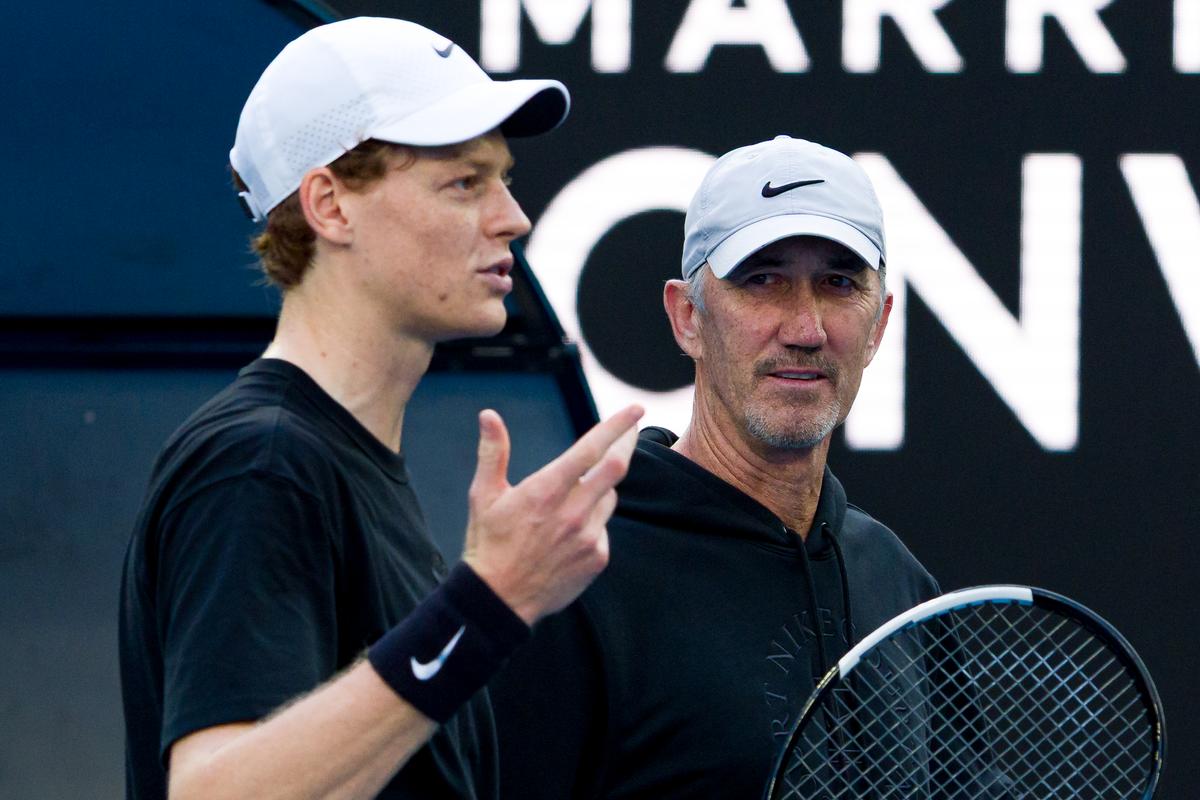
Coach and advocate: Darren Cahill publicly defended Jannik Sinner after news of the then world number 1’s double doping violations – and exoneration – emerged. | Photo credit: Getty Images
The Australian, in an interview with ESPNan agency he had worked for in the past as an analyst softened the blow, helping to reduce media attention and allowing Sinner to focus on his tennis. It is an open question whether a coach with a lesser reputation or a player without resources on the top list would have been given the same platform.
Klaasen did not speak in this specific context, but opined that the mania surrounding Alcaraz and Ferrero, and the continued interest in the bond between Sinner and Cahill, only highlighted the evolving nature of the alliance between athletes and their confidantes.
Behind the scenes
“The result you see on the match court is the end result of a long process of discussions, possibly arguments and disagreements,” said the former Australian Open and Wimbledon finalist. “A lot happens behind the scenes to arrive at that final product that you see. There are often factors that we don’t know that play a role.
“But again, as the sport becomes more and more professional and difficult, it becomes more and more difficult for players to do it themselves, so a support structure is necessary and we will see this only become more important as things develop,” he added.
#AlcarazFerrero #Split #sparks #debate #changing #face #tennis #coaching