

Your carpets, The Peacea work that remained under the rubble of Gaza during the 2023 bombings
And then a large textile monument, made on a refugee tent, on which are hand-embroidered hundreds of names of Palestinian villages destroyed during the Nakba, reaffirming their existence through the collective gesture of embroidery.
The exhibition will be held from November 8 to February 22 at the Santa Giulia Museum in Brescia Material for an exhibition. Stories, memories and struggles from Palestine and the Mediterranean houses works that survived the bombing and destruction of the Eltiqa Group for Contemporary Art, one of the first contemporary art galleries in the Gaza Strip.
Since 2000, it has played a key role in supporting local and emerging artists through workshops and exhibitions. In December 2023, the building that housed it was bombed, but its legacy continues to live on in exile thanks to the rescue, by the collective and by Mohammed Al-Hawajri and Dina Mattar, of some works present in the exhibition spaces and warehouses and kept between the Emirates of Sharjah and Dubai. Mohammed Al-Hawajri and Dina Mattar were called to participate, together with the Lebanese artist Haig Aivazian and the Palestinian artist Emily Jacir, in the ideal reconstruction of this artistic space, Golden Lion in Venice in 2007.
Mohammed Al-Hawajri, Valley of the Sheep, acrylic on canvas, 2018, 100 x 140 cm
The route, curated by Sara Alberani and promoted by the Municipality of Brescia and the Brescia Musei Foundation, brings together works by artists from conflict zones, in particular from the Middle East today characterized by division and fragmentation – from Gaza to the West Bank to Lebanon – who have experienced first-hand the daily life of war and exile. It is one of the most anticipated events of the eighth edition of the Festival of Peace. Thinking that Eltiqa would breathe new life into the spaces of the Santa Giulia Museum, the Brescia Musei Foundation offered Mohammed Al-Hawajri and Dina Mattar the opportunity to spend a period of residence in Brescia to produce new works. While the work of Mohammed Al-Hawajri stands out for an investigation that intertwines the historical memory and the daily life of his people, with works that narrate the experience of the occupation in Palestine, between pain and imagination, Dina Mattar describes life in Gaza in its daily resistance, using painting as an instrument of joy and struggle.
Female figures are portrayed in everyday life, linked to family memories and the popular Palestinian imagination. To Brescia the Lebanese artist Haig Aivazian brings his research based on a multimedia language, which varies between moving images, sculpture, installation, drawing and performance. His video installation All lights (2021) traces the use of light and darkness as a policing and control tool.
International artist Emily Jacir, one of the leading voices of contemporary Palestinian art, uses various media to explore personal and collective movements across space and time.
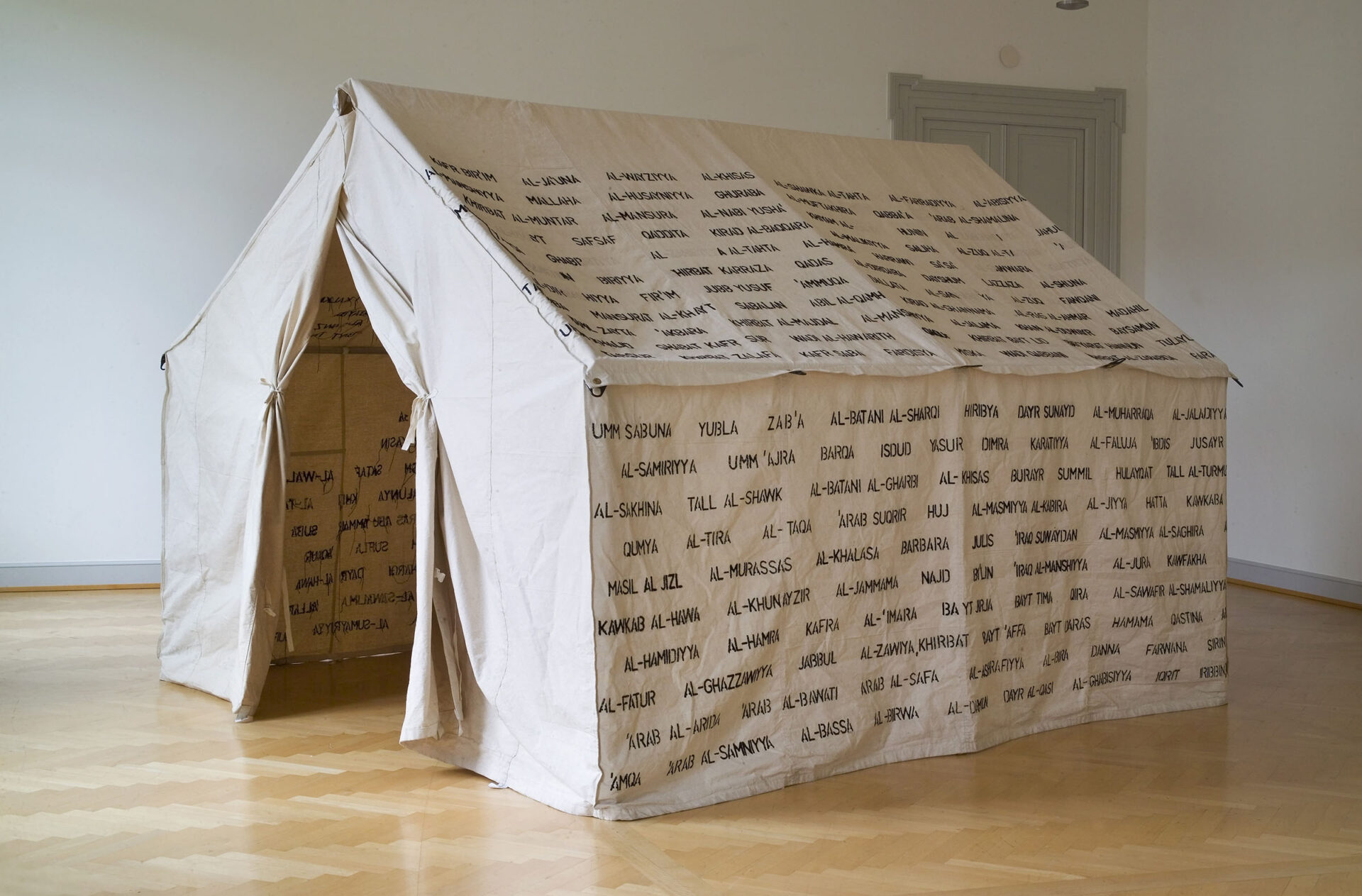
Emily Jacir, Memorial to 418 Palestinian Villages Destroyed, Depopulated and Occupied by Israel in 1948
The installation will also be presented at the Santa Giulia Museum Material for a filma work consisting of a thousand blank books, which the artist shot with a pistol, and reproduces the gunshot with which the Mossad killed the Palestinian poet Wael Zuaiter in Rome in 1972, perforating the book The Arabian Nights which Zuaiter carried in his pocket, with the intention of translating it into Italian. The visitor is invited to become an active part of the story: every step, in the corridor of volumes, becomes a gesture of reconstruction and resistance against oblivion.
Other emblematic works by Emily Jacir will attract attention, such as We ate the wind (2023), exhibited for the first time in Italy, a video installation evoking the migration of workers from southern Italy to Switzerland. The artist places it in relation to the Palestinian exile through recordings made in Salento and Palestine, often united by a Mediterranean culture that sees music and dance as expressions of a sense of belonging.
The works on display, the result of international loans, are the result of works carried out in homes and of some reproductions of which only digital finds exist, as the originals were destroyed.
#Works #survived #bombing #art #gallery #Gaza #display #Brescia #Brescia #Arte.it