

January 17, 2026
Gold will feature prominently in the financial history of 2025. The yellow metal has defied the expectations of all the naysayers and precious metal bears in the world.
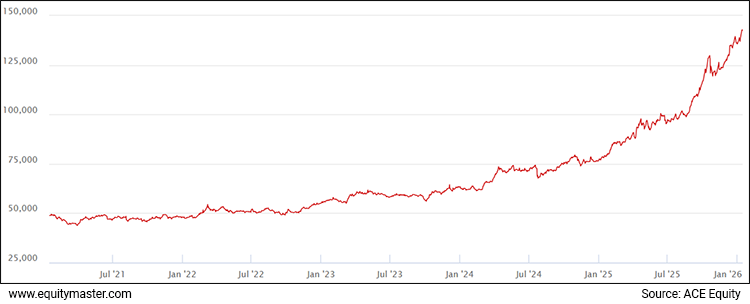
From levels of around Rs 78,500 per 10 grams at the start of 2025, gold prices ended the year up 73% to Rs 136,000 per 10 grams.
And then the price continued to rise to 145,000 per 10 grams at the time of writing. Anyone who predicted an end to the gold bull market has been repeatedly proven wrong.
It is no wonder that the ‘2 lakh’ gold price is being talked about among investors and traders alike.
To put the yellow metal’s returns into a long-term perspective, the price of gold has doubled since mid-August 2024, that is, in one year and five months.
In fact, the price has almost tripled since October 2022, that is, in two years and three months, and quadrupled since July 2019, that is, in five and a half years.
These are the kind of gains that even stock market investors would be happy with.
Just look at the long term chart of gold. You wish the prices of the stocks in your portfolio had charts like this.
Gold Price (Rs) – 5 years
Can gold price touch Rs 200,000 mark by 2026?
Yes, it is possible. The gold price should rise by about 37% in just over eleven months.
Market sentiment is extremely bullish on gold at the moment, so we wouldn’t be surprised at all if it hits the 2 lakh mark this year.
In fact, sentiment is so strong that some investors are considering selling stocks and buying gold.
However, this is not the right way to invest in gold. Think of gold as a long-term investment, as a portfolio diversifier, as a hedge against inflation, but not as a speculative asset.
What are the risks?
Will the gold price continue to rise or will it finally fall this year?
We believe that investors should pay careful attention to possible changes in the underlying factors driving the yellow metal higher.
If these factors were to change, the upward trend in the price could decrease.
What are these factors?
- Trade wars
- Inflation
Fear of a recession in the US
In short: US President Donald Trump’s tariffs have increased the appeal of the yellow metal as a safe haven.
Gold has always been a safe haven. People flock to gold when times are tough or when there is uncertainty in the financial markets.
As Trump made good on his election promise to impose tariffs, financial markets had to consider the risks of trade wars and the uncertainty caused by trade negotiations with the US.
In the case of India, this uncertainty remains as talks have not yet been concluded and no trade deal has been concluded with the US.
Although the US has concluded trade agreements with many countries, markets are concerned about the impact of tariffs, i.e. their second and third order effects.
These concerns were also reflected in the context of a slowing US economy, which could potentially enter a recession if the fallout is not properly managed.
Market uncertainty and increased risk aversion have historically been positive for the gold price.
And then there is inflation. Now that imports to the US are more expensive than before, inflation is a major risk.
As the risks of these factors decrease as the year progresses, market uncertainty will also decrease. This will be negative for the gold price.
So, gold investors eyeing Rs 200,000 per 10 grams will have to closely monitor inflation trends, trade tensions and the performance of the US economy, along with the gold price.
Conclusion
At Equitymaster we believe we should have 5-10% of our portfolio in gold at all times.
However, investors should not view gold as a potential substitute for other assets, especially stocks.
It makes sense to hold certain precious metals in the long-term portfolio, but there is no point in speculating on short-term price movements.
If you are considering an investment in gold, have a time horizon well beyond 2026 and always do your due diligence.
Have fun investing.
Disclaimer: This article is for informational purposes only. It is not a stock recommendation and should not be treated as such. Read more about our referral services here…

Sarit Panackalis editor-in-chief at Equitymaster. Sarit found his calling at the age of 19 while studying at the technical university. Fascinated by the stock market, he spent more time studying finance than engineering. He joined Equitymaster as an analyst in 2013. He has worked closely with all our editors, including co-heads of research, Rahul Shah and Tanushree Banerjee. As Managing Editor, he oversees Equitymaster’s publications and ensures the highest quality of content reaches you, the reader.
#gold #price #reach