

In liquid-cooled cars, a thermostat is a valve that regulates the flow of coolant to keep everything running safely within your engine’s proper operating temperature range. Watch your car’s temperature gauge (if it has one) for high and low irregularities. Overheating, the classic roadside steam event, can lead to catastrophic problems such as a cracked engine block. Overcooling is a lesser known situation that can also shut down your engine prematurely. Both are possible signs that a thermostat is defective and that the cooling system is in danger of failing.
Knocking sounds and the color of your car’s radiator fluid are also indicators of the health of the cooling system. You are inviting trouble if you never change your coolant. If it is a DIY project, dispose of old items responsibly. Thermostats are generally replaced when they break, not necessarily with every coolant change. However, if you’re already throwing other parts into the job, adding a new thermostat probably won’t break the budget.
In most engines, a single thermostat usually controls things, but some engines use two thermostats. Depending on the vehicle and its needs, and in terms of efficiency and wear and tear, the second thermostat can offer different advantages. Subaru is known for dedicating a second thermostat to the continuously variable transmission (CVT). For example, in some Volkswagen, Nissan and Dodge engines you will find two thermostats to split coolant circulation for different engine parts. And many, but not all, diesel engines use dual thermostats to help the engines adapt to the varying loads associated with towing and hauling. Whatever the application, the way these little thermodynamic devices work is quite ingenious.
How thermostats work and increase efficiency
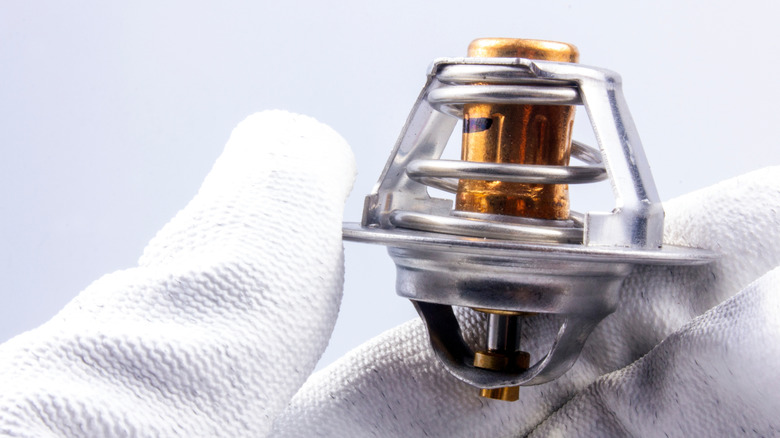
A tubular wax element is sealed in the thermostat housing. Inside is a piston that opens the main valve, which controls the flow of coolant to the radiator. A compression spring on the outside of the assembly is calibrated to close the main valve and help modulate the flow. As your engine warms up, the wax element heats up and expands against the piston, pushing it up and opening the main valve. While that’s happening, a separate radiator bypass valve allows some coolant to be heated and circulated while the main valve is closed, allowing the engine to warm up faster and more efficiently.
That’s why Subaru uses a second thermostat for its CVTs in addition to the usual cooling function. By heating the transmission fluid, the operating temperature is brought to a minimum temperature that allows the torque converter to lock up. And that, in turn, ensures that the transmission performs optimally, resulting in lower emissions, higher fuel consumption and smoother operation.
Volkswagen engines with split cooling systems with two thermostats for the block and cylinder head work in much the same way. The design isolates some of the coolant in the cylinder block, allowing the engine to warm up more quickly and allowing the block to reach higher temperatures than the cylinder head to reduce friction on the internal crankshaft components. Meanwhile, the cylinder head can run a little cooler for better combustion.
Diesels and dual thermostat dynamics

Where towing large amounts of weight is important, diesels dominate the large truck market because diesels are better for towing and hauling compared to gasoline-powered vehicles. These torque monsters – and their giant radiator cooling systems – must be designed to operate efficiently both under load and unloaded.
The challenge here is that radiators, which help bring temperatures down by removing engine heat from the coolant into the air, don’t magically change size as engine load or vehicle speed increases. One way around this is to somehow control how much air is flowing into the radiator. Grille shutters, with opening and closing flaps, achieve this by covering parts of the radiator on large trucks. The other way around is to control how much coolant circulates from the engine to the radiator at all.
That’s why large diesel engines often have a primary and a secondary thermostat – an arrangement also found on General Motors’ Duramax turbodiesels. The primary thermostat operates under normal conditions, while the secondary thermostat remains closed. This limits the volume of hot coolant flowing relative to what is required for efficient, low-voltage operation. The secondary thermostat is calibrated to open at a higher temperature, allowing all coolant to circulate optimally whether you’re hauling rocks from a quarry or a boat to the lake.
#engines #thermostats #Jalopnik