

It really all comes down to habit. Once people get used to doing things one way – such as using the word “horsepower” to refer to an engine’s power – it can be extremely difficult to change them. And it’s fair to say that people have been using horsepower to measure engine performance for hundreds of years.
People had long talked about how much work a horse could do, but in the 1780s James Watt began using the term to help quantify how much better his steam engine was than others’ early models. Remember, Watt didn’t literally invent the steam engine; that was Thomas Newcomen who created a steam-powered machine to pump water from mines in the early 18th century.
But an early business deal paid Watt (and his partner, Matthew Boulton) based on how much more work their engine could do compared to Newcomen’s. To simplify that equation, Watt gave the word “horsepower” a specific meaning, based on his belief that a real horse could lift 33,000 pounds per foot in one minute. So essentially, horsepower was a word developed as a marketing tool.
Horsepower has really only stuck as a term for engines, although how much you really need is up for debate. Watts are used in many other applications to measure power, following the pattern of units like amps, ohms, and volts, all of which come from the names of their inventors: André-Marie Ampère, George Simon Ohm, and Alessandro Volta.
The Evolution of Horsepower Marketing

By the time the Benz Patent Motor Car – widely accepted as the world’s first automobile – hit the market, the term was in widespread enough use to be part of an early news story. As reported in a June 4, 1886 article in the New regional newspaper BadenThe Benz engine, “which has a cylinder width of nine centimeters and is mounted on springs above the axle between the two wheels at the rear, develops almost one horsepower despite its rather delicate appearance.” The position of the powerplant in the chassis puts the Benz on our list of rear-engined cars that have also stood the test of time.
Like Watt, early automakers were also quick to use the measurement to differentiate their products from the competition. For example, the first advertisement for the Ford Model T came from 1908 and prominently featured its four-cylinder, 20-horsepower engine. Plymouth had “82 horsepower rarin’ to go” in its 1935 lineup, and 128 horsepower—more than one horsepower for every inch of wheelbase—was a best selling point for the 1940 Hudson Eight, according to Consumer Guide Automotive. When the 1949 Oldsmobile Rocket 88 kicked off the horsepower wars, albeit with only 135 ponies, the stage was set for the word “horsepower” to become part of American culture – even though, to be fair, a typical horse can make about 15 of Watt’s horsepower.
Other ways to measure power
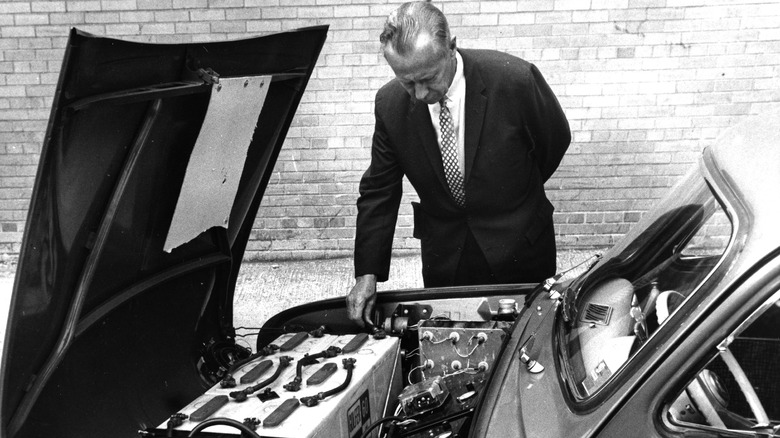
Horsepower isn’t the only old word used today whose origins seem to have lost meaning. Consider the word “high” in “highway.” It has nothing to do with the height of the road, but refers to the time when ‘high’ meant something like ‘main road’ – in other words, the original highway was a main road.
In addition, other terms have entered the field of horsepower, including the term named after Watt himself. William Siemens, part of the family behind the international engineering and technology company that is still active, proposed using Watt’s name for a unit of electrical energy in 1886, at a meeting of the British Association for the Advancement of Science. It was adopted worldwide in 1960 as an official part of the International System of Units. This is a major reason why certain parts of the world don’t actually use horsepower when it comes to modern engines.
The International System of Units is less formally known as the metric system, so many metric-minded countries use watts – or kilowatts – to measure an engine’s power. Some also use PS, but that’s an abbreviation of the German word ‘pferdestärke’, which is a direct translation of horsepower – so it also goes back to Watt. Using kilowatts to describe electric vehicles makes sense because, as mentioned, watts are specifically a measure of electric power. It was also a great name for an electric car from the early Crap era, when electric cars were at their nadir.
#modern #engines #measure #power #horsepower #Jalopnik