

The theory of a four-year cycle for bitcoin price predictions is a favorite of the crypto community, despite the fact that price movements in recent years have clearly highlighted the model’s uncertainties. The halving is still an important fundamental event, but automatically inferring a new bull market that will repeat itself every four years leads to serious statistical errors. What problems does the concept of the four-year cycle hide, and why can’t we rely on it as a serious predictive tool?
The halving is no surprise
The basis of the four-year cycle is the programmed halving of Bitcoin production, which is based on the simple logic that less new BTC means a higher price. However, the reality is much more complex than that.
All information about the financial markets is already known in advance it is built into the prices long before it happens. The exact date of the halving has been known years in advance – expected to be in the spring of next year, around April – meaning investors will be reacting to it long before it actually happens.
Just as quarterly corporate reports do not generate market patterns that repeat themselves in the same way every year, Halving does not automatically lead to a new bull market every four years. Since the date of the halving is roughly known in advance, we cannot speak of a causal mechanism that would turn this into a cyclical price explosion.
Basic statistical shortcomings of four-year cycles
Since its inception in 2009, Bitcoin has only experienced four full halving periods, which is simply not enough statistically from which anyone can derive convincing patterns.
If we analyze the price of Bitcoin many times in retrospect, in many different ways, examining many different time periods, then mathematically we are almost certain to discover a structure that appears to repeat itself, even if this is completely coincidental.
This is the multiple test issues: the more hypotheses we make, the more likely we are to find a random but statistically insignificant result, because even after many attempts an indicator can emerge that appears regular at first glance. If a time window shows a correlation with the BTC price, it does not yet have unconditional predictive power.
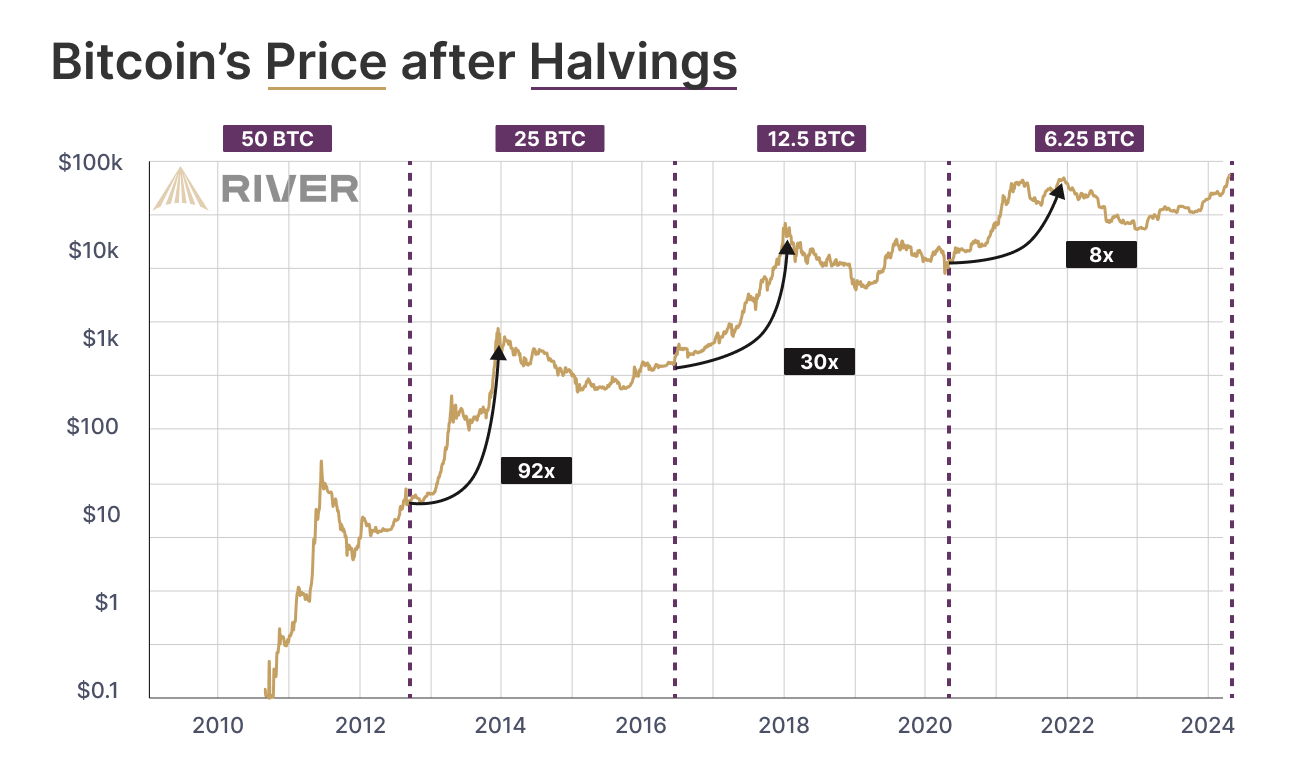
BTC price increase after halving, (correlation ≠ causation) | RiverLeer
Survival biases and environmental change
The popularity of the four-year cycle was driven in part by models such as Stock to Flow, which is based on the logic of supply scarcity, in other words that a decreasing supply increases value. As long as they seemed to be confirmed, they were widely cited as evidence, but when they failed spectacularly, more and more dubious models took their place. This is the survival bias a classic example of when we only remember successful periods and mistakes are quickly forgotten.
Not least the The bitcoin market has also undergone a complete transformation: Compared to 2009, liquidity, regulation, institutional presence, mining and market infrastructure are incomparably better developed. The patterns that still existed in the small, rudimentary market with low liquidity are no longer valid in today’s dynamically changing environment.
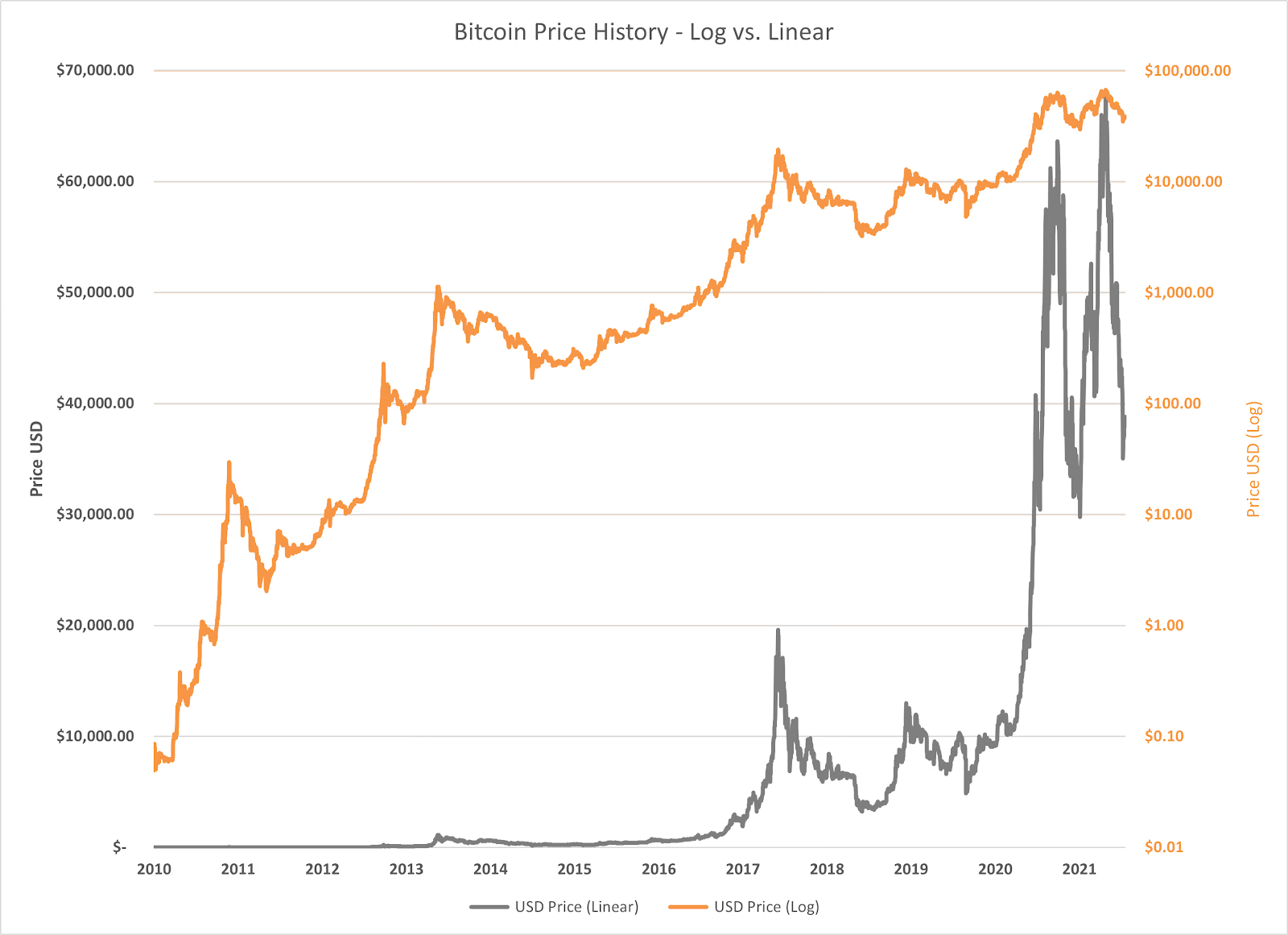
Bitcoin price evolution since 2009 (USD, linear and log scale) | Monochrome
Visually appealing displays
Four-year cycles are often represented by smoothed curves or trend channels drawn on logarithmic exchange rate graphs, which look very convincing but are statistically unfounded. If you choose a few parameters wisely, you can represent almost any essentially upward exchange rate as if it fits into a well-functioning cycle. And if the model can be adjusted in such a way that it can explain any exchange rate development, it actually predicts nothing.
Instead of the story of the four-year cycle, a more realistic approach is needed
Bitcoin’s history is simply too short and the market changes too quickly to deal with a four-year fixed pattern with serious predictive potential. Regardless, the halving is still a defining factor in terms of Bitcoin’s long-term supply model and value preservation role, but it does not guarantee a price explosion. For long-term investors, analysis of market structure, liquidity, macroeconomic environment and real supply and demand is far more authoritative than statistically volatile cycle theory.
#Bitcoins #fouryear #cycle #statistical #guarantee