

Air Force One is a strong contender for the most recognizable aircraft in the world. The white and blue Boeing VC-25, based on the 747, has carried the President of the United States since 1987. The iconic livery itself has a longer lineage, dating back to the 707-based VC-137C first used by John F. Kennedy in 1962. Despite such a long tenure, Boeing has not always been the manufacturer of the presidential aircraft.
The official transition for air travel was a matter of both convenience and necessity for the American president. Teddy Roosevelt was the first president to fly an airplane in 1910. However, he had left office the year before and the rudimentary Wright Flyer was not suitable for long-distance travel. His fifth cousin, Franklin D. Roosevelt, would be the first president to fly while in office. In 1943, FDR flew across the Atlantic Ocean to the Casablanca Conference during World War II. According to “The Presidential Aircraft,” the plane was a Boeing 314 Clipper flying boat known as the Dixie Clipper. Because German U-boats prowled the Atlantic Ocean sea lanes, flying was considered safer than sailing on the USS Potomac, the then-presidential yacht.
As the name Dixie Clipper implies, the aircraft was crewed by Pan Am. The historic airline baptized all its aircraft ‘Clippers’. This relationship with the unofficial national carrier would soon end when the US Army Air Forces successfully advised the Commander in Chief to convert a military Consolidated C-87, designated Guess Where II, for use as an executive transport aircraft.
Boeing helped the White House show off the Soviet Union
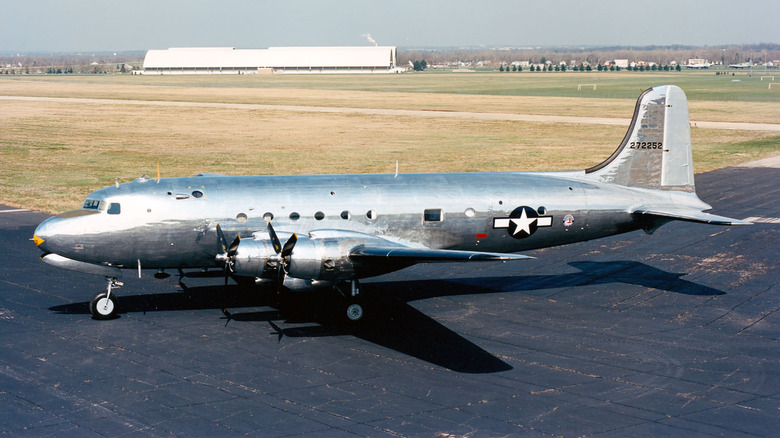
When jet aircraft became proven technology in the 1950s, the White House decided that it would be best for President Eisenhower to travel in a jet aircraft to increase the country’s technological superiority over the Soviet Union. The US Air Force would purchase three Boeing 707s in 1959, with an initial trip to Moscow led by then Vice President Richard Nixon. From that moment on, Boeing would be the exclusive provider of Air Force One.
The choice of potential contractors has decreased since the 1950s. Douglas would merge with McDonnell in 1967, and then McDonnell Douglas would merge with Boeing in 1997. Lockheed stopped producing civilian aircraft in 1984, after the commercial failure of the L-1011 TriStar. It’s basically Boeing or we don’t go, because it would be a national shame if Air Force One were ever a European-built Airbus. Despite the last Boeing 747 being built in 2023, the White House remains so determined to continue using a VC-25 that both Trump administrations were willing to retrofit a pair of undelivered 747s ordered by a Russian airline and a controversially gifted 747 from the Qatari royal family.
#built #Air #Force #Boeing #Jalopnik