
While we understand the appeal of camping at organized campsites with private toilets and perhaps even showers, what really makes an RV attractive is the ability to live as self-sufficiently as possible. A large part of this involves providing your own bathroom – or at least a toilet. Not only is this crucial for primitive camping in areas without any infrastructure or plumbing, it is also useful in letting campers avoid crowded porta-johns at tailgates and music festivals and skip expensive, rarely cleaned, fly-infested pit toilets in semi-primitive areas.
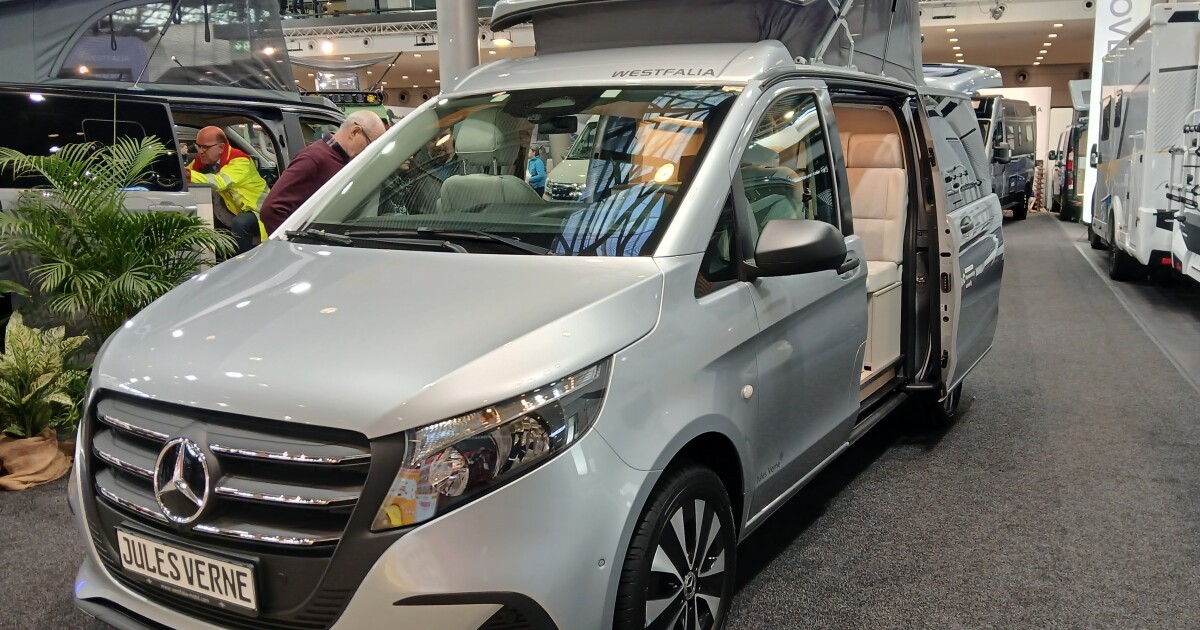
Very different from the Marco Polo – or the Volkswagen California for that matter – the Westfalia Jules Verne has its own bathroom. And it’s pretty decent as far as toilets go in small pop-up campers, with an integrated toilet and hot shower meeting in a rear compartment separated from the front by a roll-out privacy screen.
Westfalia introduced the Jules Verne in 2016, in the middle of the modernization of the Ford Nugget. Just three years earlier, the company had transferred the Nugget’s split-room/rear kitchen concept to the all-new Transit Custom, a smaller mid-size alternative to the Ford Transit van that had previously been the Nugget’s basis. Westfalia applied a similar floor plan strategy to the Jules Verne, but downsized the kitchen and squeezed in the rear bathroom, which only made its way to the Nugget in 2018.
Only Jules Verne’s bathroom is even better than the Nugget’s. Unlike the Ford camper bathroom, this one brings the shower inside rather than leaving shower users outside the tailgate. It heats the shower with a Truma boiler and has an integrated shower drain tray with a removable floor panel to cover it when not in use. Plus, unlike the Nugget bathroom, Jules’ Verne bathroom is more discreetly separated from the kitchen by a wardrobe with the aforementioned roll-out privacy screen… so it doesn’t feel so much like you’re taking a shit in the middle of the kitchen.
Jules Verne’s Marco Polo bragging rights don’t stop at the bathroom. While layout preferences will ultimately be different for each individual buyer, Ford and Westfalia have made a long and strong case for the split-room concept (kitchen at the rear, living room/convertible bed at the front, full-time bedroom upstairs) with the Nugget design. The Jules Verne takes a similar setup to a base Mercedes van and perhaps even improves it a bit.
CC Weiss/New Atlas
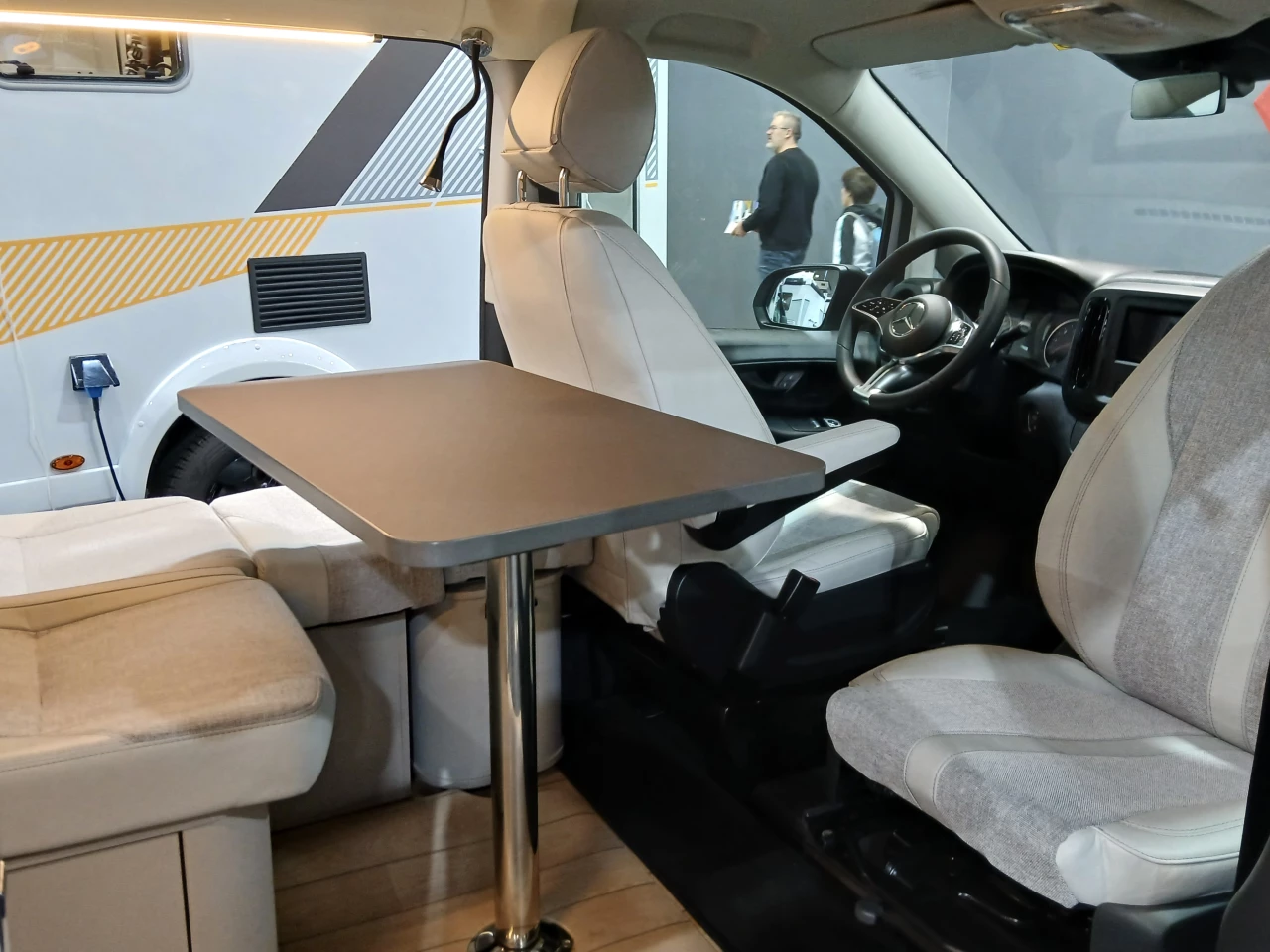
Like the Nugget, the Jules Verne has a forward-facing rear seat with seat belts, this one being a two-seater. Westfalia adds side-facing cushioned seats to create a wraparound sofa for camp, a feature the Nugget lacks. This lounge seats up to four or five people around the dining table once the swivel cabin seats rotate and features a chaise longue for extra comfort throughout the day. At night, it converts into a double bed of 172 x 120 cm – considerably shorter but slightly wider than the Marco Polo’s 80 x 44 inch lower bed.
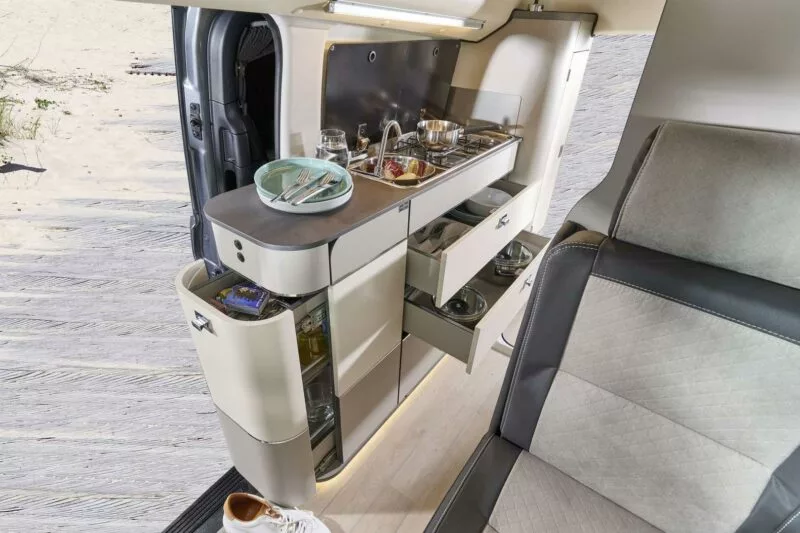
The Jules Verne doesn’t have as discreet or large a kitchen as the Ford Nugget – the price you have to pay for the full wet bathroom with shower – but the placement of the side kitchen at the rear of the van seems a more dedicated, useful space than the placement of the communal kitchen right next to the sofa/bed, as in the Marco Polo. It features a two-burner gas range and sink on the passenger side block, and a 51-litre compressor refrigerator in the tall cupboard across the aisle.
Westphalia
The Jules Verne’s pop-up roof is reversed compared to the Marco Polo, opening up the highest standing area at the rear of the van above the bathroom area. There is still a folding double bed measuring 190 x 117 cm, accessible via a folding ladder at the rear.
Other standard equipment on board the Jules Verne includes a 92 Ah leisure battery, a 2,000 W Webasto heater, a 50 liter fresh water tank and a 36 liter waste water tank.
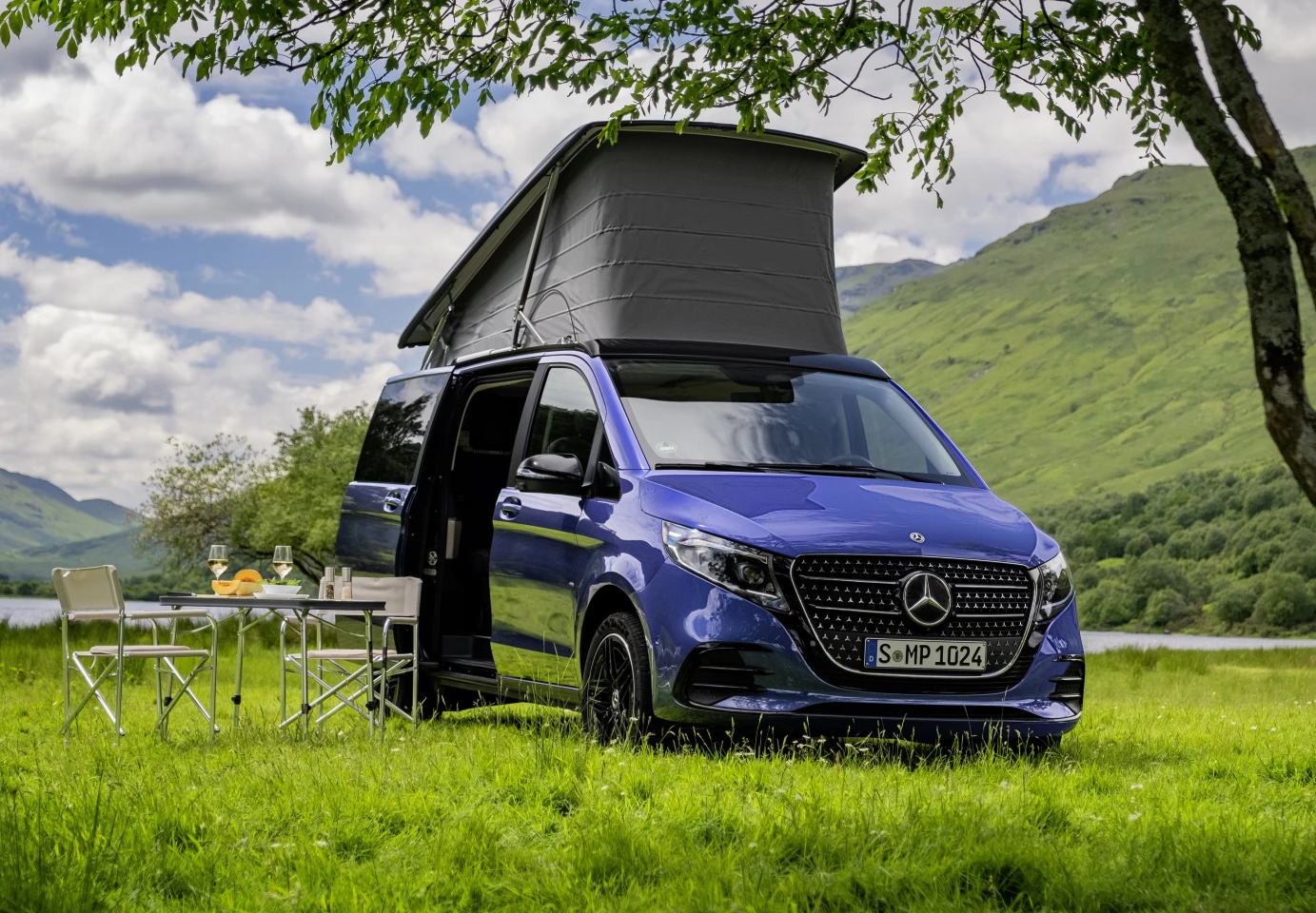
Of course, the Jules Verne does not outperform the Marco Polo in every category. For starters, the Marco Polo makes a much better first impression thanks to the sleeker styling of the V-Class passenger van underneath. The Jules Verne has always been based on Mercedes’ Vito commercial vehicle, which does not arrive as enthusiastically.
Mercedes Benz
That differential in the base car also plays a role beyond aesthetics. The Marco Polo comes with a higher level of automotive standard equipment, starting with a 161bhp 2.0-litre diesel engine/nine-speed automatic transmission versus the 134bhp 2.0 diesel/six-speed gearbox in the Jules Verne. Four-wheel drive is optional for both campers.
The Marco Polo cockpit is also several rungs above Jules Verne’s, although those who prefer a simpler analogue environment will probably like the latter better. The Marco Polo has a full-width digital instrument cluster/infotainment display as standard. That MBUX infotainment touchscreen also connects to the standard MBAC smart home system to control camper functions such as lighting and heating, a system can also be used using the accompanying smartphone app.

Mercedes Benz
Although the Jules Verne comes standard with a 10-inch MBUX touchscreen, it does not include MBAC connectivity or the digital instruments. Other standard features that come with the Marco Polo on the V-Class, but not with the Vito top Jules Verne, include active parking assistant with reversing camera and active distance assistant Distronic. Both are available as optional upgrades on the Jules Verne.
In our view, the Marco Polo offers a better basic van with higher spec, but the Jules Verne has the better camper layout, especially for a family with children who can fit comfortably on the short folding bed. The Jules Verne also undercuts the €80,664 (approximately US$95,250) Marco Polo with a base price of €74,180 ($87,575).
Keep in mind that the price is for the current 2025 Marco Polo, and not the updated 2026 model that Mercedes will build in-house. Pricing for the 2026 model year has not yet been announced.
Sources: Westphalia And Mercedes Benz
#Westfalias #Nuggetlike #camper #beats #Mercedes #camper #game