

If you’re looking to grow your wealth through automated investing, two platforms stand out: Wealthfront and M1 Finance. Both offer low-cost, practical investment solutions, but target different types of investors. In this guide, we’ll provide an overview of the features, costs, and ideal use cases to help you choose the best investment platform for your financial goals.
This article may contain affiliate links resources that – at no cost to you – I may earn a commission if you sign up or purchase something through the affiliate link.
Quick Comparison: Wealthfront vs. M1 Finance
Both Wealthfront and M1 Finance provide automated investment solutions plus self-directed investing. But there is more to each platform than meets the eye. Read on to find out which one suits your investing style.
Wealthfront: Robo-Advisor Plus More
What is Wealthfront? Wealthfront started as a classic robo-advisor, designed for investors who want a fully automated experience. After a short quiz, Wealthfront offers a diversified investment portfolio, in line with your timeline, risk level and objectives. This robo-advisor arm of Wealthfront handles rebalancing, dividend reinvestment, and even tax-loss harvesting to optimize your returns.
There’s more > Wealthfront also has individual stocks, ETFs and thematic portfolio investments,
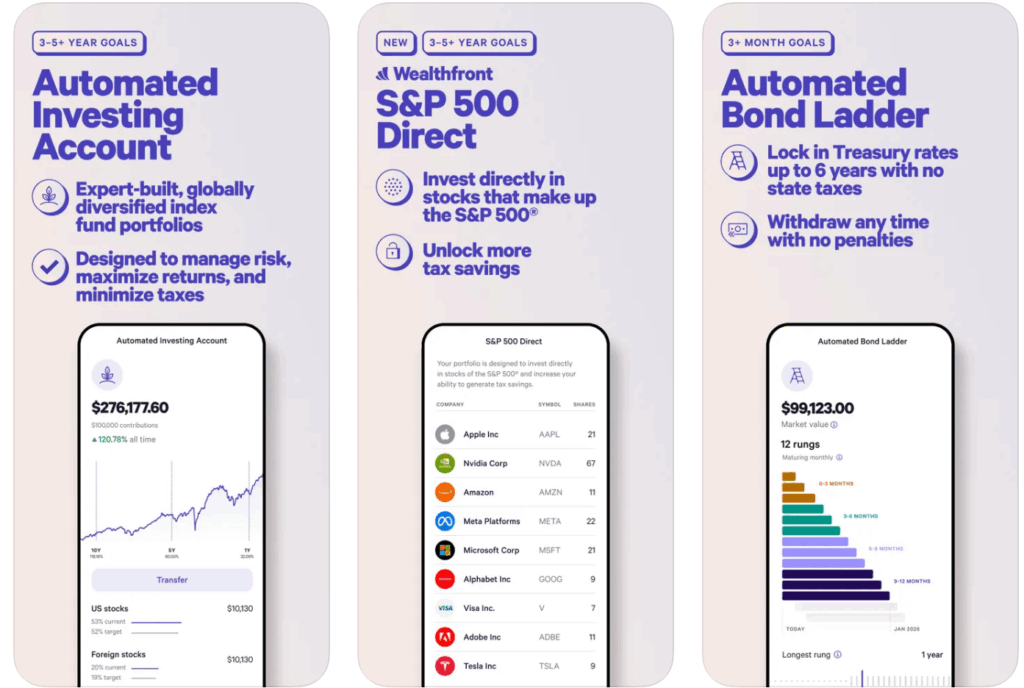
- Automated investing at low costs (0.25% per year).
- Tax-efficient strategies, including direct indexation for wealthy clients.
- Socially responsible portfolios available.
- Individual stocks, ETFs and theme portfolios, ideal for self-directed investors.
- Bond ladders for the fixed income segment of your portfolio.
- Wealthfront Cash Account is a high-yield cash account that combines checking and savings features.
Wealthfront is ideal for long-term investors who prefer a ‘set it and forget it’ approach. - Portfolio lines of credit and home mortgages are coming!
Free investing with M1 with a balance or loan of €10,000, otherwise €3/month.
M1 Finance: self-directed investing plus automated solutions
What is M1 Finance? M1 Finance provides thousands of ETFs and stocks, along with screeners to help you design your ideal portfolio. The M1 expert model portfolios are designed to meet a variety of investment preferences, including pension, stock and bond, income, global, socially responsible, aggressive and conservative choices. Whatever types of investment portfolios you choose, the platform will rebalance them to your preferred asset allocation on request.
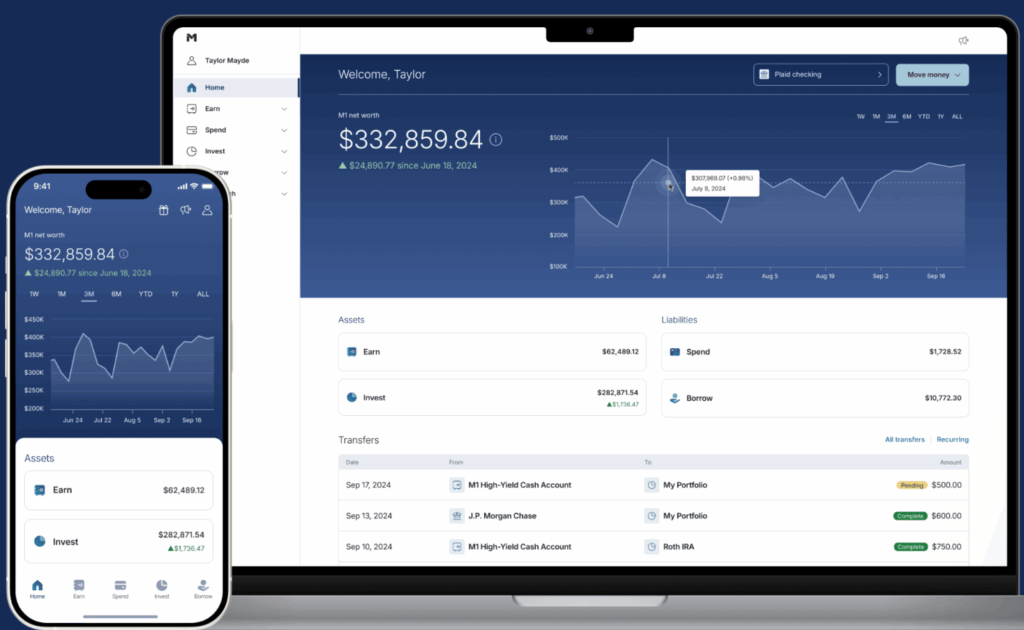
- Three dollars per month to zero account fees for people with a $10,000 account balance or a personal loan.
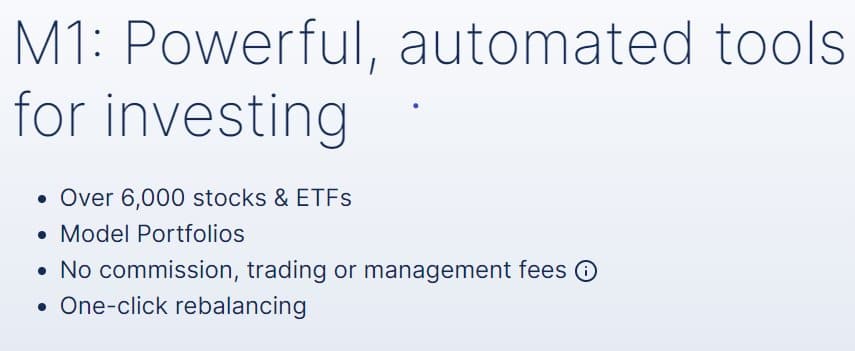
- Customizable fractional share portfolios.
- Integrated bank and high-yield cash account.
- Margin loans available for accounts with more than €2,000 invested.
📊 Wealthfront vs M1 Finance comparison chart
| Function | Wealth front | M1 Finance |
|---|---|---|
| Core focus | Automated investing with optional self-directed tools. | Self-directed investing with automated rebalancing. |
| Portfolio setup | Quiz-based, targeted, diversified portfolios. | Do-it-yourself portfolios with shares and ETFs or model portfolios. |
| Investment options | Broadly diversified stock and bond portfolios plus individual stocks, ETFs and theme portfolios. | Thousands of ETFs and stocks, fractional shares. M1 model portfolio scores. |
| Automation functions | Rebalancing, dividend reinvestment, tax loss harvesting. | Rebalance on demand. |
| Tax efficiency | Tax loss harvesting and direct indexation for wealthy clients. | Not emphasized. |
| Socially responsible portfolios | Available. | Available. |
| Fixed income | Bond ladders and bonds are included in automated portfolios and ETFS. | Included in model portfolios and ETFs. |
| Cash management | High-interest cash account (Wealthfront Savings Account) with payment/savings functions. | High-yield cash account with integrated banking functions. |
| Costs | Annual advisory fee of 0.25%. No commissions or management fees for stock and ETF portfolios.1 | $3/month or $0 with a $10,000 balance or loan.2 |
| Margin loans | Portfolio line of credit available for accounts with $25,000+. | Available for accounts with $2,000+. |
| Ideal for | Long-term, hands-off investors. | DIY investors who want automation and flexibility. |
CommissionFree investing with M1 with a balance or loan of €10,000, otherwise €3/month.
Wealthfront vs. M1 Finance Review – Which One is Best for You?
Whether you’re just getting started or optimizing an existing portfolio, Wealthfront and M1 Finance offer compelling solutions.
Choose Wealthfront if you want a fully managed, tax-efficient portfolio with minimal effort, and stocks and ETFs.
Choose M1 Finance if you want to build your own portfolio, choose a model portfolio and opt for rebalancing.
Both platforms are excellent, but your choice depends on how hands-on you want to be with your investment management. Wealthfront shines with its tax strategies and simplicity, while M1 Finance provides investors with customized and integrated financial tools
Wealthfront is ideal for passive investors who want everything managed, while M1 is suitable for DIY investors who want control with some automation. Both offer cash management and socially responsible investing options.
M1 Finance is perfect for investors who want control over their portfolio, but still appreciate automation.
Frequently asked questions
Yes, Wealthfront is committed to maintaining a high level of safety and security. Wealthfront uses bank-level security and offers insurance through partner banks for cash deposits with the FDIC and business failures with the SIPC. While investing always involves market risk and price volatility, Wealthfront’s automated strategies aim to reduce volatility through diversification and features such as tax loss absorption.
Yes, M1 Finance is considered safe for investors. It is a registered broker-dealer with the S EC and cash deposits are protected through partner banks with the FDIC. While investment assets are protected by the SIPC from corporate failures and crimes, the market is protected
Investing always involves risk. M1’s infrastructure and regulatory compliance help protect your assets and personal information.

Related
Sources:
1 https://support.wealthfront.com/hc/en-us/articles/13992378758676-Understanding-Wealthfront-fees
- Automated Index Investment Accounts: 0.25% annual advisory fee
- Automated bond portfolio: annual advisory fee of 0.25%
- Automated bond ladder: annual advisory fee of 0.15%
- S&P 500 direct portfolio: Annual advisory fee of 0.09%
- Share investment account: Free. Wealthfront does not charge customers any fees, including account fees or commissions
2 https://m1.com/legal/disclosures/platform-fee-disclosure/
Disclosure: Please note that this article may contain affiliate links resources that – at no cost to you – I may earn a commission if you sign up or purchase something through the affiliate link. That said, I never recommend anything that I don’t believe has value.
Disclosure by M1: This content is not a solicitation, is not endorsed by M1, and has not been reviewed by M1; the opinions expressed are solely those of the authors and do not reflect the views of M1. The information presented is accurate as of the date the video was posted; For the most current information, please refer to m1.com. Before making any investment decisions, you should consult your personal investment, legal and tax advisors as this content is for informational purposes only and is not intended as investment recommendations.
I have a funded account with M1 Finance.
#Wealthfront #Finance #Pros #Cons #Whats