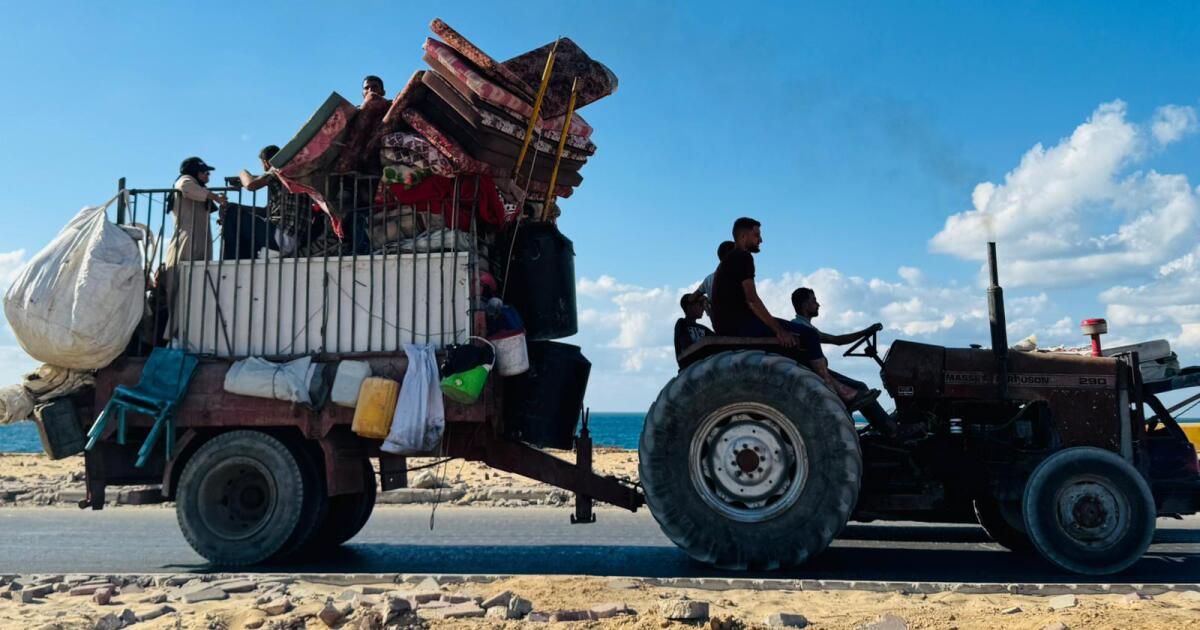

JABALIA, Gaza Strip — The trailer creaked under the weight of mattresses, blankets, tents, a gas cylinder, weathered plastic barrels, gunny bags of clothes, plastic chairs, garden tools, various kitchen utensils and a toy tricycle – the collective belongings of Mohammad Abu Warda and his family.
Abu Warda, 34, pulled the ropes securing the load and connected the trailer to his tractor. He glanced at his mother, 60-year-old Bouthaina Warda, who was braiding his daughter’s hair, then turned toward the coastal road heading north to Gaza City.
It was time to go home.
“The last time we took this highway, we escaped death,” Abu Warda said, his hands straining against the rope as he pulled it tight again.
“Today we hunt for what is left of life.”
All around him, others began a similar journey, piling what they had salvaged from their belongings onto whatever transportation they could arrange. Donkey carts and tractors jostled for space with pickup trucks and larger transporters, diesel fumes mixing with dust and salty sea air.
Every few hundred meters, more people entered Al-Rashid Highway from the side streets, adding to the slow-moving flow of hundreds of thousands returning home to see what – if anything – of the lives they had in northern Gaza.
The homecoming comes at a time of hope after two years of war. A landmark ceasefire between Israel and Hamas remains in place, with prospects for a lasting peace. President Trump was on his way to Israel in time for the expected release of the last hostages held in Gaza on Monday. Israel would release hundreds of Palestinian prisoners and plan a wave of aid to the famine-stricken region.
Abu Warda was displaced early in the war, when he and his family left their home in Jabalia, a few kilometers north of Gaza City, in November 2023; they returned 14 months later, in January this year, before Israel’s intensified attack on Gaza City and the northern part of the enclave last month forced them to leave again.
This time, Abu Warda – whose uncles and cousins had braved the 25-kilometer trek back from Khan Yunis in central Gaza to Jabalia the day before – knew it would be a bitter homecoming.

Mohammad Abu Warda sits among the rubble in Jabalia, where his family returned on Sunday.
(Bilal Shbeir / For The Times)
“Everything is gone. The house is destroyed,” he said.
Sitting in the caravan, Bouthaina spoke in a small and somber voice.
“People keep saying we’re going home. But home is no longer there,” she said. “We’re just going to see what’s left. A lot of rubble.”
Many of the 2.1 million people living in the Gaza Strip (which at about 140 square miles is less than a third the size of Los Angeles) face similar conditions, with almost the entire population forced to move in the past two years and more than 90% of homes damaged, according to expert estimates.
Some parts of the enclave are suffering from famine due to a months-long Israeli blockade, say the UN and other aid agencies, which have also accused Israel of genocide. Israel denies the accusation and says it acted to destroy Hamas.
Meanwhile, the enclave’s infrastructure, be it healthcare, water or sanitation, has been destroyed; especially in Gaza City, according to Asem Al-Nabih, spokesperson for the Gaza City Municipality.
“I can’t explain to you the tremendous damage we’re seeing,” he said.
He added that the Israeli army had deployed booby-trapped armored assault vehicles, which caused damage not only to above-ground structures, but also to water wells, underground pipes and sewage pumps, not to mention roads.
“Our priority now is getting water, and we have started clearing the main roads so people can reach what is left of their homes,” he said. “But at the same time, we have lost most of our heavy and medium equipment in the past two years, so there is not much we can do to alleviate people’s suffering.”
The war began on October 7, 2023, when Hamas-led militants attacked southern Israel, killing 1,200 people — two-thirds of them civilians, according to Israeli authorities — and kidnapping about 250 others.
In retaliation, Israel launched a large-scale military offensive that killed more than 67,000 people, more than 3% of the enclave’s population, the Gaza Health Ministry said. Although it does not distinguish between civilians and combatants in its figures, the figures are considered reliable and used by the UN and the Israeli military.
Abu Warda turned on the tractor’s engine and pushed it faster as he walked past the outside of a seaside cafe where his family once stopped for tea and grilled chicken during a weekend getaway. On the side of the road were abandoned sandals, plastic water bottles hardened by the sun, and broken toys – remnants of the exodus in recent months.
With every kilometer the family approached Jabalia, the landscape changed, with fewer tents, more ruins, and more dust on people’s faces. Entire apartment buildings leaned against each other, like carelessly fallen dominoes.
Finally, six hours later, Abu Warda parked the tractor in front of a pile of masonry and worn rebar in Jabalia: home.
“I remember my window was there,” Abu Warda said, pointing to a hollow space between fallen concrete slabs.

A trailer contains the belongings of the family of Mohammad Abu Warda, who fled northern Gaza months ago to escape Israeli army attacks.
(Bilal Shbeir / For The Times.)
A school notebook, dusty and dog-eared, peeked out from the rubble. He fished it out and wiped the cover off. His son’s name was still visible, written in red marker.
Abu Warda’s sister, 25-year-old Amal Warda, bent down and grabbed a handful of gray dust.
“This is what we came back for,” she said softly. “To touch the truth with our own hands.”
As the afternoon progressed, the family used rope taken from a neighbor’s yard to secure a tarp between two larger pieces of concrete. Abu Warda found an old metal cauldron and lit a fire with pieces of wood. Then he made tea, which he poured into dented cups and passed around.
A few neighbors and cousins emerged from the similarly destroyed ruins, exchanging greetings that sounded both joyful and vulnerable. Someone offered water. Another shared news about which wells in the area were still functioning, along with information about U.S. aid.
The children started playing and running up piles of rubble. Bisan, Abu Warda’s 12-year-old niece, took a stick and copied a picture of a house with four windows and a tree. She added her family standing outside, smiles on their faces. When the wind blew it away, she drew it again.
“Gaza still breathes through its people,” Amal said. “As long as people are back here, life will slowly return.”
Towards sunset the sea breeze became cool. The family stretched out the blankets they had brought and slept under the tarpaulin. Abu Warda looked at the sky.
“I’m not sure what tomorrow will bring,” he said.
“But I do know this: being here, even if it’s in ruins, is better than sitting in a tent waiting for news.”
Special correspondent Shbeir reported from Jabalia and Times staff writer Bulos from Jerusalem.
#hunt #whats #left #life #Gazans #journey #destruction