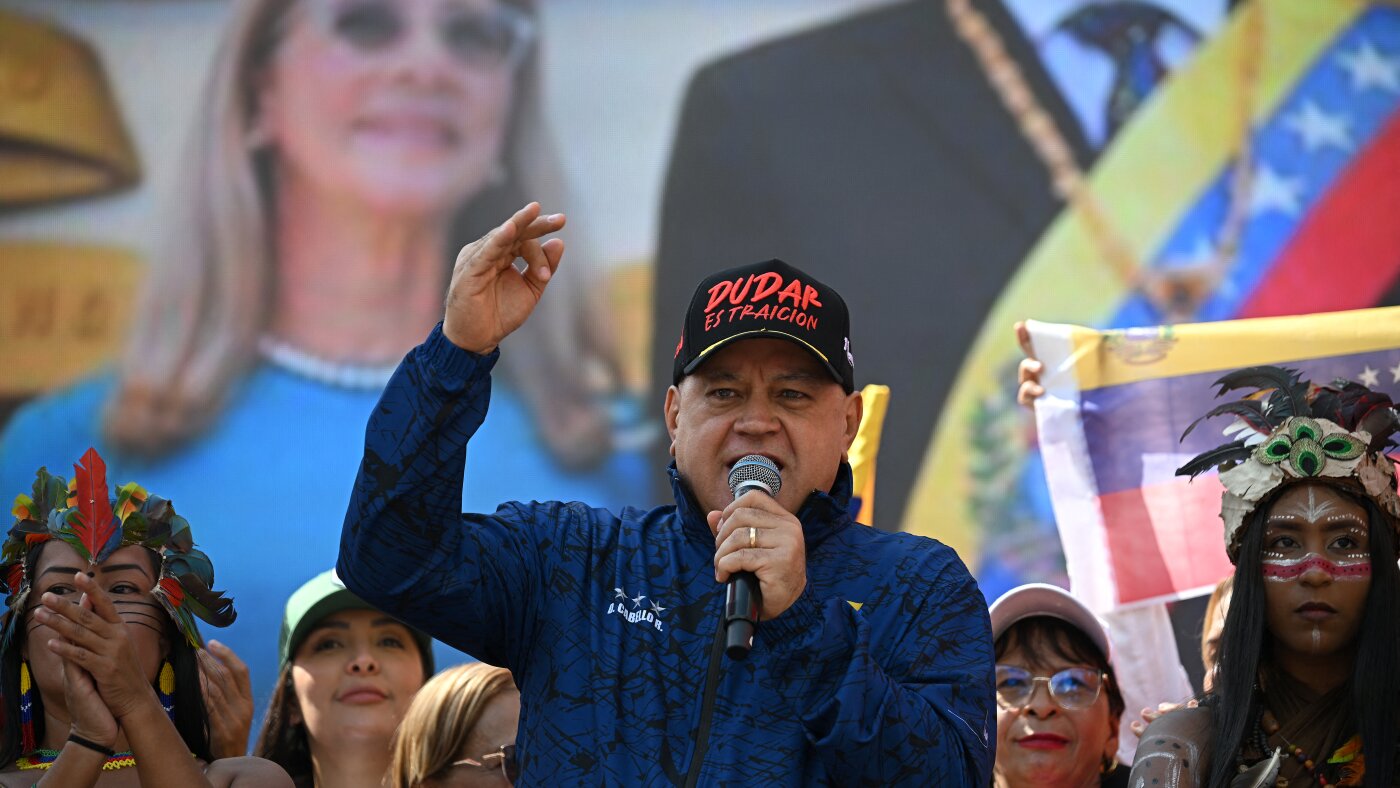

Venezuelan Interior Minister Diosdado Cabello delivers a speech during a women’s rally in support of deposed Venezuelan President Nicolas Maduro and his wife Cilia Flores in Caracas on January 6, 2026.
FEDERICO PARRA/AFP via Getty Images
hide caption
change caption
FEDERICO PARRA/AFP via Getty Images
BOGOTA, Colombia — The arrest of Venezuelan President Nicolás Maduro by U.S. special forces has raised hopes for a democratic opening in the South American country. But so far there has been no talk of a ‘Venezuelan spring’.
That’s partly because Diosdado Cabello, Maduro’s toughest enforcer, remains in power under interim President Delcy Rodríguez, who took over after Maduro’s capture by US forces.
In the hours after the US operation, Cabello, Venezuela’s interior minister, appeared on the streets of Caracas wearing a helmet and body armor. He condemned the US operation as a “cowardly attack” and urged Venezuelans not to cooperate with what he called a “terrorist enemy.”
In addition to armed security forces, Cabello called on supporters to mobilize to defend Venezuela’s sovereignty and warned opponents that those seen as traitors would face consequences for doubting the Bolivarian revolution.
Like Maduro, Cabello has been too indicted in the United States on charges of drug trafficking and narco-terrorism, and named alongside Maduro, his wife Cilia Flores and other associates in the same indictment.
Washington offers up to a $25 million reward for information leading to Cabello’s arrest, claiming he was a senior figure in what US authorities call the Cartel de los Soles or Cartel of the Sun, a network of Venezuelan officials the US alleges are involved in cocaine shipments to the United States. Cabello has denied the allegations.
But despite the US accusations, Cabello remains a central figure in the Venezuelan government and continues to wield significant power as the administration tries to improve relations with the Trump administration following Maduro’s ouster.
When President Trump was asked about Cabello at a press conference at the White House on Wednesday, he did not appear to recognize his name. But within Venezuela, Cabello is infamous.
The 62-year-old Cabello, a stocky figure with a cropped haircut, was a close confidant of Hugo Chávez, the founder of Venezuela’s socialist revolution. As young army officers, the two men took part in a military coup in 1992, with Cabello commanding several tanks to attack the presidential palace.
The coup, led by Chávez, failed and the two men were imprisoned along with dozens of other military officers. But after their release, Chávez was elected president in 1998, with Cabello becoming part of his inner circle.

This January 17, 2002 file photo shows then Venezuelan President Hugo Chavez (R) with his new Vice President Diosdado Cabello (L) during a ceremony at the Government Palace in Caracas.
JUAN BARRETO/AFP via Getty Images
hide caption
change caption
JUAN BARRETO/AFP via Getty Images
Cabello held numerous positions, including head of the telecommunications regulator, where he was instrumental in shutting down TV and radio stations critical of the government. He also served as interim president for about five hours in 2002 when Chávez was ousted in a short-lived coup.
Although Cabello was long seen as next in line for the presidency, Chávez made it clear before his death in 2013 that Maduro would succeed him. Maduro’s close relationship with Cuban officials – who were deeply involved in advising Chávez – helped solidify this choice.
“It was an open secret in Venezuela that Diosdado Cabello saw himself as the rightful successor to Hugo Chávez, and not Maduro,” said Geoff Ramsey, a Venezuela analyst at the Atlantic Council.
Instead, Cabello went on to lead Venezuela’s National Assembly and the ruling Socialist Party. But their rivalry kept him out of Maduro’s cabinet until 2024, when protests broke out over strong evidence that Maduro stole that year’s presidential election.
“Maduro needed an enforcer on board to put our heads together and put down the protests in the wake of the stolen elections,” Ramsey said.
Cabello was appointed interior minister in 2024 and led a crackdown that he said killed 24 people and arrested more than 2,000. Human Rights Watch. Now, under interim President Rodriguez, he continues in that role, controlling both the Venezuelan police and armed, pro-government motorcycle gangs known as colectivos.

Venezuela’s Acting President Delcy Rodriguez and Interior Minister Diosdado Cabello arrive at the National Assembly in Caracas, Venezuela, on Thursday, January 15, 2026.
Ariana Cubillos/AP
hide caption
change caption
Ariana Cubillos/AP
Zair Mundaray, a former Venezuelan prosecutor, says the stable business environment the Trump administration seeks to exploit Venezuelan oil will not happen as long as Cabello remains in the picture.
“How can you have legal stability when you have a man who has armed thugs on the streets and who can cause chaos, and lock people up or kidnap people whenever he wants?” says Mundaray.
Human rights activists blame Cabello for delays in the release of political prisoners, a government policy announced more than a week ago to promote national unity. Furthermore, Cabello continues to criticize dissidents on his weekly TV show, With the giving of the hammer (“Hit the hammer”). In a recent episode, he labeled opposition leader and Nobel Prize winner Maria Corina Machado a “fugitive from Venezuelan justice.”
Not surprisingly, opposition figures who have fled the country say it will be too dangerous to return as long as Cabello and other hardliners such as Defense Minister Vladimir Padrino López, who controls the military, remain in government.
During a panel discussion sponsored by Harvard University, Venezuelan economist Ricardo Hausmann said: “At this point I can’t go back. You have the colectivos on the streets. You have Diosdado Cabello as the chief of police. So the government in Venezuela is the same Chavista government that we saw before.”
He says this could further delay the transition to democracy, which the Trump administration says it is also aiming for.
Trump has warned of a second wave of military strikes if Maduro remnants like Cabello step out of line. Cabello could try to make a deal and go into exile. Another option would be to remain quiet, cooperate with the interim government and try to outlast Trump.
“If he expects to stay out of prison and avoid Maduro’s fate, his best chance lies in working with Delcy Rodríguez, at least for now,” Ramsey said. “But that doesn’t mean he’s going to give up his long-standing ambitions.”
#Venezuela #Maduros #enforcer #Cabello #remains #central #power