

The Boeing E-4B Nightwatch, better known as the US military’s ‘Doomsday Plane’, made a rare and highly visible appearance this week, sparking speculation due to both its flight pattern and the geopolitical moment in which it occurred. Flight tracking data showed the plane departed Offutt Air Force Base on January 6 and flew to Camp Springs, Maryland, near Washington, DC, before later landing at Los Angeles International Airport. Videos of the landing circulated widely online, attracting attention precisely because the E-4B is designed to avoid public visibility. The plane is not part of routine business trips and its movements are rarely discussed. That alone made the flight remarkable.US media later reported that Defense Secretary Pete Hegseth was on board the plane. The Pentagon did not explain why the E-4B was used instead of a conventional government aircraft, nor did it provide details on the flight’s mission profile. The lack of an official explanation is a well-known feature of previous E-4B movements and part of what gives the aircraft its mystique.
What the “Doomsday Plane” actually is
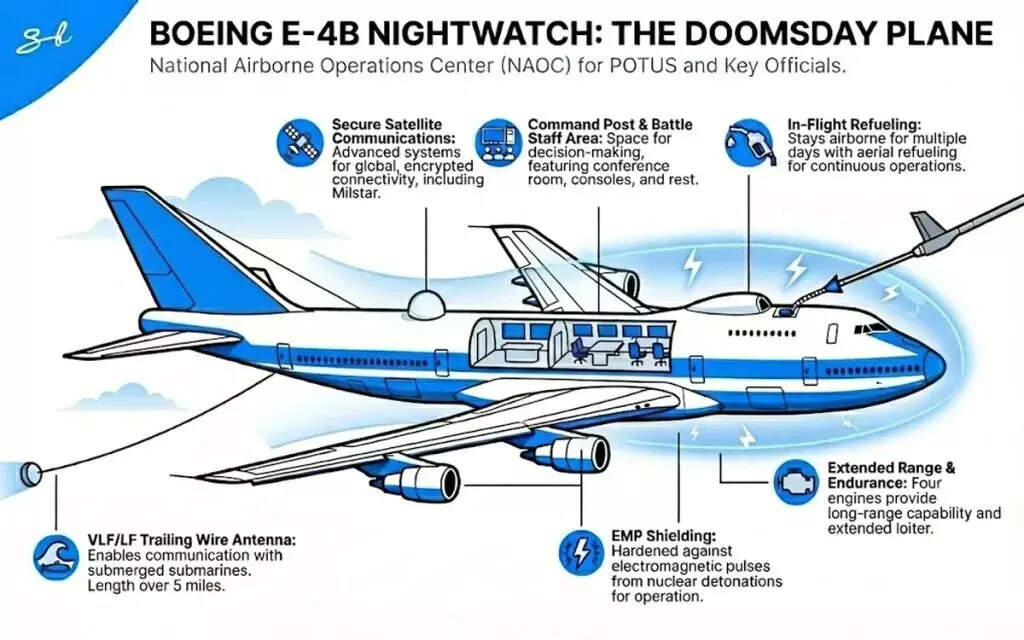
The E-4B Nightwatch serves as the National Airborne Operations Center, a flying command post designed to keep the U.S. government functioning during the most extreme scenarios imaginable, including nuclear war, catastrophic attacks on U.S. soil or the destruction of ground command centers. Built on a highly modified Boeing 747-200 airframe, the aircraft is hardened against electromagnetic pulse effects, shielded against nuclear and thermal radiation and equipped with multiple layers for secure communications. It is a core component of the Army’s nuclear command, control and communications system, often referred to as NC3, which enables senior leaders to authorize and manage nuclear forces under all circumstances.
What makes Doomsday Plane special and why was it spotted in Los Angeles for the first time in 51 years? The landing of the U.S. Air Force E-4B Nightwatch at Los Angeles International Airport draws public attention. Photo credit: X/@JeffVaughn
The current E-4B fleet has its origins in the E-4A, which entered service in the late 1970s. The first B model aircraft was delivered to the US Air Force in January 1980 and by 1985 all aircraft had been converted to the improved configuration still in use today. All four E-4Bs are assigned to the 595th Command and Control Group at Offutt Air Force Base in Nebraska, which has operated under the Eighth Air Force since October 2016.At least one aircraft is kept on continuous alert at all times. Each E-4B has a maximum take-off weight of 800,000 pounds (about 360,000 kilograms), an unfueled endurance of about 12 hours, and an operational ceiling above 30,000 feet (about 9,091 meters). It is designed to function as a flying government and can carry up to 111 personnel, including senior command staff, intelligence teams and communications specialists. Each aircraft cost approximately $223.2 million in fiscal 1998, and despite entering service more than four decades ago, the E-4B remains a core component of U.S. government continuity planning.
Inside the air command center
The main deck is divided into six functional areas, including command work areas, conference and briefing rooms, an operations floor, communications hubs and rest areas. There can be up to 110 personnel on board, ranging from senior command staff and intelligence teams to communications specialists, security units and flight crew. The aircraft can remain aloft for extended periods through in-flight refueling, allowing the national leadership to operate independently of ground infrastructure. Advanced satellite systems provide global connectivity and ensure uninterrupted command authority. The E-4B’s mission is led by the Joint Chiefs of Staff and executed through the US Strategic Command, with the Air Force Global Strike Command responsible for aircrew, maintenance, security and communications support.Despite its ominous nickname, the E-4B has only been activated once in a true emergency, in the aftermath of the September 11, 2001, attacks, when it was used to ensure government continuity. Training flights take place regularly, but public sightings are rare, which is why this week’s multi-city trip stood out.
Why the flight attracted attention
The appearance comes amid heightened global tensions, including an expanding US military campaign linked to Venezuela and the recent arrest of President Nicolás Maduro, who has since been transferred to New York to face criminal charges. U.S. officials have not linked the E-4B movement to these developments. Still, the coincidence of timing has fueled online speculation, especially given the plane’s special role in worst-case national security planning.Whether the flight reflected routine logistics, high-level travel requirements, increased security measures or strategic signals remains unclear. What is clear is that the E-4B exists precisely for moments when ambiguity, uncertainty and risk dominate the strategic landscape. Whenever the Doomsday Plane appears in the public eye, it tends to raise the same silent question every time: not what happened, but what the US government is preparing for.
#Doomsday #nuclear #plane #spotted #Washington #called #flying #Pentagon #times #India