

These words, spoken by Camillo Benso, Count of Cavour, envisioned the train as early as the 1840s as a tool for connecting peoples and territories, transforming political geography into a living network of exchanges and relationships.
It is based on Cavour’s intuition “Italian Railways (1861-2025). From national unity to the challenges of the future”an exhibition promoted and organized by VIVE – Vittoriano and Palazzo Venezia and the Ferrovie dello Stato Italiane Group.
Until January 11, the exhibition, set up in the Sala Zanardelli of the Vittoriano and in the large garden of Palazzo Venezia, explores the impact that the railways have had on the history of the country and its people, as well as their capacity for transformation. On the other hand, the train is and remains not only a means of transport, but also a device capable of changing the perception of time, redefining the concept of distance and inspiring new visions of work, identity and community.“The exhibition – said Edith Gabrielli, curator of the exhibition and general director of VIVE, during the presentation to the press – emerged from the intuition of Cavour who saw in the railways not just a means of transport for people and goods, but rather an instrument capable of transforming the peninsula into a nation and ‘making Italians’. The railways helped redefine the national identity.” While Tommaso Tanzilli, president of the FS Group, highlighted how the exhibition, far from representing a self-celebration, aims to commemorate the contribution of the Ferrovie dello Stato on the path it has taken and to underline how much can still be done to modernize the country.
Angelo Morbelli, At the central station (of Milan)
In 120 years of history – many years since its founding in 1905 – the railways have marked every crucial Italian phase, from the post-war reconstruction to the economic boom, to high speed and the current digital transition.
The first phase of the exhibition takes visitors between 1861 and 1904 and tells about the difficult transformation of the first regional networks into a national system. With De Nittis and Morbelli we discover how, in the space of a few decades, the train has found its way into the daily lives of Italians, imposing a common time, creating new professions and reshaping distances and mentalities. The bust of Camillo Benso, made in bronze by Ignazio Boggio, attends with satisfaction the inauguration of the Naples-Portici railway, immortalized by Salvatore Fergola, which took place on October 3, 1839 in the presence of Ferdinand II of Bourbon, King of the Two Sicilies. The years between 1905 and 1944 instead mark the second part in which the 1905 nationalization marks a decisive turning point in the history of Italian transport. A beautiful canvas by Ettore Tito condenses the arrival of modernity in the peasant world through the white smoke rising from the chimney of a passing train.
During World War I, the railway network became the heart of the war effort, ensuring the transport of troops to the front with the famous “transports”. But the train becomes synonymous with farewell through a white handkerchief that the woman painted by Ansalmo Bucci waves to the sky to greet her husband on his way to war or the sad journey of a widow with her daughter.
A few years later it would become a dramatic symbol of national mourning: the body of the Unknown Soldier travels along the tracks from Aquileia to Rome, and is still kept in the Vittoriano, in the center of the Altare della Patria. The train also crosses art and literature, from Carducci to Pirandello, and continues to underline the ambivalence of modernity: a promise of progress and freedom for many, starting with the futurist Boccioni, but also the alienation of contemporary man.
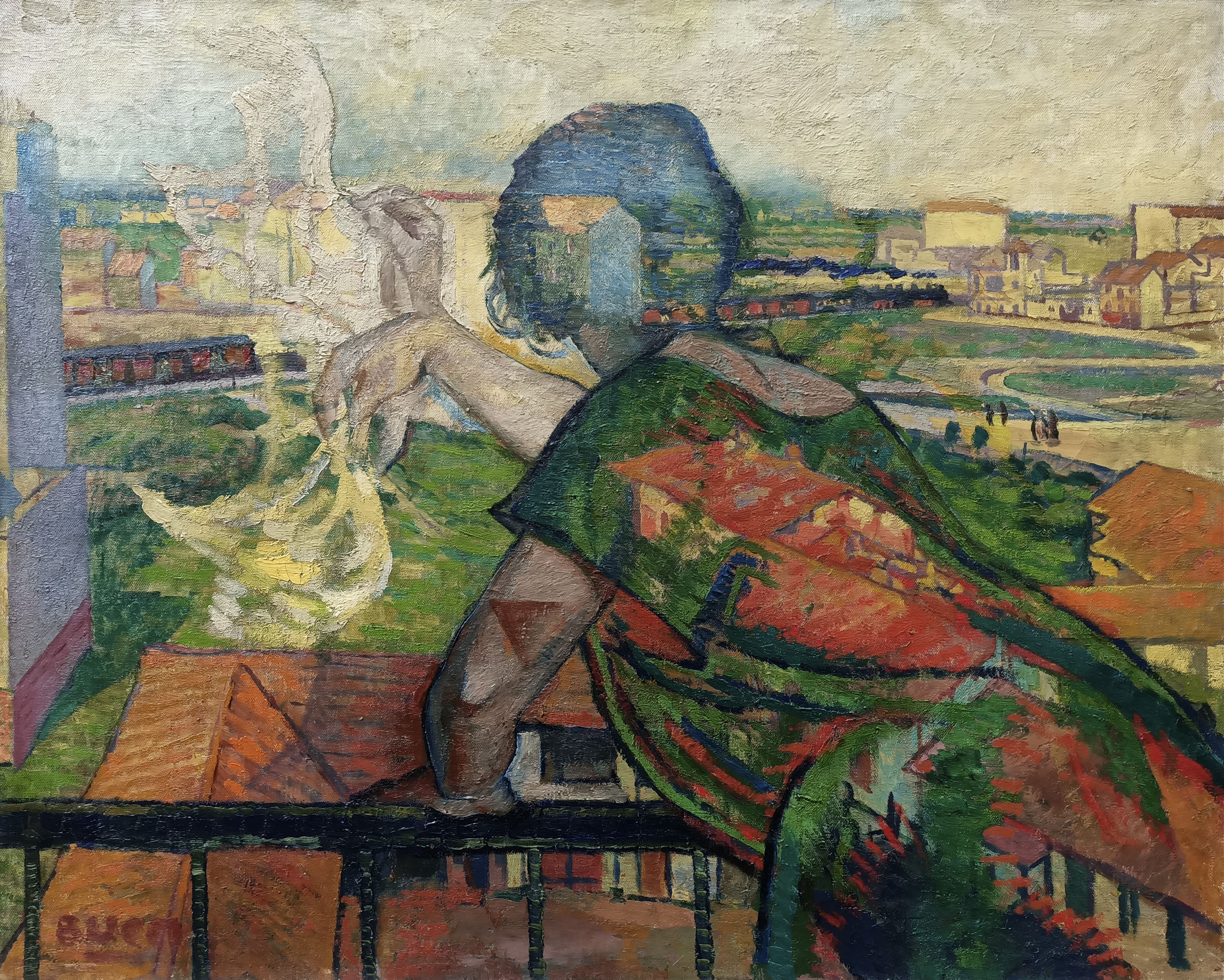
Anselmo Bucci, The Farewell, 1917, Matteo Maria Mapelli contemporary art
While the third part, from 1945 to 1984, deals with post-war reconstruction, the economic boom and the role of trains in major internal migrations and in daily commuting, the fourth and final phase of this journey, from 1985 to today, focuses on the challenges of sustainability and thus opens up a view to the future. In the immersive part, in the Zanardelli room, you can also enjoy the story emotionally and multisensory.
Finally, two monumental reproductions in the large garden of Palazzo Venezia draw attention to the “Settebello” and the “Arlecchino”, icons of post-war Italian design.
#Travel #Italy #railways #national #unity #challenges #modernity #Rome #Arte.it