

Back-to-back races in Austin and Mexico City provide two special venues with huge crowds, but the track characteristics couldn’t be more different. At over 2,000 meters above sea level, the Autodromo Hermanos Rodriguez is a unique test, and the guide for the challenge it presents this weekend is local hero Pato O’Ward, who will once again compete in FP1 for McLaren.
“The most important thing is that the overall down force of the car is significantly lower, so the cars will feel like they don’t have the same amount of grip as they always did. I will say that the top speeds are also very high because the air is not as dense. Cooling is an issue because of the altitude, so the engines struggle to breathe a little more.”
“But as far as the circuit goes, it has a lot of slow, tight and twisty stuff, it has some very heavy braking zones and it has a sector that is quite fast.
“For me, coming out of an IndyCar, it still feels very fast. To me it doesn’t feel like it’s disappointing. No, it’s still quite the opposite. It still feels like it can do a lot more than what I’m used to. But it’s a very nice track.”
“For the fans, I would like to say that it is a track where you can really appreciate all the people who come because all the sections have their own character. Everyone is super lively and they are excited to be here. When I finish my session I will definitely wave when I get to the stadium area because it is quite special.”
“In terms of the main sections, Turns 7 to 11 are quite tricky because you have to trust the car. You have to go in and believe it’s going to do it. But it’s also an area where the car will bite if you get greedy, as we’ve seen in the past. So I’d say that section is quite easily the one that can make or break your lap.”
Slow and winding turns encourage aggression, but O’Ward warns that it is easy to overplay that hand. Hector Vivas/Getty Images
“After that section you have the ultra-slow stadium section, Foro Sol. It invites you to push that much harder, but the grip isn’t there to do it. So I’d say that’s probably the worst part of destroying your lap, because if you get everything right and then screw it up, well, it won’t be good. And it’s in front of so many fans!
“I wouldn’t say the FP1 conditions are particularly tough. Obviously there’s rubber being put down over the weekend. But there’s also a lot of progression in lap time due to weight and just the fuel load.
“Because FP1, at least for us, is not a light fuel at all. And a lot of times you’re more conservative in what you explore. But I would say once you start reducing the fuel level and you start giving the engine more power, that lap time just comes to you automatically. The grip itself at low speed, I wouldn’t say it’s a night and day difference.”
“If you’re driving very stiffly, it’s all about how far you can go until the car feels like the oscillation is too aggressive. I would say it’s a fine line of how low you want to go. Are you dragging too much on the straights? Because the straights are very long.”
“So I think there’s definitely a fine line where it doesn’t go as low as you can and push. There’s definitely a scenario where it becomes too much. So you have to try that in P1 and that becomes my job.”
“It’s actually not necessarily maximum downforce either. I mean, it’s obviously not going to be like Monza. I don’t know exactly what specs I use or have used at other circuits, but I know I’m trying different things than what Oscar [Piastri] in terms of downforce, so we’ll see where that takes us.”
AT A GLANCE
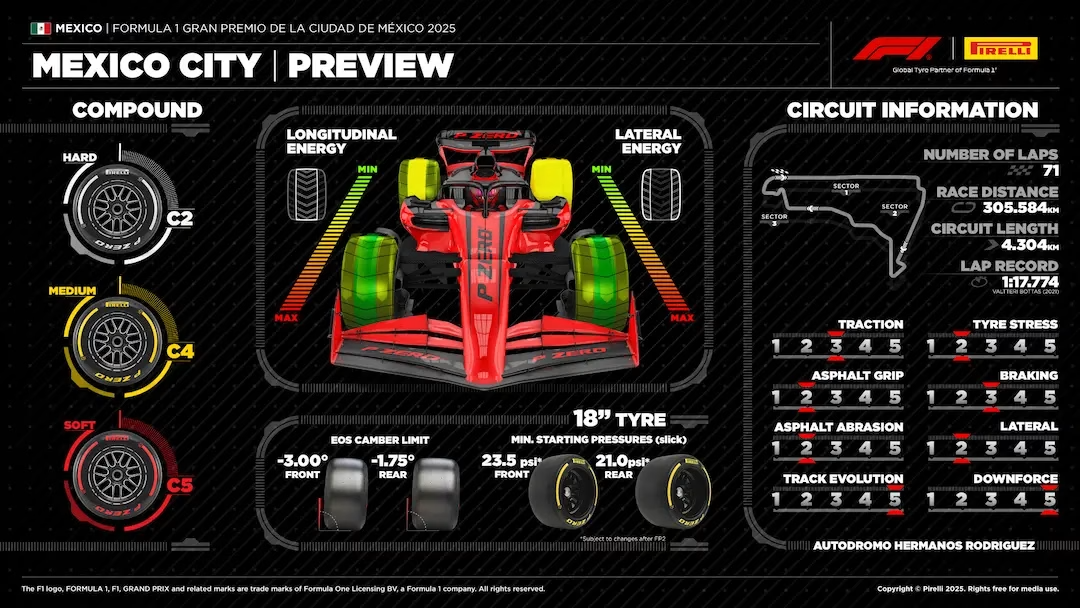
Race distance: 71 laps/189.9 miles
Pole time 2024: 1m15.946s (Carlos Sainz, Ferrari)
Winner 2024: Carlos Sainz, Ferrari
Pirelli tire allocation: Just like last weekend in Austin, there is another jump in the compound selection for the Mexican round between the hardest of the three and the medium. While the Medium and Soft are the C4 and C5 respectively, the Hard, as in 2024, will now be the C2. For the Mexico City circuit, this compound is an extremely conservative choice, offering a significant delta in lap time compared to the other two, while also offering less grip.
Last year the Soft was only in action in qualifying and then in the race, only in an attempt to secure the extra point for setting the fastest race lap, but now the scenario could change significantly. The advantage of the C4 and C5 could in fact lead to the teams aiming for a race held mainly on these links. However, this entails the risk that you may have to make a second pit stop due to relegation. Anyone opting for the C2 could manage a longer stint in relative comfort, with a one-stop on the way to the checkered flag, although this comes with a reduction in performance.
The use of the two softest compounds will certainly be carefully evaluated during the three free practices, during which teams can drive long stints with a full fuel load and check the condition of the tires. Historically, grain levels in Mexico have been quite pronounced because the thin air at high altitudes reduces the amount of aerodynamic downforce the cars can produce.
On a track that already offers little grip due to limited use, the tires tend to slide, leading to grain formation. It will also be interesting to see if the greater resistance to this phenomenon offered by current compounds will help limit it and therefore benefit those who are masters of tire management.
MEXICO CITY GRAND PRIX WEEKEND SCHEDULE (all times ET):
Friday October 24
2:25 PM – 3:30 PM – Free practice 1, ESPNU
5:55 PM – 7:00 PM – Free Practice 2, ESPNews
Saturday October 25
1:25 PM – 2:30 PM – Free practice 3, ESPNews
4:55 – 6:00 PM – Qualifying, ESPNews
Sunday October 26
4:00 PM – 6:00 PM – Grand Prix of Mexico City (71 laps or 120 minutes), ABC
#Tour #Mexico #City #Pato #OWard #RACER