

The real-world analog for the “Star Wars” Y-wing starfighter is less obvious than for other spacecraft in the series. The cockpits of the B-29 Superfortress clearly inspired the Millennium Falcon, and X-wings are basically Spitfires in space. Even many of the weapons in “Star Wars” are built around real weapons, like Han Solo’s blaster (Mauser C96) and the Empire’s Stormtrooper blaster rifle (Sterling Mk.4 submachine gun), and seeing them side by side makes this clear.
It may seem strange to find out which 70-year-old Earth plane is the basis for a spaceship in a galaxy far, far away. But don’t forget that “Star Wars” owes its existence as much to George Lucas’ love of World War II films as it does to science fiction films like Fritz Lang’s groundbreaking “Metropolis” and the work of Japanese director Akira Kurosawa. This is why the ships and blasters in “Star Wars” are often based on World War II and pre-World War II planes and guns, because those would have had the right aesthetic for the kind of story George Lucas wanted to tell.
If we go back from movie nerdery to airplane nerdery, the Republic P-47 Thunderbolt is the most likely candidate as the inspiration for the Y-wing starfighter. The P-47 was powered by a 2,400-hp Pratt & Whitney Double Wasp R-2800, which essentially stacked two nine-cylinder radial engines on top of each other to create the coolest, most insane-looking 18-cylinder engine this side of the strange Napier Deltic triangle-18. Another aircraft powered by this engine was the Grumman F6F Hellcat, which inspired Chrysler/Dodge’s Hellcat name.
At first glance, second glance, close inspection and a dismissive frown over the top of reading glasses, “Star Wars” Y-wings and P-47s look nothing alike. But just as the Spitfire influenced the agile X-wing, the inspiration lies more in purpose than form.
Why Y-Wing? Why not Y-Wing!
P-47s featured bulletproof glass and thick armor to protect pilots. Fuel tanks were self-sealing thanks to rubber layers that would swell and seal holes once they came into contact with gasoline. Y-wings use an alusteel fuselage reinforced with titanium and a Chempat deflector shield generator. Backup batteries, redundant life support systems and ample freshwater storage ensure pilots survive time-consuming long-range missions and extensive combat damage.
And they’re both armed to the teeth. The P-47 is a damn heavy aircraft that can weigh up to 17,500 pounds in total! By contrast, the Spitfire max was a relatively breezy 6,418 pounds. But then the Thunderbolt was loaded with 3,400 rounds for its eight .50-caliber Browning machine guns and up to 2,500 pounds of rockets, napalm or bombs. Think of it this way: Thunderbolts are single-seat fighters that can deliver half the payload of a B-17 Flying Fortress. Republic also tried fast, more responsive aircraft, but that effort unfortunately resulted in the “Spın̈al Tap”-loud, attack-inducing XF-84H “Thunderscreech” experimental fighter.
Weapons for Y-wings include KX5 or IX4 laser cannons (I wouldn’t have it any other way, of course), which can easily punch through the hulls of battle cruisers. A rotating turret with SW-4 or SW-5 ion cannons is mounted above the cockpit (depending on model) and can be controlled remotely by a gunner or the pilot. Two MG7 proton torpedo launchers fire from six-round magazines and additional ammunition can be mounted on the hull if required.
A bolt of lightning, very frightening
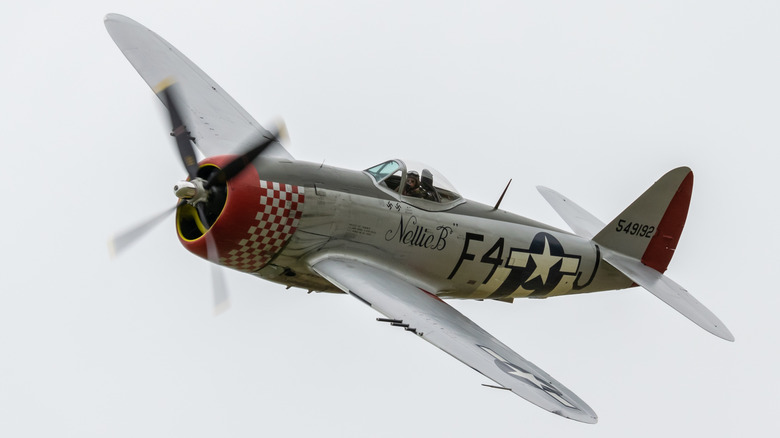
And each had the fat trimmed away. Although both the P-47 Thunderbolt and the Y-Wing starfighter were heavily armored, that did not stop efforts to make them lighter and less sensitive to inertia, keeping them on existing trajectories. In other words, they maneuvered with the ease of a cruise ship without a rudder. To make the Thunderbolt more powerful, Republic redesigned the aircraft from the ground up, increasing engine power with larger turbos, removing two .50-caliber machine guns, reducing the amount of ammunition, removing the rear fuel tank, and discarding the radio equipment. This new version was called the XP-47J Superbolt.
The weight loss for the Y-wing was similar. Proton torpedo launcher magazines went from six to four rounds, the fuel recovery system was discarded, and the pylons supporting the engines were shortened. Removing the armor plating over the cooling system probably also significantly reduced weight, but this was done to make maintenance of the cooling system easier. And because it’s a fictional ship from a science fiction story, the engineers just added power to the deflector shields.
So there, World War II enthusiasts, this space opera is for you! Your next step is to make a “Star Wars” art car and visit conventions. Don’t look so frowny; dressing up as Darth Vader would be awesome, and you know it.
#World #War #fighter #plane #inspired #YWing #Starfighter #Star #Wars #Jalopnik