

JEKYLL ISLAND, GEORGIA | The Old Man’s last golf course has been brought back to life by two young architects along the ocean dunes of the Georgia coast.
The separate design teams of Brian Ross and Jeff Stein collaborated on a project to restore and expand the remaining nine holes of Walter Travis’ nearly century-old Great Dunes Course with nine redesigned holes inspired by the Old Man’s work at Jekyll Island Golf Club.
The result of their meticulous and inventive work will reopen to the public on November 1.
“Brian, Jeff and the Jekyll Island Authority have renewed and reinvigorated that spirit with this restoration and renovation, bringing Travis back to life in the dunes and forest with the mission of promoting and preserving Travis’ legacy,” said Kevin Murphy, chairman of the executive committee of the Walter J. Travis Society.
Travis was a native Australian but a naturalized American citizen after moving to the United States for work at the age of 23 and marrying an American. He started playing golf in 1896, when he was almost 35, and regretted all the years he had spent away from the game in his life. His colleagues called him “the old man” because of his late start in the competition, but the old man quickly overtook him and became the best amateur champion in the country.

Travis won the US Amateur in 1900, 1901 and 1903 and finished second at the 1902 US Open, claiming five low amateur honors in six career starts. In 1904, he became the first American to win the British Amateur in his only start across the pond.
As a journalist, Travis founded The American golfer before handing over the game’s premier magazine to Grantland Rice. As an architect, he had strong views on strategic design and incorporated them into his work in places such as Garden City (New York), Ekwanok (Vermont) and Canoe Brook (New Jersey). His influence was evident on some of America’s greatest golf courses in consultation with fellow architects CB Macdonald (National Golf Links), Donald Ross (Pinehurst No. 2) and George Crump (Pine Valley).

The Great Dunes of Jekyll Island turned out to be the Old Man’s final project. The island was a private winter playground for families with names like Rockefeller, Vanderbilt, Morgan and Pulitzer. The wealthy club members had been golfing at Jekyll since 1899, but they invited Travis to take a look and commissioned him to demolish what was left and build a proper 18-hole links course, right along the dunes and beach.
Travis designed Great Dunes, but he died in 1927 before the course was completed and officially opened in 1928 – a year before the stock market crash began leading to its almost immediate neglect and eventual closure in 1942. Exposure to the ocean and wind left the nine beachside holes vulnerable to storms and erosion that reclaimed them. The state of Georgia acquired the island in 1947 and reopened the remaining nine holes to the public in 1948 as the Jekyll Island Golf Course, where a round cost just $1.
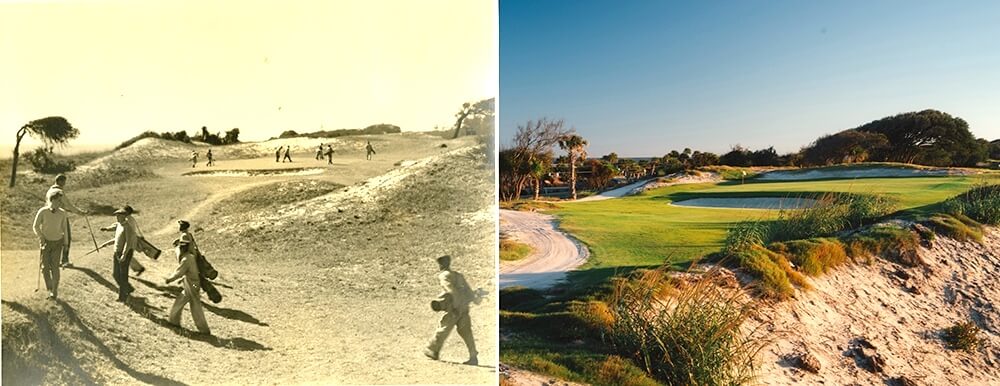
Those original nine survived, but over the years its Travis features were gradually shrouded and buried under a century of overgrowth.
The Travis-inspired journey that Ross and Stein take you from the maritime forest to the ocean and back finds its way on the par-3 third hole, with a green terrain that stands out like an island surrounded by sand with contours inspired by Travis’ unique 12th hole in Garden City.
Uncovering the original Travis Nine and expanding it to 18 holes using half of the adjacent Oleander course, built in 1963 by Dick Wilson, was an exercise in forensics and imaginative design by the team of Ross and Stein. They sifted through archival footage of the course and studied Travis’ articles and other projects to not only restore the rugged coastal features of the original Great Dunes Nine, but also incorporate Travis elements from the lost holes and elsewhere to blend the dune landscape with the wooded coastal area of the Oleander site.
The first three holes have been rebuilt with some Gilded Age-era elements installed on the former Oleander, such as the three bunkers in the left corner at No. 2 retrieved from archival photos of the lost 15th hole on the original Great Dunes.
The Travis-inspired journey that Ross and Stein take you from the maritime forest to the ocean and back finds its way on the par-3 third hole, with a green terrain that stands out like an island surrounded by sand with contours inspired by Travis’ unique 12th hole in Garden City.
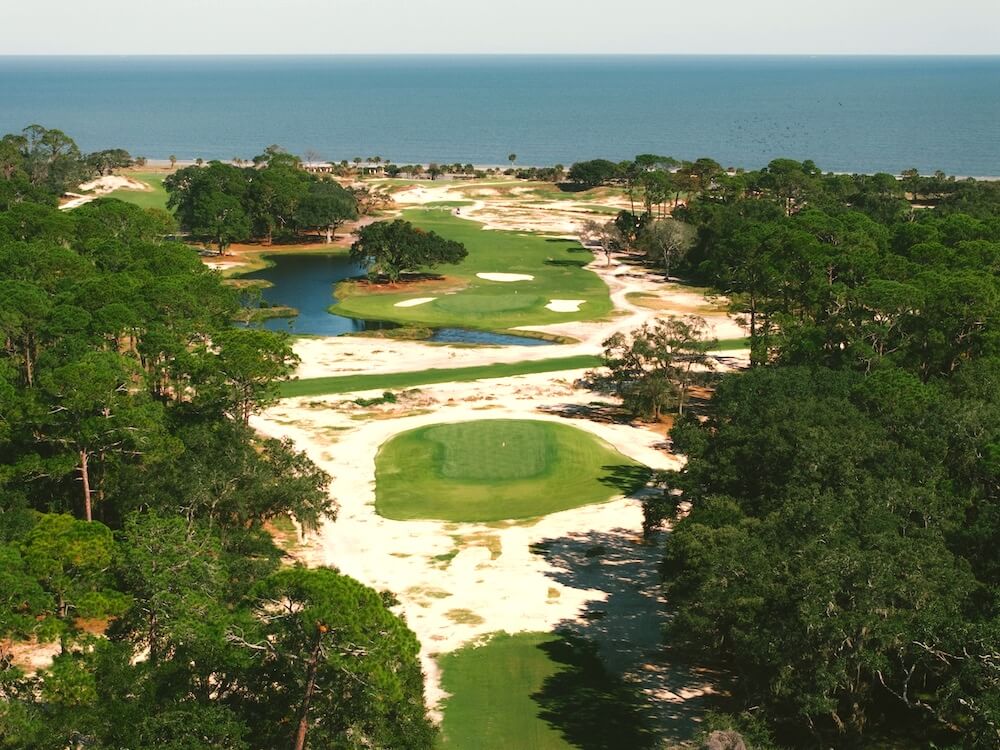
They completely removed a thick wall of pines, vines and palms behind the third wall that separated the Oleander from the Great Dunes, creating a previously non-existent view all the way to the horizon that serves as a transition to the restored Travis Holes (now Nos. 4-12).
“How are you going to get the two different golf courses, one from the 1920s and one from the 1960s, and make them work?” said Ross of Jekyll Island’s main concerns. “This was a really crucial point in that process: having the eyes follow all the way to the dunes and also bringing them a little bit closer by emulating Travis’ style here on the green. I believe we created a seamless connection between the two.”
There is no better introduction to the Travis holes than the par-5 fourth – which in the less politically correct 1920s was called ‘Mae West’ because of the two large dunes that flank the entrance to the elevated green overlooking the Atlantic Ocean. It takes a daring man to go for the narrow stretch of gap between the dunes and not lie down to drive a wedge.

The architects excavated the organic structure to its original quality and rebuilt it all the way to the original corners based on archive photos.
From there, the Great Dunes experience continues with nine holes as the centerpiece, with a cozy par-3 fifth parallel to Beachview Drive. The par-4 sixth and 12th share adjacent tees overlooking the sandy bottom. After the long par-3 seventh in a prevailing wind, the par-5 eighth reaches all the way to the southeast corner, where the green is hidden by a dune ridge that cuts diagonally, making it reachable with a well-placed approach that can tumble over the top of the ridge.
The green at the dogleg 10th is tucked into the dunes with a wooden plank bridge recreated above the green that looks exactly like the original that goes to the back 11th tee. The short par-4 11th offers a tempting challenge to go for another green, sitting on the dunes, with problems lurking long and left.
From 13 inwards lies the rest of the redesigned Oleander course, which includes the maritime forest and several lakes. The green on the par-5 13th that curves around a freshwater lake has been inventively recreated from one of the lost Travis greens that now sits somewhere below the beachfront Holiday Inn Resort.
Overall, the new Great Dunes offers a good mix of holes with a few short par-4s, reachable and unreachable par-5s and a wide range of par-3s.
Great Dunes is the only golf course in Georgia to utilize a brackish water irrigation system, a groundbreaking sustainability feature that reduces reliance on freshwater, reduces chemical use and minimizes environmental impact with salt-tolerant coastal paspalum grass. The architects removed more than 30 hectares of grass on the site to not only improve the sandy features below, but also to further reduce water consumption. The remaining 52 hectares on the former Oleander track will be converted into a conservation area that will become a wildlife corridor connecting habitats from the marsh to the ocean side of the island and providing public nature trails.
Along with the newly renovated Pine Lakes ($95 including cart) and Indian Mound ($75) courses, the reopened Great Dunes ($135) Jekyll Island Golf Club offers 54 holes of quality golf available year-round to residents and visitors at affordable prices, making it one of the largest public golf course operations in the Southeast. Great Dunes is one of only three Travis courses that are publicly accessible – along with Grover Cleveland (Buffalo, New York) and Grand Mere (Quebec, Canada) – and stands alone as the only one that has been restored.
“Because it’s a state park, they want it to be affordable,” Stein said. “The public access is so important, but so is the price. Pebble Beach and Kiawah are public, but not at this price point. We would like to see it remain at a level that supports what we’ve built.”

It’s an impressive team effort from Ross and Stein, who merged their separate formative experiences at places like Oregon’s Bandon Trails (Ross) and Georgia’s Ohoopee Match Club (Stein) into a successful effort to reinvent Travis’ legacy at Jekyll.
“We were the strongest bid because of the amount of attention we paid to Travis’ history and bringing the inspired nine into the Great Dunes Nine,” said Stein, who said he and Ross independently created the same route plan, which made sense because the same nine Dick Wilson holes of the Oleander were originally often combined with the Great Dunes.
“It was actually always the intention,” says Ross.
The old man would be happy.
Above: An aerial view of Great Dunes on Jekyll Island, which opens to the public after a reinvention on Saturday. Photos Austin Kaseman, courtesy of Jekyll Island Resort
© 2025 Global Golf Post LLC
#work #Man #merges #modern #times #Jekyll #Island