
The ‘Super-K’ flu variant is spreading in Australia. This is what makes it ‘unusual’

The ‘Super-K’ flu variant is spreading in Australia. This is what makes it ‘unusual’

3 minutes, 57 seconds Read

A new flu strain known as ‘Super-K’, or the subclade K variant, could be responsible for an unusual spring and summer boost in flu cases, epidemiologists say.
“The unusual thing here for Australia is the timing,” Patrick Reading, director of the WHO Collaborating Center for Reference and Research on Influenza, told SBS News.
“The not unusual thing is probably the symptoms,” he said.
Reading recalls that the subclade K variant emerged in Australia and New Zealand towards the end of the typical flu season, circulating in September rather than the winter months.
“That was responsible for the increased flu cases throughout the spring and actually during the beginning of our summer in December.”
According to the Global Initiative on Sharing All Influenza Data (GISAID), the total number of laboratory-confirmed cases of subclade-K in Australia to date currently stands at 1,083.
A new report from the Australian Center for Disease Control (ACDC) states that the rapid spread of subclade K has the potential to place increased pressure on Australian healthcare services during the summer and 2026 flu season.

“Current flu case numbers are higher than normal for this time of year compared to previous seasons,” an ACDC spokesperson said.

So far this year, more than 4,100 flu cases have been confirmed by laboratories, with the actual number of flu cases likely to be higher.

By comparison, an average of about 3,300 cases were confirmed weekly in the first quarter of last year.

What caused the subclade K flu variant?

“Every few decades a flu virus can undergo a much larger genetic change called an antigenic shift that can lead to a pandemic, but this is not what happened with super-K,” said University of South Australia epidemiology professor Adrian Esterman.
“Instead, super-K is best understood as a derivative version of the well-known H3N2 virus, with enough changes to allow it to spread more widely among populations with existing immunity.”
The ACDC report notes that Australian subclade K viruses may have originated or been imported from the US, following detections in the US in June and July last year.
Reading said there is currently no evidence the variant is more serious than regular flu. What experts see, however, is that it is easily transmitted.
“It looks like it will probably have the ability to be at least slightly less sensitive to antibody- or vaccine-mediated protection,” he said.
Professor Catherine Bennett, professor of epidemiology from Deakin University, told SBS News: “This new subvariant of the H3N2 is slightly more immune-evasive with these latest mutations in the part of the virus that allows it to enter our cells, making us more susceptible.”

Bennett said the 2025 flu vaccine included H3N2, but not this specific class.

“The effectiveness of flu vaccines is waning, so people who were vaccinated in April and May and are only now becoming infected will no longer have the same benefit,” she said.
However, the 2026 flu vaccine for the Southern Hemisphere has already been updated to include this variant and will likely be available around April, Bennett said.
Esterman said the flu vaccine remains worthwhile and provides important protection.

“It still significantly reduces the risk of serious disease.”

What does a typical flu season look like in Australia?

“When we get seasonal flu every year in Australia or anywhere else, it’s a combination of three viruses,” Reading says.
There are two influenza A viruses – an H3N2 and H1N1 – and one influenza B virus.

According to the Australian Center for Disease Control, there were 365,261 reports of influenza in 2024. The number of cases peaked between May and August, and dropped dramatically after the winter.
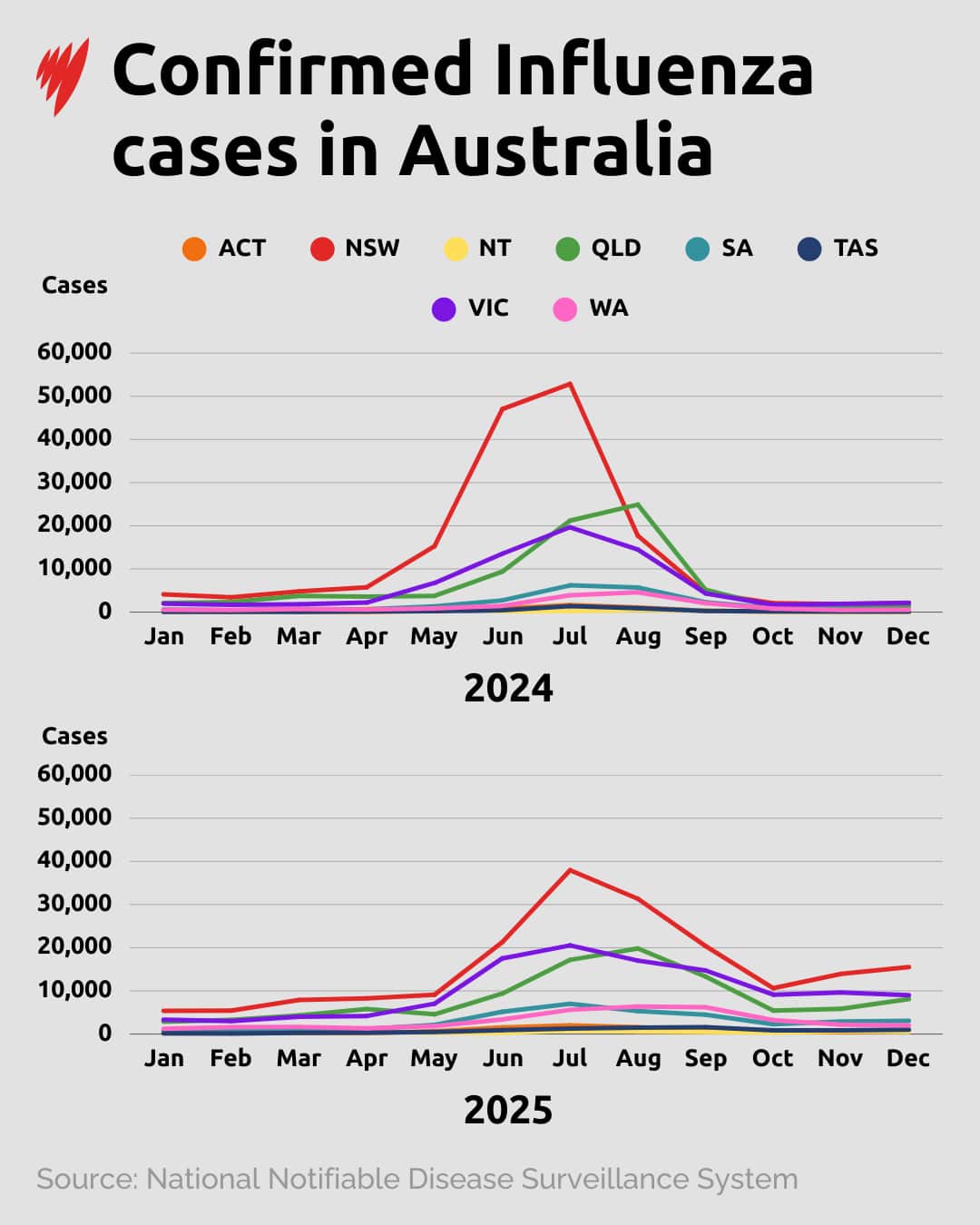
Two line graphs showing the number of flu cases in 2024 and 2025

“As we get into spring, flu generally comes down in Australia, and then flu is very low in the summer,” Reading says.

Last year there were 502,493 reports of flu, with cases clearly continuing after the winter months and into the end of the year.
According to GISAID, H3N2 subclade-K is the cause of an estimated 90 percent of cases in the United States.

“What we saw around September [in Australia] As of now, the number of H1N1 and B viruses has decreased, but we saw an increase in the number of H3N2 viruses,” Reading said.

How can I prevent myself from getting the flu?

“People who are not feeling well should consider getting tested and should avoid contact with other people as much as possible,” Bennett said.

“Keep homes well ventilated, hold gatherings outdoors if possible and wear a mask in crowded indoor public spaces if they are susceptible to more serious respiratory infections.”
NSW Health recommends getting the flu vaccine annually and practicing good hand hygiene – including hand washing.

#SuperK #flu #variant #spreading #Australia #unusual

Similar Posts

Leave a Reply

Your email address will not be published. Required fields are marked *