

Modern décor, greater accessibility and new storytelling technologies enhance the renovated venue, which will be open to the public from tomorrow, December 20.
The works, arranged in the rooms according to a chronological criterion, are protected by anti-seismic and anti-vibration systems.
“The return of the National Museum of Abruzzo to the sixteenth-century castle of L’Aquila – said the General Director of Museums Massimo Osanna – represents not only the return of a museum to its historic location, but the concrete sign of a reconstruction process that has put heritage at its center as a public good, an instrument of knowledge and a factor of cohesion for the community”. The National Museum of Abruzzo, which, as director Federica Zalabra underlined, “will once again be a museum in step with the times, in dialogue with the community and with international research”, has been housed in the sixteenth-century castle since its inauguration on September 23, 1951, after the city and the artists of L’Aquila opposed the transformation of the fortress into a prison and its use as a museum after the Second World War. Its closure was decreed by the 2009 earthquake, which caused serious damage to the castle, with the collapse of the second floor and heavy damage to the upper floors. In the meantime, since December 19, 2015, MUNDA has found a home in the spaces of the former Borgo Rivera slaughterhouse, within the historic walls.
Munda – National Museum of Abruzzo, Loggiato | Photo: © Marco Giugliarelli
Today’s inauguration is the first phase of an organic project that covers the entire castle.
The part of the spaces returned to MUNDA now houses three rooms dedicated to an introductory course with the history of the city of L’Aquila, the castle and the museum. An educational area for younger visitors will be added. The tour of the ground floor ends with a visit to the eastern bastion of the building where the fossil skeleton of Mammuthus Meridionalis is kept, found in March 1954 in the municipality of Scoppito, near L’Aquila. On the first floor, the route continues with a journey into the artistic production of Abruzzo between the 9th and 13th centuries through stone sculptures, Marian tables and ancient iconography. There is therefore room for Gothic tabernacles and late Gothic in Abruzzo, with polyptychs and richly decorated works. The highlight of the story is one of the rooms dedicated to the Renaissance, which illustrate the evolution of the local visual language: from Andrea Delitio to the Master of San Giovanni da Capestrano, to Saturnino Gatti, Cola dell’Amatrice and Francesco da Montereale, real protagonists of a modern Abruzzo Renaissance. The archaeological part, the works from the seventeenth century to contemporary art, will instead be arranged gradually, according to an already defined museum project that foresees the delivery and preparation of the second floor by the end of 2027. Finds from the archaeological collection that the public can admire include the Calendar of Amiternum, a slab from the early 1st century AD, composed of several fragments, and then the Herm of Hercules, probably placed at the entrance to the Theater.
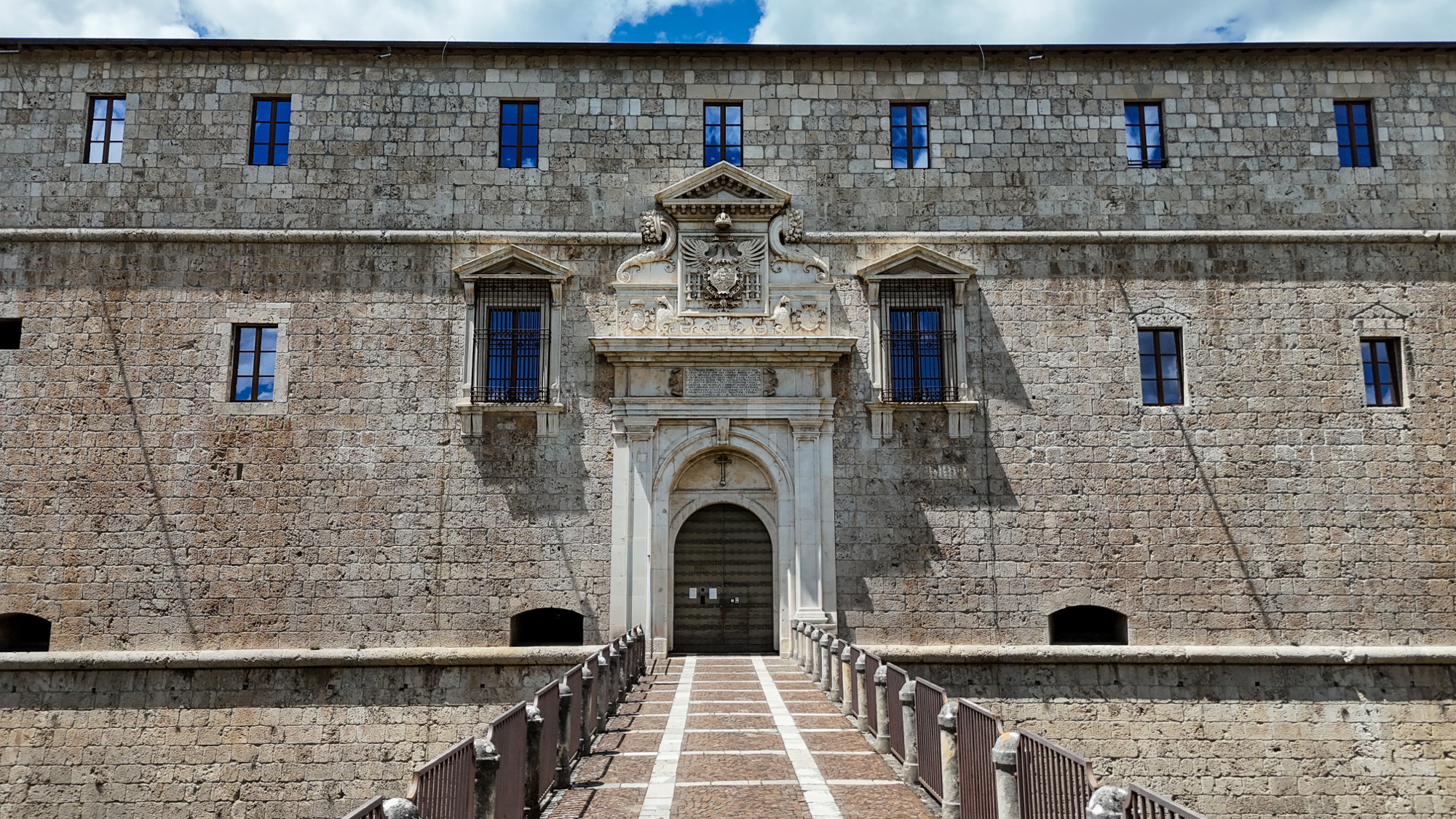
Munda – National Museum of Abruzzo, sixteenth century castle | Photo: © Marco Giugliarelli
In this local museum (more than 99% of the works come from Abruzzo), created for “the rescue of the remaining heritage” of the region and to protect masterpieces otherwise exposed to dispersal and theft, there is room for recent acquisitions, such as the Dragonetti de Torres triptych by Antoniazzo Romano and his studio, returned to L’Aquila after the dispersal of the historic family collection or the large panel of the Master of the Beffi triptych, the Dormitio Virginis, a high artistic expression of Abruzzo from the late fourteenth century. There is no shortage of works that have arrived from national institutions in multi-year storage, such as a wooden Madonna and Child from Castel Sant’Angelo.
In fact, the project is not limited to returning the works to the castle, but to reconsidering them in the light of the most current research and the impressive protection and restoration works carried out over the years.
#National #Museum #Abruzzo #returns #home #elements #exhibition #sixteenthcentury #castle #LAquila #LAquila #Arte.it