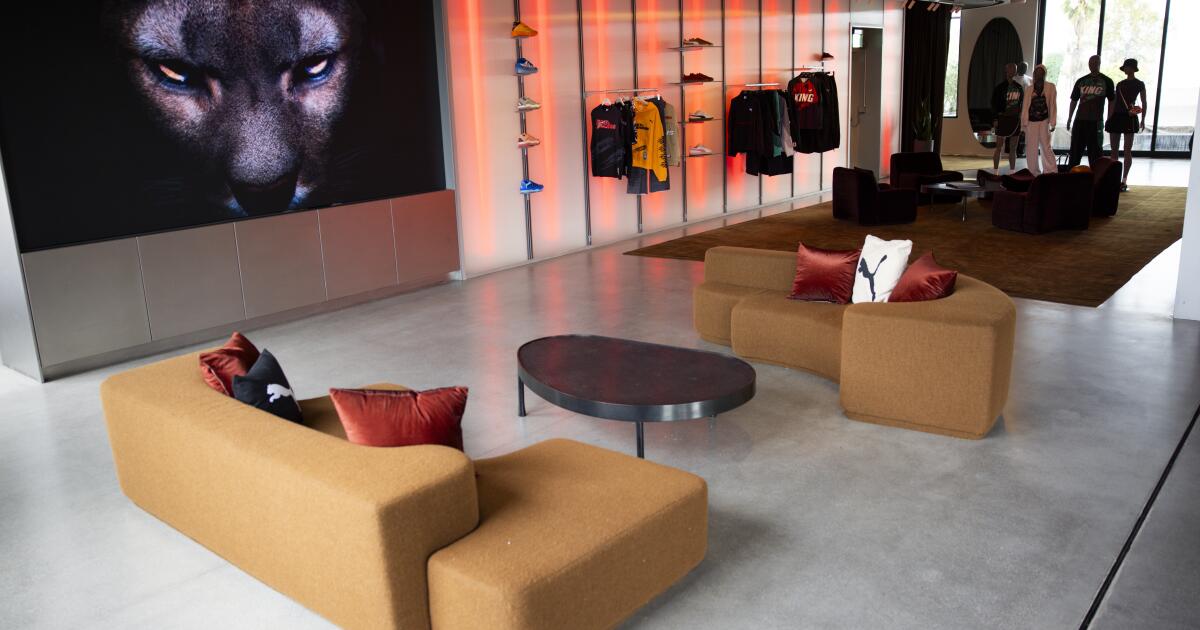

To capitalize on the endless stream of stars and influencers passing through Los Angeles, a growing number of companies are building fun corners where content creators can try out products and make short videos. Athletic apparel maker Puma, Kim Kardashian’s Skims and cheeky cosmetics retailer Elf have spaces specifically designed to give people a place to experience and broadcast about their brands.
Hollywood, which hasn’t traditionally been home to apparel companies, is now attracting the offices of fashion retailers, says CIM Group, one of the area’s largest commercial real estate landlords.
“When we tour a space, one of the first things they bring up is, ‘Where can I build a studio?’” says Blake Eckert, who leases CIM offices in LA.
Their studio offices also serve as marketing centers, with showrooms and meeting rooms where brands can host in-house events that are not open to the public.
“For companies where brand visibility is very important, there is a trend to create spaces that don’t just function as offices,” says real estate agent Nicole Mahalka of CBRE, who coordinates the leasing and sale of entertainment real estate.
Puma’s global entertainment marketing team is based in the new Hollywood office, working with musical celebrity partners such as Rihanna, ASAP Rocky, Dua Lipa, Skepta and Rosesays Allyssa Rapp, head of Puma Studio LA
(Kayla Bartkowski / Los Angeles Times)
Hollywood is a central location, she said, for meetings with celebrities, stylists and outside designers, most of whom are based in Los Angeles.
The office is a “creation center,” she said, where influencers can capture Puma’s design prototyping lab, supported by libraries of materials and equipment used to make Puma clothing. Founded in 1948, the company is known for its emblematic sneakers such as the Speedcat and its bold feline logo, and makes sportswear, accessories and equipment.
Puma’s entertainment marketing team is also based in the office and sometimes uses it for exclusive events.
“We use the space as a showroom, as a social space that transforms from a traditional workplace to a more experiential space,” says Rapp.
Non-traditional applications include content creation, sit-down dinners, product launches, album listening parties, and workshops.
“Inviting people into our space and being able to give them high-touch brand experiences is something tangible and important to them,” she said. “The cultural layer is very important to us.”
The company has a closet full of Puma products ready for VIP guests. However, visits to the studio sanctuary are by invitation only. There is no retail portal to the exclusive Hollywood offices.

Puma shoes are on display at the Puma Studio LA
(Kayla Bartkowski / Los Angeles Times)
Puma is also positioning its LA studio as a connection point for major upcoming sporting events coming to Los Angeles, including this summer’s World Cup, the 2027 Super Bowl and the 2028 Olympics.
Office studios don’t have to be big to have an impact, Mahalka said. “These are smaller stages, closer to a green screen than a huge soundstage.”
Social media is the main driving force behind the content created by most companies. They can set up small booth-like stages where influencers can promote popular products while offering discounts to people who watch them perform.
Larger, elevated stages host multiple performers for extended discussions for small audiences, with towering screens behind them to set the mood or illustrate products.
One of the defrauded offices, she said, is Skims. The company, that is valued at $5 billionis located in a glass and steel office building near the legendary intersection of Hollywood Boulevard and Vine Street.
The fashion retailer declined to comment on the use of the studio at its headquarters, but according to architectural firm OdaaIt features open and private offices, meeting rooms, collaboration zones, photo studios, sample libraries, prototype showrooms, an executive lounge and a 400-person commissary.

Pieces of a shoe lie on a workbench in Puma Studio LA
(Kayla Bartkowski / Los Angeles Times)
The brands that build studios typically want to find the darkest spot in the building to put their content creation or podcast rooms, Eckert said, where they can limit outside light and noise. This is usually in the middle of the office floor, far from windows and close to permanent partition walls that limit noise intrusion.
They also need space for green spaces and restrooms dedicated to the talent.
Spotify recently built a chic podcast studio in a CIM office building on trendy Sycamore Avenue that is by invitation only to creators in Spotify’s partner program.
“Ambitious shows need spaces that support big ideas,” Bill Simmons, head of strategy at Spotify, said in a statement. “These studios give teams the space to experiment and keep pushing what’s possible.”
#latest #trend #office #space #inhouse #studios #traveling #influencers