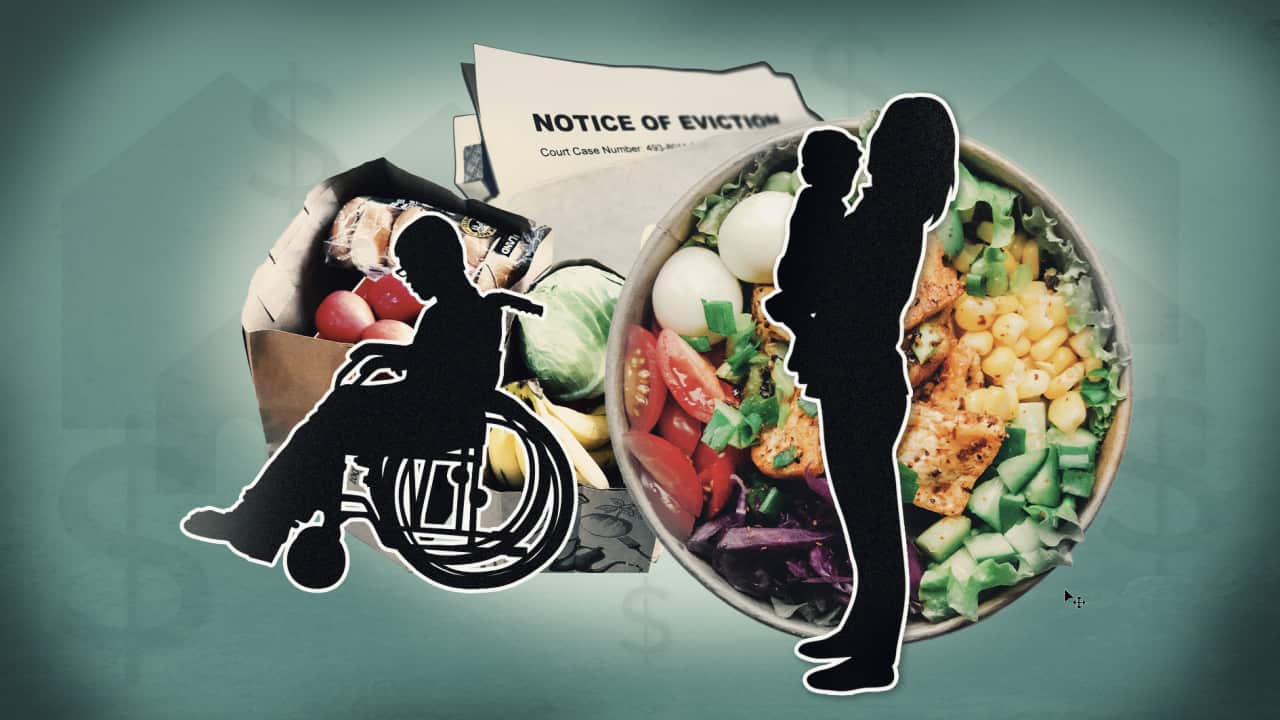
The ‘insidious problem’ means Australians like Jessica are ‘lucky’ if they eat twice a day

The ‘insidious problem’ means Australians like Jessica are ‘lucky’ if they eat twice a day

5 minutes, 7 seconds Read

One in three Australian households have not eaten for entire days or compromised on meal choices in the past 12 months, according to a report released on Wednesday.
Data from food aid organization Foodbank shows that food insecurity has worsened compared to 2024, leaving 3.5 million families facing hardships that are “not getting better.”
Food Bank Australia CEO Kylea Tink said the “reality for families” is worsening, despite targeted government support such as one-off energy rebates.
“Families skip meals, or they only feed certain members of the family at certain meals, or in the worst cases, they go entire days without eating,” she told SBS News.

“The real concern for us here is that with this data cumulatively, we now see that this is a systemic endemic problem that is not getting better, and that is why we are really calling on the federal government to come to the table and work with us to solve the problem.”

More and more tenants are skipping meals

According to the report, renters are one of the most likely groups to experience food insecurity. Last year, one in two renting households was affected by this.

Jessica Menace has been a tenant for five years and told SBS News that “the costs are getting worse and worse”.
“I left home at the age of 17 when I ran away from home due to safety concerns. Part of me now wishes I could go back and stay home as long as possible,” she said.
“I would say to myself, ‘Stay around, it’s going to be very expensive. We’re going to have a rental crisis’. The rental system just doesn’t work well.”
The 22-year-old studies full-time in Canberra and has Youth Allowance, a government scheme that supports full-time students aged 18 to 24. She receives just under $900 every two weeks.

She pays $1,000 every two weeks in rent and works to close the gap.
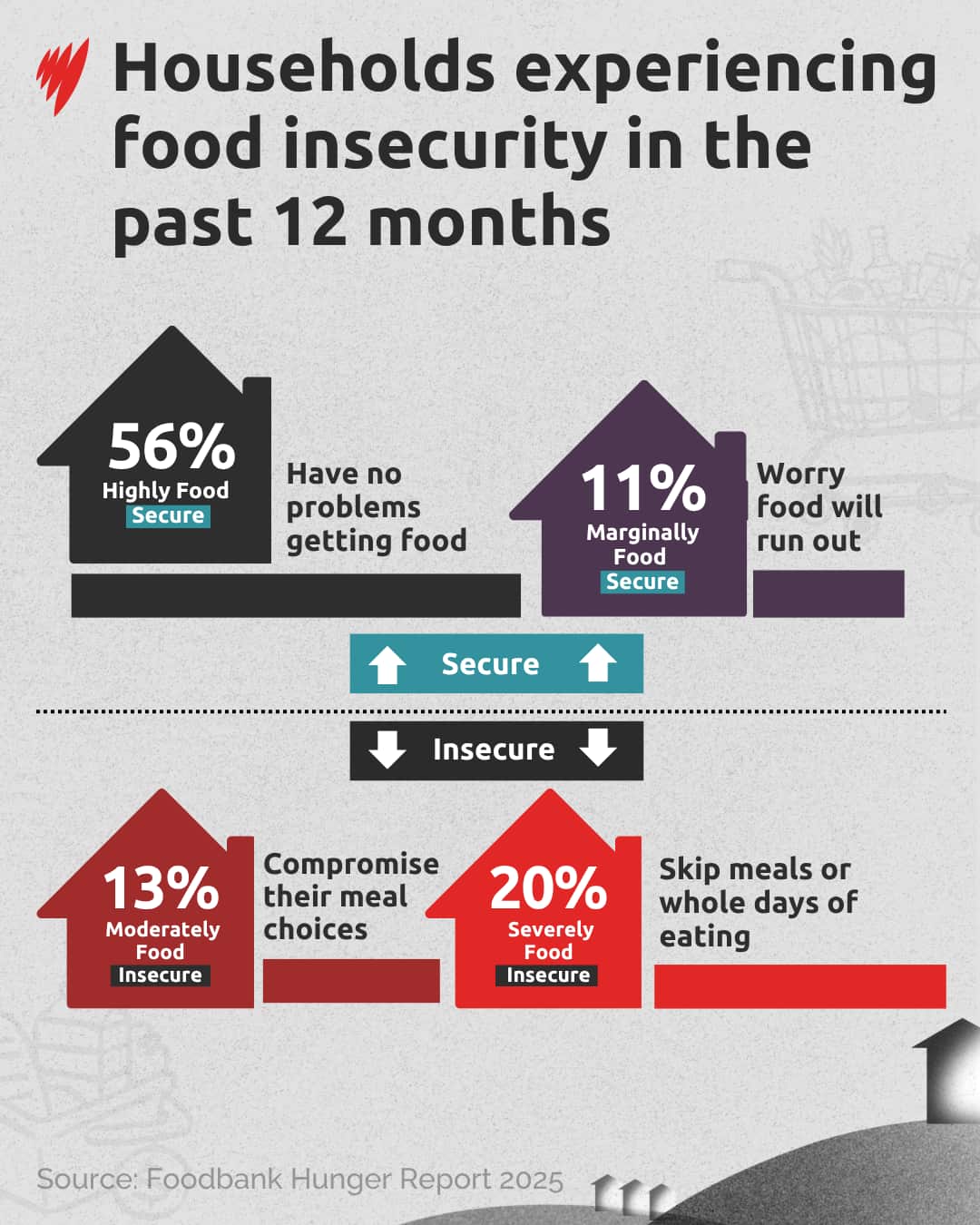
A graph on how households experienced food insecurity

Source: SBS news

When she can’t make up the difference, she shops at the food bank, but even the heavily subsidized food can be out of reach.

“It’s normal now to cut meals,” she said.

“I usually have maybe two meals a day if I’m lucky, or one.”
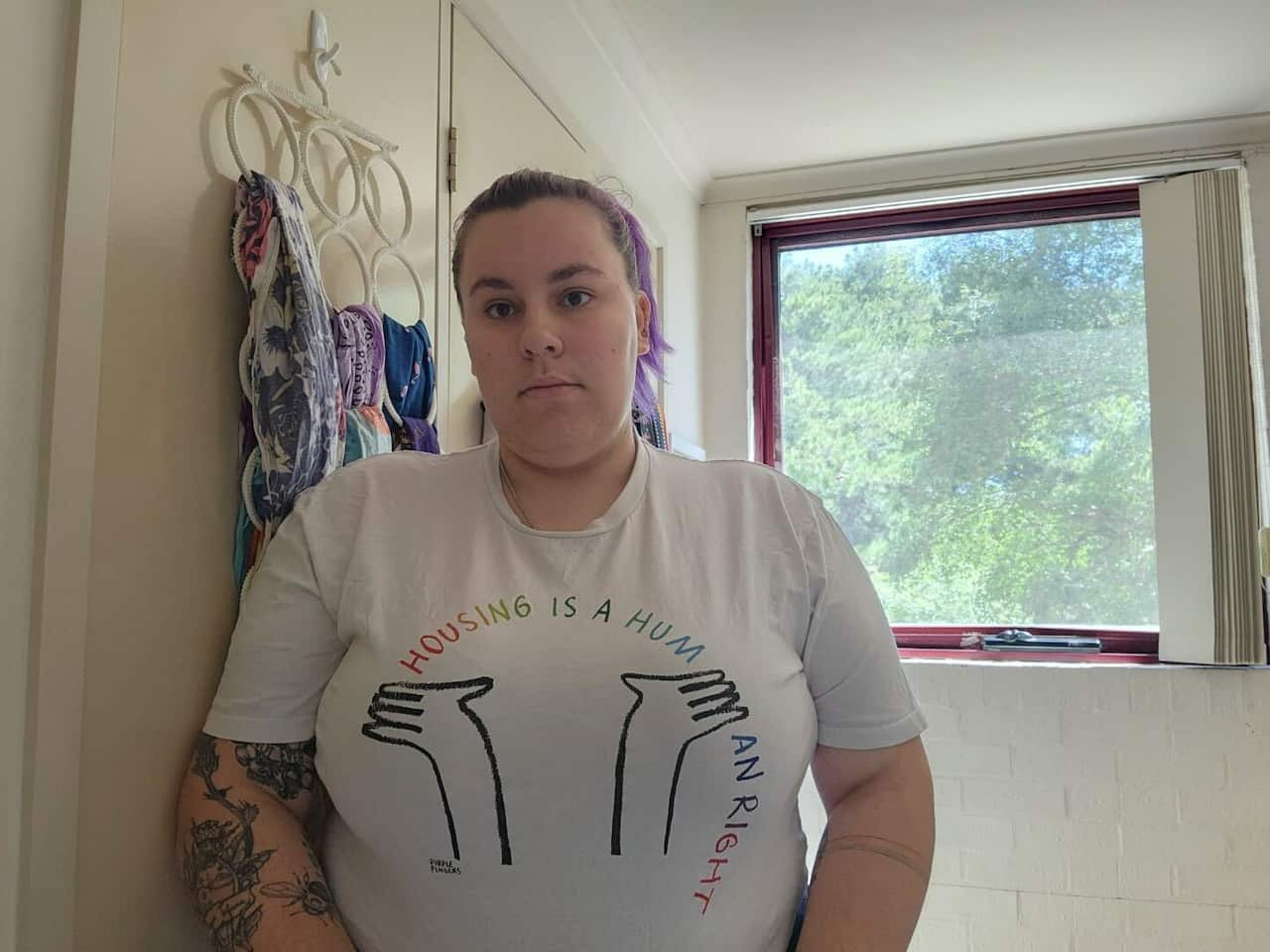
A woman wearing a t-shirt looks at the camera

Jessica Menace says “the costs are getting worse.” Source: SBS news / Delivered

On a good week, Jessica said she goes to a discount grocery store to buy ground beef and prepare meals for the week. But often she cannot afford meat, fresh fruit and groceries and opts for cheap microwave meals.

“You need variety in your diet and I don’t understand that,” she said.

“And I don’t really see that happening in the near future unless they drastically increase the youth allowance and all the other payments. I just can’t afford that kind of food.”

Damage from poor nutrition

Emeritus Professor Amanda Lee from the University of Queensland’s School of Public Health told SBS News that poor nutrition has detrimental health effects.
She explained that junk food is typically cheaper than groceries, forcing financially challenged households to purchase more processed and unhealthy foods.
“In households struggling to make ends meet, you often have mothers who have to go without food to try to improve their children’s diets, and that means their future children may be at risk in terms of nutrient intake during pregnancy,” she said.
“It really is a very insidious and surprisingly common problem in a country like Australia.”

Lee said lower socioeconomic households and single-parent families tend to experience some of the worst health outcomes.

This decline in diet quality can lead to or worsen chronic diseases.
“People who cannot afford healthy staple foods often rely on the cheaper options that are very energy-dense, so obesity becomes a problem,” Lee said.
“But it really is a terrible form of malnutrition because there is a double whammy of the chronic diseases associated with obesity and poor health.”
She said advertising also plays a role in the overconsumption of unhealthy foods.
“In our society, the foods that are most available, advertised and affordable are often the foods with very limited nutrient gains,” she said.

“It really encourages people to spend more on the least healthy things.”

Other vulnerable groups

The Food Bank report also identified other groups vulnerable to food insecurity.
The survey found that 67 percent of households with someone with a disability or health condition had experienced food insecurity in the past 12 months.

Meanwhile, 68 percent of single-parent households are now food insecure.
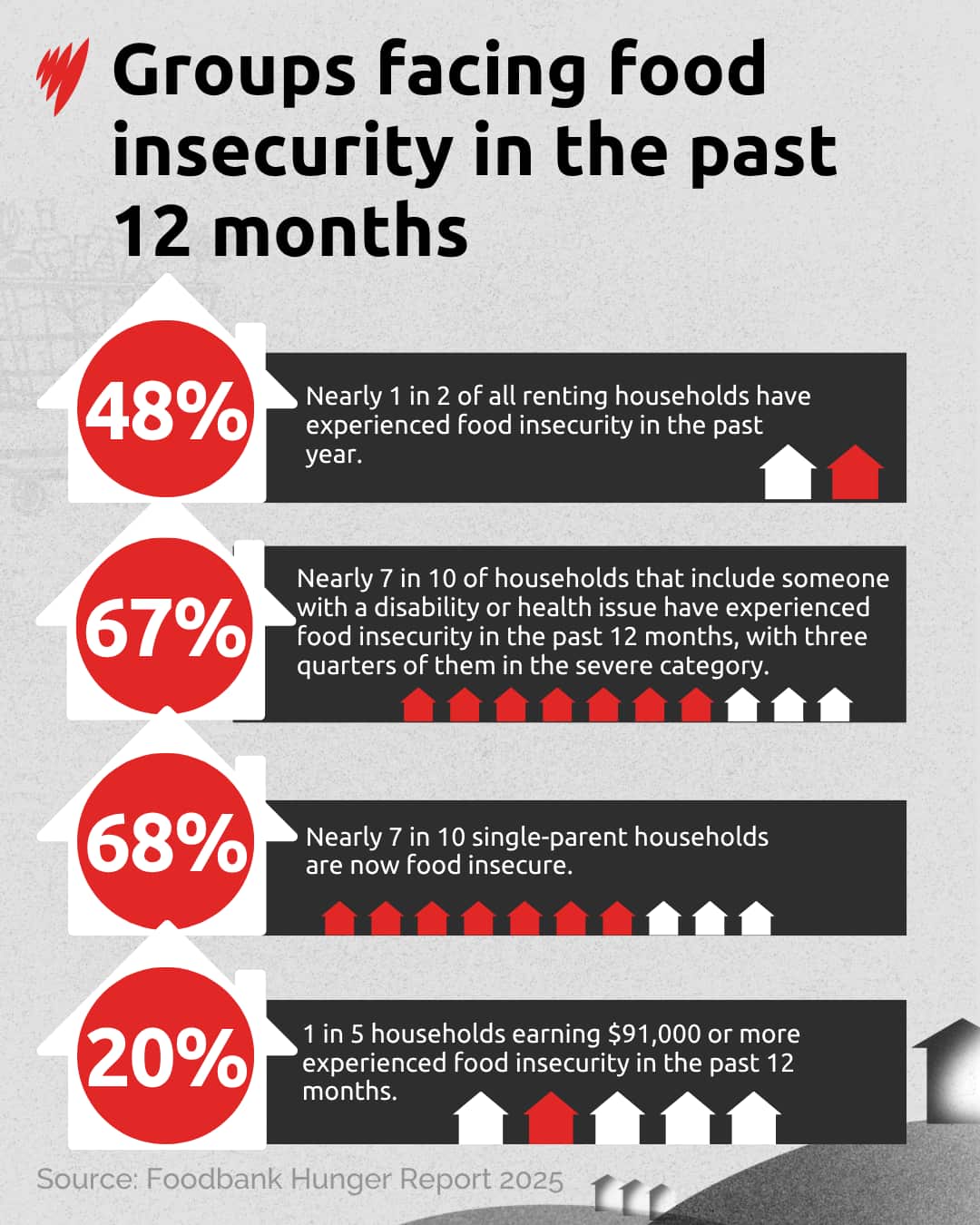
A graph showing different groups facing food insecurity

Source: SBS news

Overall, one in five households earning $91,000 or more experience food insecurity.

Tink said there may be intersections between these more at-risk groups, which could put households at a further disadvantage.

At the same time, according to the Food Bank, an estimated 7.6 million tons of food is wasted annually, costing the economy more than $36.6 billion annually.

Is a new tax the solution?

The Food Bank supports a National Food Donation Tax Incentive, which would change tax laws to encourage small and medium food producers to donate surplus food.

Tink explained that the proposed tax incentive would provide a cash back or tax credit to businesses, such as farmers or growers, based on the costs incurred when donating food.

Similar models exist in the United States, Canada and France.
“For many food producers, it is cheaper to bury the excess food or send it to the landfill than to send it to charities and donate it,” she says.
“We are asking the government to give these types of companies a tax break, allowing them to claim a small tax deduction at the end of the year to offset those extra costs.”
Australian Food and Grocery Council CEO Colm Maguire told SBS News the incentive is a practical step to increase food donations.
Food and grocery manufacturers want to address food insecurity, but the associated costs can be a barrier. A targeted tax incentive would help offset these costs, making it easier for businesses of all sizes to participate in food relief efforts,” he said in a statement.
“This reform has the potential to transform the food aid sector, increasing reliable supply chains that deliver real social and environmental benefits.”

#insidious #problem #means #Australians #Jessica #lucky #eat #day

Similar Posts

Leave a Reply

Your email address will not be published. Required fields are marked *