

The report launched by UNAIDS – the global body committed to ending AIDS and HIV infections – finds that inequality not only worsens the spread and impact, but also undermines the global capacity to prevent and respond to outbreaks.
Breaking the cycle of inequality and pandemic: building real health security in a global age, calls for a fundamental change in what we mean by ‘health safety’.
Vicious circle
The new data shows that pandemics increase inequality, fueling a cycle that is not only visible in their aftermath COVID-19but also for AIDS, EbolaInfluenza, mpox and more.
The Global Council on Inequality, AIDS and Pandemics – which conducted the study – is co-chaired by Nobel laureate Joseph E. Stiglitz, former First Lady of Namibia Monica Geingos, and leading epidemiologist Professor Sir Michael Marmot, and reaches a stark conclusion: pandemics and inequality are stuck in a vicious cycle, feeding off each other in ways that threaten global stability and progress.
“Inequality is not inevitable. It is a political choice, and a dangerous one that threatens the health of everyoneMs Geingos said. “Leaders can break the cycle of inequality and pandemic by implementing the proven policy solutions in the Council’s recommendations.”
Global inequality increases risks
Research reviewed by the Council shows that unequal access to housing, education, employment and health care created conditions in which COVID-19, AIDS, Ebola and Mpox spread faster and hit hardest.
For example, people living in informal settlements in African cities were found to have a higher HIV prevalence than people in formal housing. In England, overcrowded housing has been linked to higher mortality from COVID-19.
In Brazil, people without primary education were several times more likely to die from COVID-19 than those who completed primary school.
© UNICEF/Denis Jobin
In the Mathare slum in Nairobi, 500,000 people live within a radius of 5 square kilometers.
Between countries, global inequalities increase shared risks. Low-income countries repeatedly face barriers to accessing vaccines, medicines and emergency financing, leaving outbreaks unchecked and prolonging global disruption.
“The evidence is unequivocal,” Professor Marmot said. “If we reduce inequality, through decent housing, fair work, quality education and social protection, we reduce the risk of a pandemic at its roots.”
Towards real healthcare
UNAIDS Executive Director Winnie Byanyima said the findings come at a crucial time, with the G20 meeting under South Africa’s presidency.
“This report shows why leaders urgently need to tackle the inequalities causing pandemics, and it shows them how to do this,” Ms Byanyima said.
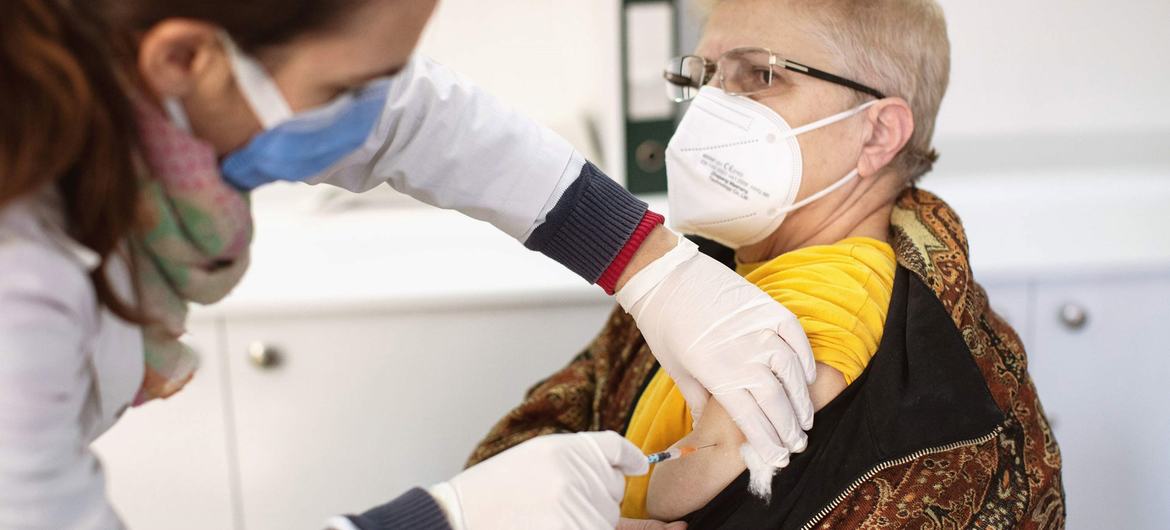
© WIE/Arete/Florion Goga
Retiree Xhane Grodani, who lives with her husband in Tirana, Albania, receives her third COVID-19 vaccination at a clinic in the capital.
“Reducing inequality within and between countries will enable a better, fairer and safer life for all,” she added.
The report is in line with the South African G20 theme of ‘Solidarity, Equality, Sustainability’ and emphasizes that achieving real healthcare will depend as much on economic justice and social equality as on vaccines or laboratories.
The Global Council outlines four key actions to break the ‘cycle of inequality and pandemic’:
- Removing financial barriers to ensure that all countries have the fiscal space to tackle inequality.
- Investing in the social determinants of health, such as housing, nutrition, education and employment, to reduce vulnerability to disease.
- Guaranteeing fair access to pandemic-related technologies by treating research and innovation as global public goods and promoting regional production.
- Strengthening community-led, multi-sectoral responses by anchoring pandemic preparedness in local systems and ensuring broad participation of government, civil society and science.
#Surviving #pandemic #depend #live