

The energy at this year’s INBOUND conference was electric, with one topic dominating the hallways, keynotes and coffee conversations: artificial intelligence. Everyone was talking about AI, buying AI and trying to integrate AI. But behind the excitement was a quiet frustration. Many organizations I spoke with were stuck in the chaos of AI, trapped in a cycle of random experimentation, tool overload, and a widening gap between AI’s promise and reality.
In my session, “Scaling AI: Going Beyond Experimentation Without Team Burnout,” I collected real-time data from hundreds of marketing leaders and walked them through the AI Enablement Canvas – a strategic framework for mapping an organization’s AI journey. Their answers painted a vivid, data-driven picture of collective goals, goal-oriented workflows, and the barriers that hold them back.
Here, I’ve distilled these insights into a snapshot of the industry’s AI mindset, showing what marketers really want, where they’re applying AI, and what challenges stand in their way.
A universal call for efficiency
When I asked participants to define a good 90-day activation goal, the answers weren’t about futuristic, world-changing AI applications. They were mostly practical. The top trend was a deep, immediate desire for automation and efficiency.
Marketers dream of getting a first draft of web content from an AI, automating the tedious work of social media analytics and streamlining time-consuming operational tasks. They want to grow their own skills, tailor directions for their niche industries, and build the confidence to use these tools effectively.
This push for practicality represents the crucial first step in the Hyperadaptive Model’s five phases of AI integration. Most organizations are in Phase 1 (Foundation), characterized by early, often isolated experiments.
The shared goals reflect a clear ambition to move to phase 2 (task augmentation), where AI is integrated at the task level to increase individual throughput. The point is not just to save a few hours, but also to build the organizational capacity needed for higher-value strategic work – the foundation for rewiring an organization to become hyper-adaptive.
Dig deeper: why mindset, not just technology, defines AI success in marketing
Where AI meets the marketing workflow
Where exactly do marketers want to apply this new efficiency? The data on high-performance workflows shows a focus on three core areas.
Content creation and marketing
This was the most common theme. Visitors want to streamline the creation of web content, social media copy, and the materials needed to support promotional campaigns (such as emails and posts for a new blog). The content engine is hungry, and marketers see AI as a way to feed it more effectively.
Data analysis and reporting
The second central area focuses on understanding performance. Marketers are turning to AI to identify and track success metrics, automate weekly dashboards, and create reports that clearly communicate results and ROI to leadership.
Sales and lead management
Many also pointed to workflows at the intersection of marketing and sales, such as using AI to help qualify new warm leads before passing them to a sales rep.
This shows that marketers are intuitively finding the best starting points for AI, focusing on specific, frictionless processes that need to be optimized. That is why a structured approach is so crucial.
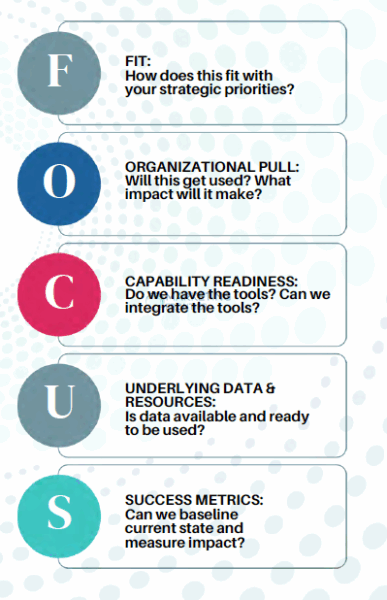
In my work, I use the FOCUS framework to evaluate use cases to ensure they align with strategic fit, have organizational appeal, are ready for match capabilities, are supported by the necessary underlying data, and have clear success metrics.
Dig deeper: why active sponsorship is the only way to make AI work
The real roadblocks to AI are organizational
When marketers were asked to name the biggest barriers to AI activation, they didn’t point to the technology, but to their own organizations. The barriers are predominantly human.
- The time paradox: The most commonly mentioned blockage was simply time. Teams are too busy with daily tasks to learn and implement the tools that would save them time. It’s a catch-22 that causes organizations to get stuck in manual, inefficient workflows.
- The knowledge gap: The second major barrier was a lack of knowledge. Marketers expressed uncertainty about which tools were right for them and a lack of awareness of what was even possible. This reflects a significant skills gap and underlines the need for continuous learning, rather than just a one-off training event.
- The data hurdle: Several attendees noted that their underlying infrastructure was not yet ready. One respondent put it clearly: “A lot of work is needed to make their CRM data 100% usable,” which undermines trust across the company. Poor data quality is a fundamental problem that can hinder even the most promising AI initiatives.
- The strategy vacuum: Finally, a lack of clear goals, an undefined strategy, and the chaos of using too many AI tools for certain purposes emerged as major roadblocks. This reflects the broader state of AI chaos, where haphazard efforts and leadership confusion prevent meaningful progress.
Your first step out of the AI chaos
The data is clear: Marketers are ready for AI. They have practical, efficiency-oriented goals and know exactly which workflows they want to improve. The problem is the tangled web of time pressure, knowledge gaps, data issues and strategic ambiguity that holds them back.
The first step out of the chaos is to gain clarity. By assessing where you are, defining a tangible goal, and identifying your biggest blocker, you can start building a real plan. The marketers in my session left with a personalized roadmap for the next 90 days using the AI enablement canvas – and you can do it too.
Dig deeper: My AI marketing team has a professor, a writer, and a smooth salesperson. Yours can do that too.
Energize yourself with free marketing insights.
Contributing authors are invited to create content for MarTech and are chosen for their expertise and contribution to the martech community. Our contributors work under the supervision of the editors and contributions are checked for quality and relevance to our readers. MarTech is owned by Semrush. The contributor was not asked to make any direct or indirect mentions of it Semrush. The opinions they express are their own.
#Structuring #marketing #impact #targeted #realworld #activation #MarTech