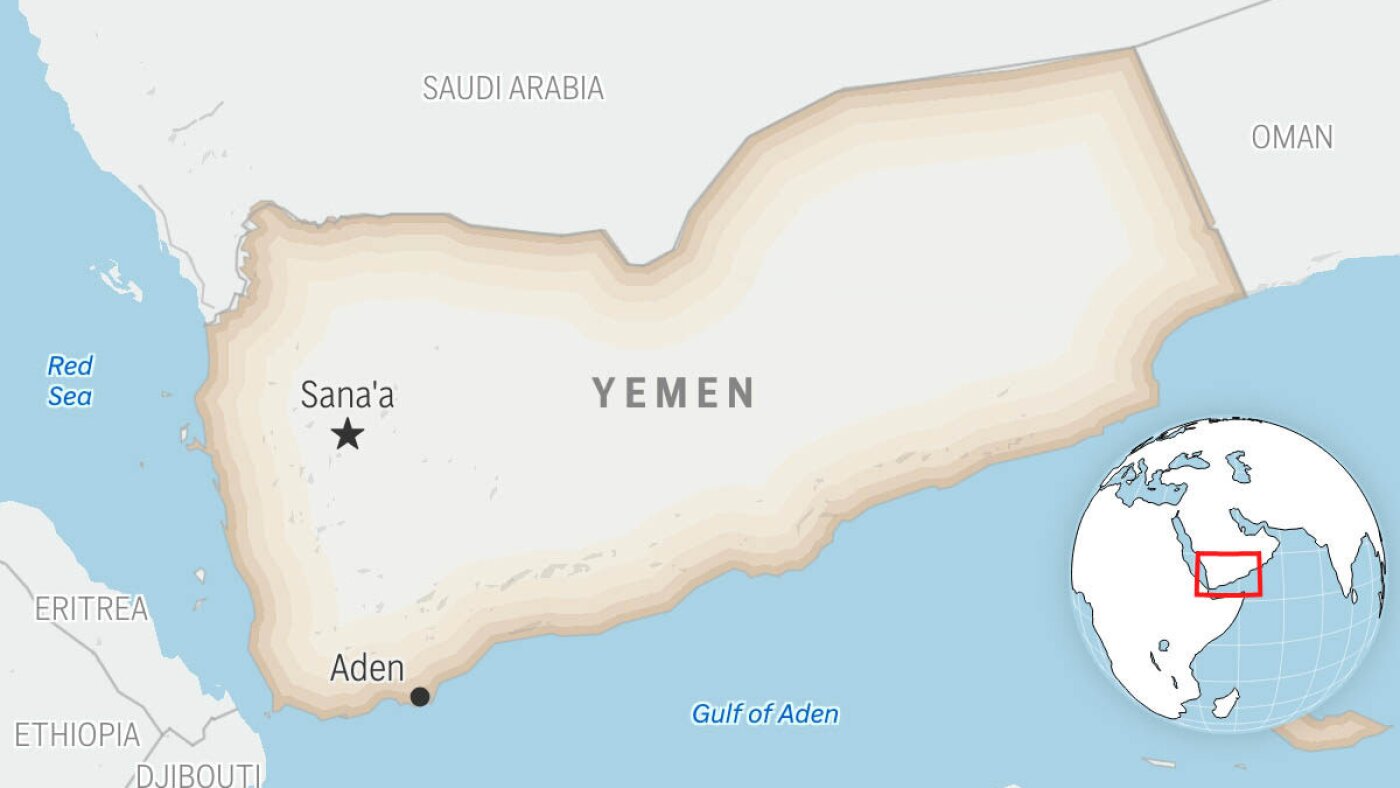

This is a location map for Yemen with its capital Sanaa.
AP
hide caption
change caption
AP
CAIRO – Yemen’s main separatist group and its institutions will be dismantled from Friday, the group’s secretary general said, after weeks of unrest in areas of southern Yemen and a day after its leader fled to the United Arab Emirates.
Abdulrahman Jalal al-Sebaihi said the Southern Transitional Council would close all its bodies and offices inside and outside Yemen, citing internal disagreements and mounting regional pressure.

But that decision was disputed by council spokesman Anwar al-Tamimi, who said on X that only the full council, under its president, can take such steps – highlighting the internal divisions within the separatist movement.
Yemen has been embroiled in a civil war for more than a decade involving a complex interplay of sectarian and tribal grievances and the involvement of regional powers.
The Iran-aligned Houthis control the country’s most populous regions in the north, including the capital Sanaa. Meanwhile, a loose regional coalition of powers – including Saudi Arabia and the UAE – has supported the internationally recognized government in the south.
The separatists conquer territory and then lose it
The unrest follows an advance last month by STC forces into Hadramout and al-Mahra governorates, where they seized oil-rich areas and facilities and the presidential palace in the main southern city of Aden. These measures drove out the Saudi-affiliated National Shield Forces and exposed tensions between Riyadh and Abu Dhabi.
Saudi-backed forces have since regained control of Hadramout, the presidential palace in Aden and the camps in al-Mahra.
Explaining the STC’s dissolution, al-Sebaihi said the council had not approved the military operations, which he said had broken unity in the south and “damaged relations with the Saudi-led coalition.”
As a result, “the continued existence of the council no longer serves the purpose for which it was established,” al-Sebaihi said.
The STC was founded in April 2017 as an umbrella organization for groups seeking to restore southern Yemen as an independent state as it was between 1967 and 1990.
Al-Sebaihi said the group’s members would now focus on reaching a “fair” solution for southern Yemen and prepare for a conference in the Saudi capital.
A victory for the Saudis
The STC’s military operations on Saudi Arabia’s borders were seen as a threat to the kingdom’s national security, and Saudi officials welcomed the council’s announcement that it would disband.
Saudi Defense Minister Khalid bin Salman said the southern issue is now on a “real path, nurtured by the kingdom and endorsed by the international community.” Mohamed al-Jaber, the Saudi ambassador to Yemen, called the decision “courageous” and said the conference in Riyadh would include all influential southern figures. A date for the conference has not yet been announced.
Yemen’s Shura Council, which is backed by the internationally recognized government, also welcomed the STC decision, saying the southern issue should be resolved through “a comprehensive political process.”
Abdulsalam Mohammed, the head of Yemen’s Abaad Studies and Research Center, said Friday that Saudi Arabia has managed to control the situation on the ground.
“Riyadh has proven that it will not allow any foreign interference to change the Yemeni road map by supporting one side over the other, especially if force is used and chaos continues to threaten the security of Yemen, the region and the world,” he said in a commentary on X.
Separatist leader flees to the United Arab Emirates
The STC announcement comes a day after the council’s leader, Aidarous al-Zubaidi, fled Yemen to the UAE.
The Presidential Leadership Council said the STC leader was accused of treason after he reportedly refused to travel to Saudi Arabia for meetings on Wednesday and after deploying STC troops to al-Dahle, where his village is located.
The STC’s national assembly had called for a march on Saturday in Aden and Hadramout’s port city of Mukalla in support of the “right to self-determination” in southern Yemen and in support of al-Zubaidi. However, it is unclear whether the march will still take place after the council is dissolved.
A curfew previously imposed across Aden due to the security situation was lifted on Friday, according to Abu Zarae Al-Mahremy, member of the Presidential Leadership Council, which is responsible for overseeing security across Aden.
The civil war in Yemen, on the southern edge of the Arabian Peninsula and bordering the Red Sea and the Gulf of Aden, has killed more than 150,000 people, including fighters and civilians. It has also caused one of the world’s worst humanitarian disasters.
#South #Yemen #separatist #group #disband #chief #flees #UAE