

Accepted by the General Meeting in December 2024 after five years of negotiationsthe Convention against Cybercrime creates the first universal framework for investigating and prosecuting crimes committed online – from ransomware and financial fraud to the non-consensual sharing of intimate images.
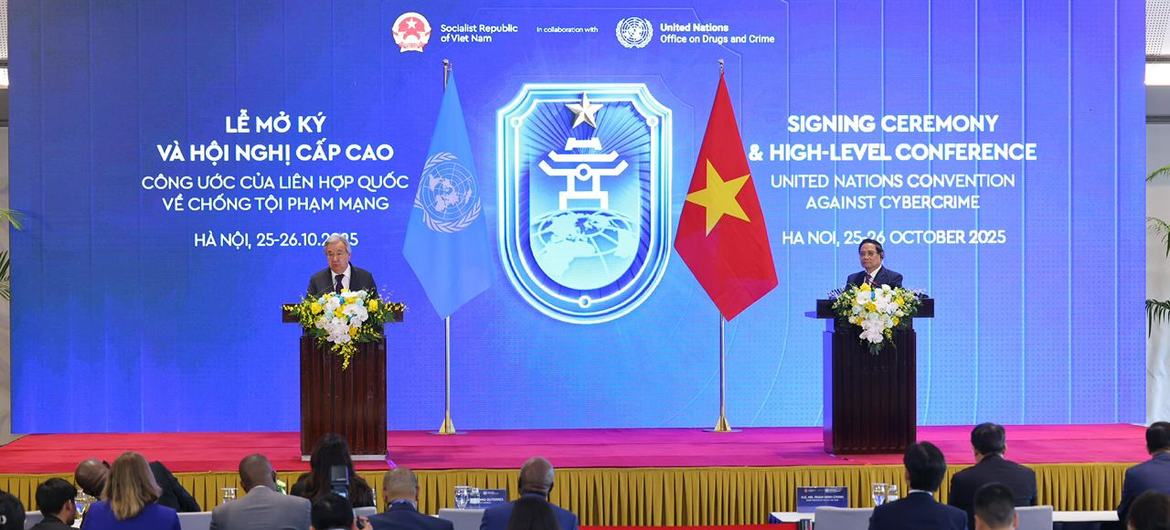
“The UN Cybercrime Convention is a powerful, legally binding instrument strengthen our collective defense against cybercrime,” said Mr Guterres during the signing ceremony on Saturday.
“It’s a testament to the continued power of multilateralism to deliver solutions, and it does a vow that no country, regardless of its level of development, will remain defenseless against cybercrime.”
The signing ceremony was organized by Vietnam in collaboration with the UN Office on Drugs and Crime (UNODC), attracting senior officials, diplomats and experts from all regions.
A global framework for collaboration
The new treaty criminalizes a range of cyber-dependent and cyber-related crimes, facilitates the sharing of electronic evidence across borders and establishes a 24/7 cooperation network between states.
It also makes history as the first international treaty to recognize the non-consensual distribution of intimate images as a criminal offense – a major victory for victims of online abuse.
It will enter into force 90 days after the 40th state submits its ratification.
Read more about the treaty here.
UN in Vietnam
Secretary General António Guterres addresses delegates during the signing ceremony.
A collective defense for the digital age
In his remarks, Mr Guterres warned that while the technology has brought “extraordinary progress”, it has also created new vulnerabilities.
“Every day, sophisticated fraud schemes defraud families, steal livelihoods and drain billions of dollars from our economies,” he said. “In cyberspace, no one is safe until everyone is safe. One vulnerability anywhere can expose people and institutions everywhere.”
The Secretary-General emphasized that the Convention represents “a victory for victims of online abuse” and “a clear path for investigators and prosecutors” to overcome barriers to justice when crimes and evidence cross multiple borders.
By providing a global standard for electronic evidence, the treaty aims to improve cooperation between law enforcement agencies while safeguarding privacy, dignity and fundamental human rights.
UN in Vietnam
Secretary General António Guterres (left) and Prime Minister Pham Minh Chinh of Vietnam during the joint press conference.
Visit of the UN chief to Vietnam
The signing ceremony was part of Mr Guterres’ official visit to Vietnam, where he also met with President Lương Cường, Prime Minister Pham Minh Chinh and other top officials.
At a joint press conference with the Prime Minister, Mr Guterres marked Vietnam’s critical role in the global digital supply chain.
“That’s part of it [the signing ceremony] is taking place here – in a country that has embraced technology, stimulated innovation and become an essential part of the world’s digital supply chains,” he said, urging states to quickly ratify and implement the treaty.
“Now we must translate signatures into action,” he said. “The treaty must be ratified quickly, fully implemented and supported with financing, training and technology – especially for developing countries.”
A safer cyberspace for everyone
The new treaty is expected to change the way countries tackle cybercrime at a time when digital threats are on the rise. The global cost of cybercrime is expected to reach $10.5 trillion annually by 2025, according to industry experts.
For many governments, especially in the South, the treaty offers an opportunity to access channels for training, technical assistance and real-time cooperation.
“Let’s seize this moment,” Mr. Guterres said. “Let’s build a cyberspace that respects everyone’s dignity and human rights – and ensure that the digital age delivers peace, security and prosperity for all.”
#Sixtyfive #countries #sign #treaty #combat #cybercrime #milestone #digital #cooperation