

BELÉM, Brazil, Dec 12 (IPS) – In all comparisons, the statistics for Sindh People’s Housing for Flood Affectees (SPHF) are phenomenal.
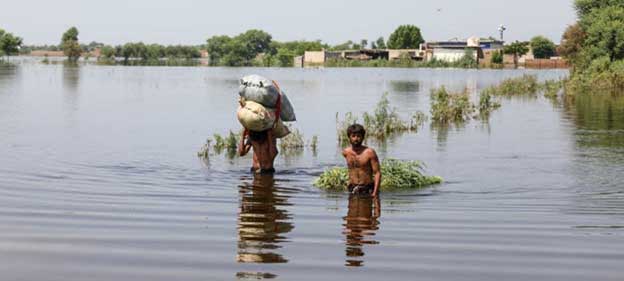
In 2022, photos from the region showed people carefully stepping through waist-deep water with their few belongings clutched tightly above their heads in an attempt to escape flooding caused by 784 percent above-average monsoon rains.
Tens of thousands of families housed tents facing an uncertain future, displacing an estimated 15 million people and killing more than 1,700.
That’s where the story ends for many international survivors of floods and other climate-related disasters. They have to collect the pieces themselves. Funding for adaptation and loss and damage is still “runs empty.”
And if there was to be clarity at the COP30 in Belém, Brazil, the so-called ‘adaptation COP’, countries that arrived with clear objectives to leave the negotiations with a roadmap for adaptation that included grant-based adaptation financing and more support were left disappointed.
The final Mutirão decision calls for efforts to triple adaptation financing by 2035 (compared to 2025 levels). While this reaffirms Glasgow’s previous target of doubling by 2025, the new target was a compromise as the deadline was pushed back from 2030 to 2035.
Amy Giliam Thorp, writes for the Africa-based think tank Power shift Africasummarized the views of many analysts who say that while the final decision refers to “efforts to at least triple adaptation funding,” the language is “politically evasive and makes it unclear who is responsible.”
Yet COP30 provided an opportunity to demonstrate the best that adaptation finance, albeit in the form of loans and not grants, can achieve.
Let’s get back to those statistics.
Speaking to a sweltering hot and humid Pakistani hall at COP30, Khalid Mehmood Shaikh, CEO of SPHF, detailed the achievements of the housing project – work is currently underway to build 2.1 million multi-hazard homes, directly benefiting over 15 million people – more than the population of 154 countries.
Currently, the construction of 1.45 million houses is underway, of which 650,000 have already been completed and another 50,000 are being completed every month.
Photos shown at the COP’s side event, Women Leading Climate Action in Sindh through SPHF: The World’s Largest Post-Disaster Housing Reconstruction Program, showed women and their families involved in various phases of the construction of their new homes.
The photos showed construction methods that… Asian Development Bank (ADB) calls architecture ‘resilient to multiple hazards’: high baseboards to prevent floods from entering homes, as well as windows and ventilation systems that improve air flow and lower temperatures during heat waves; the region sometimes experiences temperatures of over 45 °C. In addition, there is a transition of to callusing natural local materials such as mud, straw and bamboo pucca, built with modern materials such as brick, cement, steel and concrete.
Completed homes, colorfully decorated, witnesses to a project that creates both shelter and dignity.

The program, which is entirely managed by the private sector, started with a loan of USD 500 million from the World Bank and PKR 50 billion (over USD 178 million) from the government of Sindh.
While this was not enough to build the required 2.1 million homes, the SPHF, with a “robust system” of delivery with partners EY, KPMG and PwC, and using technology for monitoring, was able to mobilize a further $2 billion from the Asian Development Bank (ADB), the Islamic Development Bank (IsDB) and additional support from the World Bank.
In addition to the loans, the project has also benefited women and those considered ‘unbanked’, with 1.5 million bank accounts opened.
One of the successes they mention is the “largest transfer of home ownership in the history of Pakistan”, benefiting women.
“Around 800,000 women are direct beneficiaries, while land title for every house is granted in women’s names – the largest transfer of housing assets in Pakistan’s history,” Shaikh said. “This will ensure that those most vulnerable to climate change, including female-headed households, widows and older women, gain long-term security and financial inclusion, embedding equity and resilience in the recovery process.”
The administrator of the Department of Climate Change and Environment at the Islamic Development Bank (IsDB)According to Daouda Ben Oumar Ndiaye, the project reflects the bank’s focus on gender inclusion, especially for women, widows and the elderly.
“SPHF’s scale and transparency set a new benchmark for climate adaptation projects worldwide. We are creating synergies in Pakistan, especially in Sindh, with integrated projects in healthcare and women’s empowerment,” he said.
The director of Climate change at the Asian Development Bank (ADB)Noelle O’Brien was impressed by SPHF’s transformative approach, especially as it linked financial inclusion and resilient infrastructure.
“SPHF shows what real resilience in action looks like: putting women at the center of adaptation, finance and governance. This is the kind of scalable, gender-responsive model the world needs.”
IPS UN office report
© Inter Press Service (20251212085809) — All rights reserved. Original source: Inter Press Service
#Sindh #Peoples #Housing #redefining #success #postdisaster #adaptation