

MUMBAI: The Supreme Court has stayed the requirement of goods and services tax (GST) on a real estate project under a joint development agreement (JDA) in a case that could have major implications for real estate developers and land owners across the country. JDAs between developers and landowners are a common structure because they allow developers to open up land without prior purchase.
The authorities have sought to classify the transfer of land development rights under JDA as a taxable ‘supply of services’ under the GST law. Developers dispute this, arguing that the deal ultimately involves a ‘transfer of land’, which is outside the purview of GST.
A top court of Justices Aravind Kumar and R. Mahadevan, through an order earlier this month, stayed the execution of an assessment order dated January 27, 2025, passed by the CGST and Central Excise, Nashik-I division against Arham Infra Developers and its partner Nirmite Buildtech.
The court issued notices to the central government and other respondents named in the developer’s special leave petition and posted the matter for next hearing within four weeks of the order passed on October 13.
The Bombay High Court had earlier refused to stay the GST demand, holding that the developer should first approach the statutory appellate authority under the CGST Act instead of directly invoking the court’s jurisdiction.
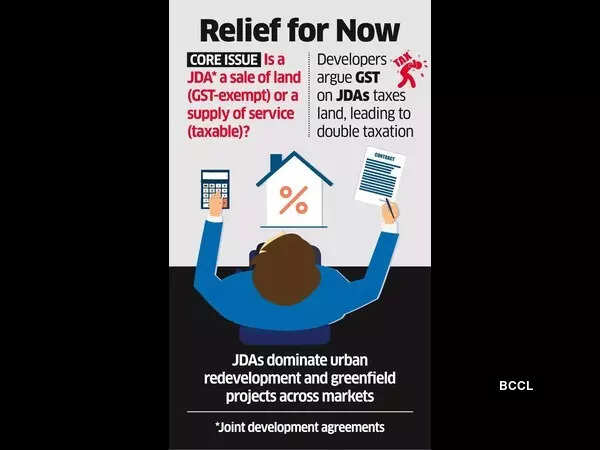
The Supreme Court’s interim stay has revived the debate over the taxability of JDAs.
According to legal experts, the case hinges on the fundamental question of how the transfer of land is treated under GST.
“At its core, a JDA is nothing but a structured mechanism for the transfer of land interests,” says Abhishek A Rastogi, founder of Rastogi Chambers. “Legally, the sale of land is excluded from the purview of GST. When a landowner contributes land to a development project, the substance of the transaction remains the transfer of land or rights in land.”
According to him, the intrinsic nature of the transaction cannot be converted into a ‘service’ merely because the scheme involves deferred compensation in the form of units built.
The attempt to impose GST on development rights effectively taxes the land component through the back door, Rastogi argued.
Such a levy undermines the very intent of the legislature and results in double taxation, especially when the same units are subsequently taxed at the time of sale, he said.
The case takes on significance for the wider real estate sector as joint development structures dominate urban redevelopment and greenfield projects across the country.
The Supreme Court’s intervention is a sign of the ongoing judicial turmoil over how GST applies to JDAs. In August, the Goa bench of the Bombay High Court ruled that no GST is payable once ownership of the land is transferred to the developer, providing clarity on when tax is payable in such schemes.

#upholds #GST #demand #real #estate #joint #development #pacts