

Retire to Spain from the Philippines by applying for a non-lucrative residence visa through the Spanish Consulate.
This visa allows Filipino retirees to live in Spain long-term without working, provided they meet income, health and documentation requirements.
Planning ahead is essential as approval must be obtained before leaving the Philippines, ensuring a smooth transition to permanent residency.
This article covers:
- Can I move to Spain when I retire?
- How do I move to Spain as a Filipino citizen?
- What is the minimum income for a retiree?
- What documents do you need if you retire to Spain from the Philippines?
Key Takeaways:
- Spain does not offer a retirement visa, but the non-lucrative visa is the main route.
- Proof of stable passive income is required.
- Retirees will have access to Spanish healthcare and Schengen travel.
- Taxes, bureaucracy and housing costs require advance planning.
My contact details are hello@adamfayed.com and WhatsApp +44-7393-450-837 if you have any questions.
The information in this article is intended as general guidance only. It does not constitute financial, legal or tax advice, and is not a recommendation or invitation to invest. Some facts may have changed since the time of writing.
How to retire in Spain for Filipinos?
Filipinos retire in Spain by applying for a non-lucrative residence visa, which allows long-term stays without working.
This visa is intended for retirees with sufficient passive income, such as pensions, annuities, rental income or investment returns.
The application must be submitted through the Spanish Consulate in the Philippines and approved before departure.
Applicants must provide proof of income or savings, private health insurance valid in Spain, a clean criminal record and a medical certificate.
Once approved, the initial residency permit is valid for one year and can be extended for a period of two years, allowing Filipinos to establish long-term residency and eventually qualify for permanent residency.
What is the first step to move to Spain?
The first step is to decide which Spanish residency route suits your situation, followed by preparing documentation in the Philippines.
For most retirees this means:
The application must be approved before leaving the Philippines, as in Spain you cannot convert a tourist stay into a residence permit for the elderly.
What is the minimum income to retire in Spain?
The minimum income for a Spanish pension is enough to cover living costs without working, usually around €28,000 – €30,000 per year for one applicant.
Spain requires proof of sufficient passive income to ensure retirees can support themselves without work.
The benchmark used is the IPREM (Income indicator). As a general guideline:
- A single applicant must demonstrate income or savings equal to 400% of the IPREM per year
- An additional 100% IPREM per dependent
Acceptable sources of income include pensions, annuities, rental income, dividends or significant savings.
How much does it cost to retire in Spain?
For Filipinos retiring in Spain, the total cost of living typically ranges from €1,800 to €2,500 per month, assuming a modest to comfortable lifestyle without work.
This estimate is in line with Spain’s non-lucrative expectations for a residence permit and excludes large one-off moving costs.
Spending is generally lower in smaller towns and inland areas, while coastal and large urban areas increase housing and daily costs.
For Filipino retirees who rely on pensions, savings or investment income, Spain remains cost-competitive compared to other retirement destinations in the EU, provided that housing choices and tax burden are planned in advance.
What are the requirements to retire in Spain?
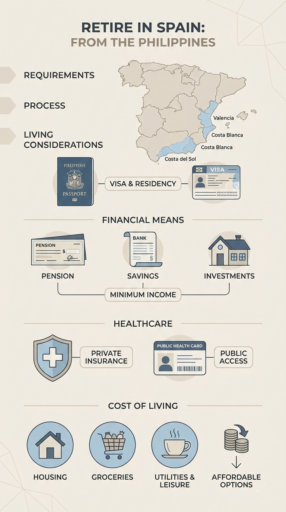
To retire in Spain, Philippine nationals must meet specific visa and residency requirements, including proof of income, health coverage and legal approval.
- Valid Philippine passport
- Proof of sufficient passive income or savings
- Private health insurance with full coverage in Spain
- Clean criminal record from the Philippines
- Medical certificate showing that there are no serious risks to public health
- Proof of accommodation in Spain (rental or ownership)
Once approved, the initial residence permit is usually valid for one year and can then be extended for a further period of two years.
What are the advantages of Filipinos in Spain?
Filipinos in Spain benefit from strong communities, accessible healthcare, affordable living and long-term residency options.
- Strong Filipino communities and support networks
- Cultural similarities rooted in a shared history
- Access to Spain’s universal healthcare system after residency
- Affordable cost of living compared to other EU countries
- Visa-free travel through the Schengen area
Spain also offers a clear path to long-term residency and, ultimately, citizenship, depending on length of stay and integration requirements.
What is the disadvantage of retiring in Spain?
The main disadvantages of retiring in Spain are bureaucracy, tax burden and limited flexibility regarding retirement visas.
- High bureaucracy and slow administrative processes
- Language barriers outside the big cities
- Restrictions on employment under retirement visas
- Rising housing costs in popular coastal and urban areas
- Worldwide income tax once Spanish tax residence is established
Understanding Spanish tax obligations is particularly important, as retirees can become tax residents after spending sufficient time in the country.
Are there other ways for Filipinos to retire in Spain?
Yes, there are other retirement options for Filipinos in Spain, but most alternative paths are limited. The most practical retirement route remains the non-lucrative residence visa, which allows long-term residence without work.
Other possible routes include:
- Family reunification: If you have a spouse, parent or child who is a Spanish citizen or legal resident, you may be eligible to join them under the family residency rules. This is not a retirement visa per se, but it allows long-term stay in Spain.
- Routes for work or self-employment: Some Filipinos initially enter Spain on a work or self-employment visa and later transition to long-term residency before fully retiring. Qualifying employment or business plans are required for these routes.
Spain officially ended its Golden Visa (investor visa) program for new applicants effective April 2025, so investment-based residency is no longer an option for Filipinos looking to retire there.
Conclusion
Retiring to Spain from the Philippines is less about finding a special retirement program and more about aligning your finances, residency status and long-term plans with the Spanish legal framework.
The process rewards preparation: those who understand the income thresholds, tax residency implications, and renewal obligations early on typically experience a much smoother transition.
For Filipino retirees, Spain works best as a long-term lifestyle decision rather than a short-term experiment, making careful pre-relocation planning as important as the destination itself.
Frequently asked questions
How much money do you need in the bank to become a resident of Spain?
There is no fixed bank balance requirement, but most applicants must demonstrate a minimum of €30,000 in accessible funds for one person, with higher amounts required for dependents.
Can I still receive social security if I move to Spain?
Yes. Filipino retirees who receive foreign pensions or social security benefits can generally continue to receive them while living in Spain.
However, these payments may be subject to Spanish tax depending on tax treaties and residency status.
Why do so many expats leave Spain?
Some expats leave Spain due to tax changes, administrative complexity or rising costs in big cities.
Others find the slower pace of bureaucracy and strict compliance requirements challenging compared to more flexible retirement destinations.
How much money do you need to retire comfortably in Spain?
A comfortable retirement budget varies by location, but outside major cities many retirees live well on €1,800 to €2,500 per month.
Coastal and central urban areas may require higher budgets, especially for housing.
Tormented by financial indecision?

Adam is an internationally recognized financial author with over 830 million answer views on Quora, a best-selling book on Amazon, and a contributor to Forbes.
#Retiring #Spain #Philippines