

Rangers can’t buy a goal and it has been a thorn in everyone’s side since the season started. With only 16 goals in 8 games and 10 of those goals coming in just 2 games, the Rangers’ scoring woes are becoming a major problem that will bring this team to a standstill. The defense has improved a lot and the Rangers are a better product on the ice, but they won’t win by scoring one goal per game. The Rangers’ scoring woes are caused by much more than just a massive drought, so a solution won’t necessarily come anytime soon.
Shooting luck is only one factor
As a team, the Rangers’ scoring woes are rooted in three key areas: shooting luck, roster formation and individual shot location. Luck is the luck that the team doesn’t necessarily control, but will eventually level out to career averages.
If we focus on the main scorers: Mika Zibanejad, Artemi Panarin, Alexis Lafreniere, Vincent Trocheck and JT Miller, only Miller and Panarin score more than 10% (10% and 10.5% respectively). Zibanejad (6.5%), Lafreniere (4.5%) and Trocheck (0% – injured) complete the top scoring players. Despite Trocheck, all of the Rangers’ key scorers are well below their career shooting percentages.
Shooting luck is one of the most important factors in Rangers’ scoring, but mentioning SH% without context doesn’t help anyone. For example, Panarin is a 14.7% career shooter, so he’s well below his level. The same goes for Miller (15.2%), Zibanejad (13.2%) and Lafreniere (13.2%).
The Rangers will only go as far as their leading scorers take them, especially with limited scoring depth. The good news is that simple math tells us that this quartet – and Trocheck – will come to blows at some point. The bad news is that the Rangers’ scoring woes are forever tied to them given the current roster construction.
Roster composition is a major factor in the Rangers’ scoring woes
As many have noted, the Rangers’ scoring woes are directly related to the current roster construction. The current third line is a mess, which certainly plays a role in this. Noah Laba is essentially lost playing with Juuso Parssinen and Taylor Raddysh. While both Parssinen and Raddysh each have a purpose, there is little else to show us that this line is more than just a filler line.
The Rangers’ scoring depth was absolutely gutted, losing key contributors across the lineup. No one has stepped up to fill Chris Kreider’s shoes. Laba has, at least on paper, filled the young 3C role that Filip Chytil vacated, but without a good line and role he is stuck in purgatory. But it goes beyond just the attackers.
Reilly Smith’s production has not been replaced. K’Andre Miller’s puck-moving ability on the blue line hasn’t been replaced. Will Cuylle is off to a slow start and appears to be struggling to adapt to his new role in the new system. Cuylle will be fine in the end, but it feels like he’s better off as a mid-range winger and not a top-line winger. But there is currently no one to replace him in the top six, adding to the Rangers’ scoring woes.
The Rangers need three things to address their construction issues: another puck-moving defenseman to help with game transition, another top-six scorer, and a third line that actually fills a role and can score.
Shot locations are a mess
As a team, Rangers’ scoring problems are quite clearly focused on finishing in the high-danger areas. The rightmost card of Hockeyviz highlights this as Rangers are well below league average when it comes to finishing from the front of the net. They have 15 goals on a 23.3 xG (all situations) this season, with their “hot” finishing coming from the middle. Not an ideal scenario.
Team shot locations aren’t that bad, but that sea of blue in the medium danger areas at the top of the circles and the high slots is a bit alarming. In theory, Rangers are generating decent chances at the mouth of the net, and when you combine this with snake bites, there is reason for optimism. The Rangers’ scoring problems in this scenario would largely be related to shooting percentage. Unfortunately, there is more to it.
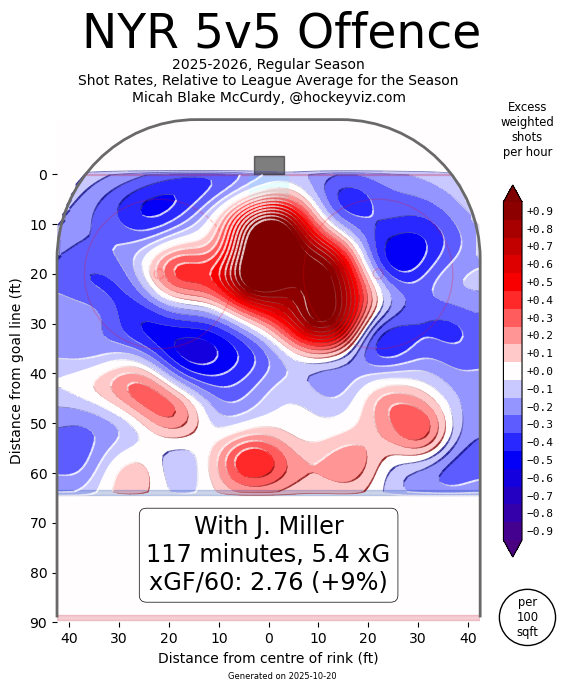
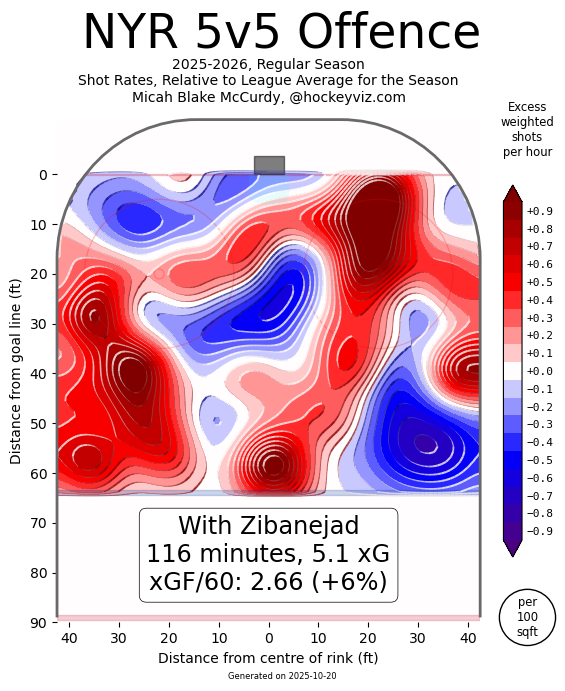
Focusing on the positive, it appears that both Miller and Zibanejad were simply snake bitten. They generate offense from high-danger areas but are simply unable to convert consistently. Zibanejad in particular looked like a man on a mission and is completely rejuvenated. He has been the Rangers best forward, bar none. The Rangers’ scoring problems with this duo could simply be due to SH% regression. This duo, should this game continue, will get back on track.
As a side note, Miller and Zibanejad routinely draw top competition. This could impact their final grades if there is stronger defensive play in front of them, but it is anecdotal and extremely difficult to prove.
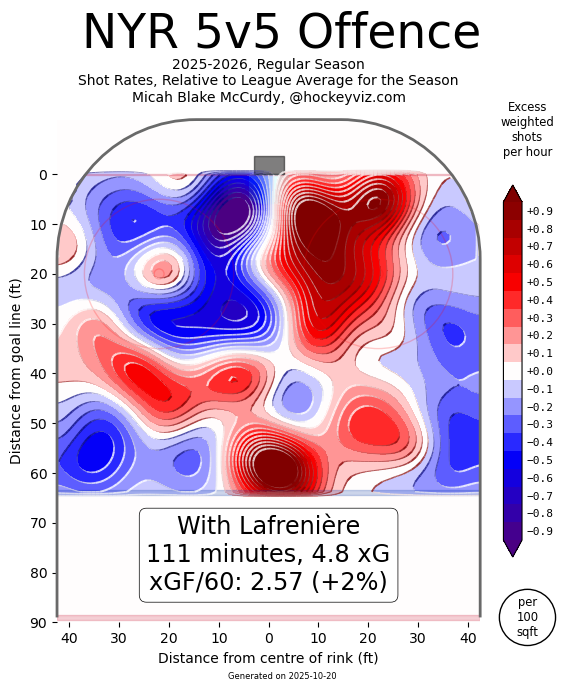
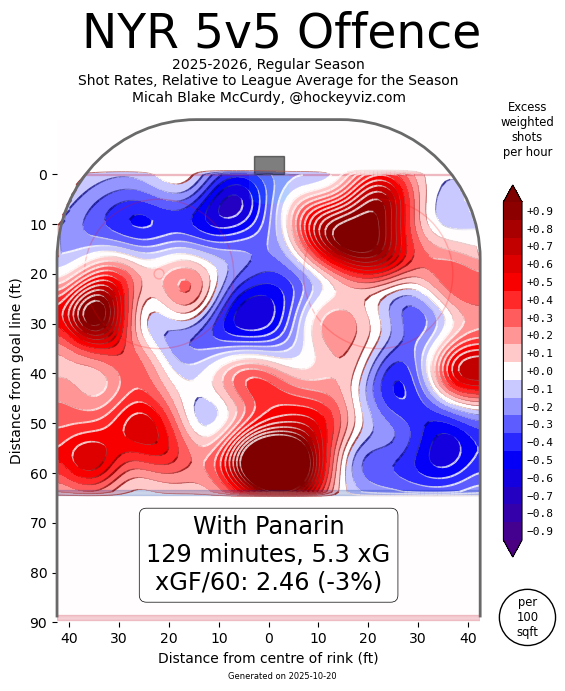
The Rangers’ shooting woes are especially concerning when looking at both Panarin and Lafreniere. That’s a lot of blue in high-danger areas, indicating that the Rangers’ scoring problems are related to perimeter play when they’re on the ice. Neither Laf nor Panarin have been real frontmen, usually handing that job over to Trocheck. If this is what the Rangers are going to do with both of them on the ice, then they’ll need a hard-nosed center to take the attention off them.
Both Panarin and Lafreniere are dangerous players and both will eventually make it. However, it will be much more painful than we expect as we wait for Trocheck to return.
The Rangers will only get as far as their current top-four (five if Trocheck is back) scorers will take them. Hopefully the Rangers’ scoring woes correct themselves via shooting regression, but there’s more to it than just bad luck.
#Rangers #scoring #misery #shooting