

Contents
- Minimum support prices: from safety net to self-sufficiency
- India is accelerating AI self-reliance: from computing power to basic models
Minimum support prices: from safety net to self-sufficiency
Basic concept
- Minimum Support Price (MSP): The pre-announced price at which the government buys crops from farmers, acting as a safety net against price fluctuations.
- Objective:
- Protect farmers from distress sales.
- Provide a fair income and stimulate production.
- Promote crop diversification and national food security.
- Coverage: Announced for 22 mandatory crops; also extended to Toria And deshelled coconut.
Relevance: GS 3 – Agriculture, Inclusive Growth, Public Policy, Food Security, MSP Reforms
Policy framework
- Recommended body: Commission on Agricultural Costs and Prices (CACP).
- Approval: By the Cabinet, after consulting the State Governments and Central Ministries.
- Determinants:
- Production costs (base A2+FL).
- Domestic and international price trends.
- Terms of trade (agricultural versus non-agricultural).
- Effect on economy and inflation.
- Formula since 2018-19: MSP = 1.5 x production costs (ensuring a 50% profit margin).
Cost calculation
- Inclusive: Expenses paid (A2) + Allocated family labor (FL).
- Components: Seeds, fertilizer, irrigation, rent of leased land, depreciation, interest, labor, diesel/electricity, etc.
- Uniform formula: Applied to 22 crops and all states.
Rabi crops (MSP 2026-2027)
- Highest MSP margin:
- Wheat — 109% more than cost (₹2,585/qtl).
- Rapeseed & Mustard — 93%.
- Highest absolute increase:
- Safflower — ₹600/qtl.
- Purchasing purpose: 297 LakhMT; farmers receive ~₹84,263 crore.
Kharif crops (MSP 2025-2026)
- Highest increase: Niger seed (+₹820), Ragi (+₹596), Cotton (+₹589).
- Highest margin: Bajra (63%), maize and tur (59%).
- Focus: Legumes, oilseeds and food grains – encourage diversification beyond grains.
Procurement mechanisms
- Main offices:
- FCI — Cereals and coarse grains.
- NAFED & NCCF — Legumes, oilseeds, copra (under PM-AASHA).
- CCI & JCI — Cotton and jute.
- Estimation basis: Production, surplus and inputs at the state level.
- No quantitative limit about the purchasing of cotton and jute.
PM-AAASHA (Pradhan Mantri Annadata Aay Sanrakhan Abhiyan)
- Objective: Ensure remunerative prices for farmers.
- Key Component: Price Support Program (PSS) — activated when market prices < MSP.
- Purchasing mode:
- Directly from pre-registered farmers (Aadhaar, land registration mandatory).
- Financial provision: PM-AASHA guarantee increased from ₹45,000 crore to ₹60,000 crore (Budget 2025).
- Extension: Continued up to and including the 2025-2026 financial year.
From MSP to Atmanirbharta (self-sufficiency)
- Goal: become India self-reliant in pulses by December 2027.
- Government commitment:
- 100% purchase of tur, urad and masoor until 2028–29.
- Supported by announcements on the 2025 budget.
- Progress:
- By March 2025 2.46 lm there purchased in 5 states.
- 1.71 lakh+ farmers benefited.
Impact analysis (2014-2025)
A. Food grains in general
- Purchasing: ↑ from 761 LMT (2014-2015) Unpleasant 1,175 LMT (2024-2025).
- Paid out value: ↑ from ₹1.06 cross → €3.33 cross.
- Farmers benefited: ↑ from 1.63 crore (2021-2022) → 1.84 crore (2024–25).
B. Paddy and Kharif crops
- Purchasing: ↑ from 4,590 LMT (2004-2014) → 7,608 LMT (2014-2025).
- MSP payout: ↑ from ₹4.44 special → €14.16 groups (paddy).
- For all 14 Kharif crops: ↑ from ₹4.75 groups → €16.35 groups.
C. Legumes and oilseeds
- Legumes purchasing: ↑ 7,350%from 1.52 LMT (2009–14) → 82.98 LMT (2020–25).
- Purchasing of oilseeds: ↑ over 1,500% (2014–25).
- Clear decrease in import dependence and price volatility.
D. Wheat
- RMS tender 2024-2025: 266 LMTan increase of 262 LMT (2023–24).
- ₹0.61 lakh crore directly credited to the bank accounts of 22 lakh farmers.
Technology and transparency reforms
- Digital portals:
- e-Samriddhi (NAFED): End-to-end digital purchasing for pulses and oilseeds.
- E-SYUKTI (NCCF): Maintains farmer registration, scheduling and payments.
- Cotton Kisan App (CCI): For cotton: self-registration, quality control updates, multi-language interface.
- Advantages: Eliminates middlemen, ensures timely MSP payments, and improves data traceability.
Overall results
- Economic security: Tripling MSP payouts in ten years.
- Wider recording: More than 20 lakh+ farmers have benefited since 2021-22.
- Diversification: Strong craving for legumes, oilseeds and millet.
- Digital governance: Transparent, cashless purchasing ecosystem.
- National self-reliance: Policy shift from safety net → productivity and import substitution.
Challenges ahead
- Regional skew in procurement (Punjab and Haryana dominance).
- Storage and logistics constraints for extended MSP crops.
- Balancing fiscal burdens and inflation management.
- Ensuring participation in the private market without price distortion.
Conclusion
- MSP has evolved from one price safety mechanism in one strategic instrument for self-sufficiency.
- With strong sourcing, digital transparency and focus on pulses and oilseeds, India is making progress Atmanirbhar Krishi.
- The 109% margin on wheat and 100% purchasing guarantee on legumes mark a new phase of inclusive, data-driven and technology-enabled agricultural management.
India is accelerating AI self-reliance: from computing power to basic models
Why in News
- MeitY hosted Pre-summit events for the India– Impact Summit 2026 during the day India Mobile Congress 2025 in New Delhi.
- Announced:
- 12 Indian companies developing basic AI models to use 38,000 GPUs.
- Calculation costs: ₹65 per GPU per hour – one of the lowest in the world, ensuring affordable AI model training and access to innovation.
- National Large Language Model (LLM) should be launched at the end of 2025.
Relevance : GS 3 – Science and technology, IT and computers, indigenous technology, digital economy
Core objective
- Strengthen AI self-reliance and digital sovereignty under the IndiaAI Mission.
- Build one economical, inclusive and globally replicable model for the development of AI – by leveraging affordability, public-private partnerships and equitable access.
Institutional Framework
- Ministry junction: Ministry of Electronics and Information Technology (MeitY)
- Executive body of the mission: IndiaAI under Digital India Corporation
IndiaAI Mission: Pillars of AI Self-Reliance
- Affordable computing infrastructure:
- 38,000 GPUs available at €65/hour (one of the lowest in the world).
- Enabling National AI Computing Network equality between the public and private sectors.
- National Data Platform:
- Curated, secure and anonymized datasets for AI R&D.
- Development of foundation models:
- 12 companies are developing indigenous LLMs and multimodal models.
- AI skills and workforce:
- Initiatives for AI literacy, reskilling and inclusion.
- Safe and reliable AI:
- Frameworks for responsible use, reduction of bias and transparency.
Strategic context: from dependency to digital Atmanirbharta
- Reduce dependence on foreign AI models and computing infrastructure (such as OpenAI, Google or Nvidia clouds).
- India wants to develop into one “computer-rich, cost-efficient hub” for the Global South.
- Coordination with Digital India, Make in IndiaAnd @2047 goals.
India-AI Impact Summit 2026: Vision and Themes
- Date and location: February 19–20, 2026, Bharat Mandapam, New Delhi.
- Theme: “From action to impact.”
- Accompanying Sutras:
- People: Inclusive, human-centric AI with respect for diversity.
- Planet: Sustainable, resource-efficient AI in line with climate goals.
- Progress: Equal access to AI benefits, computing power and models.
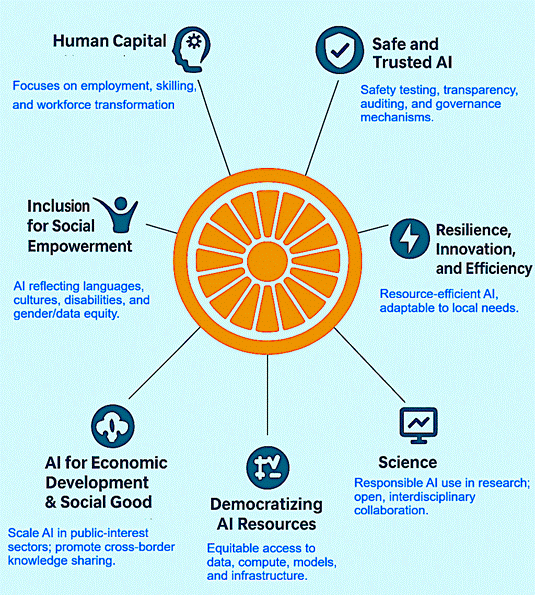
Seven Chakras: Operational Pillars of AI Diplomacy
- Human capital: Global AI literacy, upskilling and a just workforce transition.
- Inclusion for social empowerment: Multilingual, gender-neutral, accessible AI systems.
- Safe and Trusted AI: General tools for security testing, auditing and governance.
- Resilience, innovation and efficiency: Lightweight, resource-optimized AI for real-world use.
- Science: Open and responsible AI research collaborations in the South.
- Democratization of AI Resources: Shared access to computing power, datasets and models.
- AI for economic development and social well-being: AI implementation in healthcare, education, governance and agriculture.
Key areas of AI application in telecom
- AI in telecom for social and economic impact: Improved connectivity, smart infrastructure.
- Reliable AI in telecom: Frameworks for security, transparency and ethics.
- AI staff development: Training engineers and professionals for telecom AI integration.
- AI for inclusive growth: Bridging the digital divide in rural and disadvantaged areas.
Institutional participants
- Government: MeitY, NIC, IndiaAI, C-DOT.
- Industry: Trust Jio, Airtel, TCS, AWS, AMD, Google, Netweb Technologies, Tanla Platforms.
- Academia: BITS Pilani.
- International agencies: UNESCO and other global AI stakeholders.
Results and global relevance
- India’s AI model recognized by international agencies for:
- Cost-effective scalability.
- Public-private inclusivity.
- Replicability for Global South nations.
- Strengthens that of India leadership in responsible AI diplomacylinking digital access to social empowerment.
Achievements and recognition
- MeitY Pavilion promised Best Government Exhibitor at IMC 2025.
- Recognized for interactive showcase of the Indian AI ecosystem and digital innovation.
Broader implications
- Economic: Boosts domestic AI industry, startups and export potential.
- Strategic: Reduces dependence on foreign AI technology and improves data sovereignty.
- Social: Promotes inclusive digital growth and AI accessibility for marginalized groups.
- Environment: Encourages low-energy, sustainable AI design principles.
Conclusion
India’s AI strategy is an example of this frugal innovation and inclusive modernizationwhere affordability is combined with ambition.
Of national base models, accessible computing infrastructure and global partnershipsIndia positions itself as the AI Hub of the Global South– ensuring that the power of artificial intelligence serves People, planet and progress.
#pib #summaries #October #Legacy #Ias #Academy