

The Insurance Institute for Highway Safety (IIHS) recently released its safety ratings, with headlight ratings being one of the prominent factors, along with other parameters such as frontal and side-impact testing, frontal crash prevention, and pedestrian safety ratings. The headlight tests were first introduced in 2016 and have since become an important factor in determining the safety ratings for any vehicle. Vehicles are given four grades for these tests: Good, Acceptable, Marginal and Poor. Only 51% of cars tested in 2025 were rated Good, while 16% were rated Marginal or Poor.
While this is a significant jump from 2016 testing, when only one car was rated Good, the importance of cars with quality lighting cannot be overstated. According to IIHS, vehicles rated Good for headlights experience 19% fewer single-vehicle crashes at night and 23% fewer pedestrian crashes at night than vehicles rated Poor. To assess the effectiveness of a vehicle’s headlights, each car undergoes a rigorous test that involves making multiple approaches with both low and high beams on straight and winding roads, while engineers measure how far the headlights illuminate the road. Headlights lose points if their high or low beam does not illuminate the road properly or if the low beam causes dazzle to oncoming traffic, while vehicles with high beam assist receive fewer low beam points in the IIHS tests.
Oncoming traffic is tested to ensure the vehicle illuminates the road effectively without dazzling drivers coming from the opposite direction, which is a particular problem with modern LED headlights. IIHS reports a noticeable improvement in this parameter, as only 3% of vehicles in the 2025 test showed excessive glare, while in the 2017 test it was 21%.
Which cars have a good rating in the 2025 IIHS safety tests?
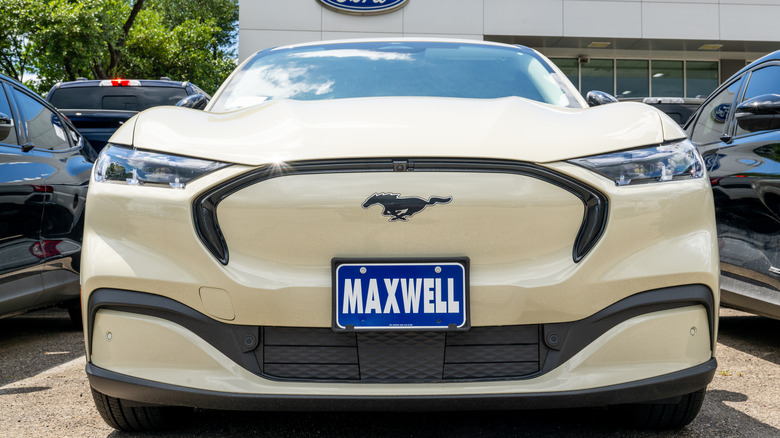
IIHS has pushed manufacturers to improve headlight quality, announcing in 2019 that vehicles rated Good or Acceptable would be eligible for the Top Safety Pick+ award. Several parameters are taken into account, as mentioned above, and test vehicles are set to the factory headlight settings, noting that most owners do not adjust these. IIHS does not consider the type of headlight bulb (halogen, LED or HID) when determining its ratings, but instead evaluates how effectively the headlights illuminate the road. The cars that received Top Safety Pick+ honors – IIHS’s highest safety award – include the Honda Civic, Ford Mustang Mach-E, Kia Telluride, Audi Q6 e-tron, Mercedes-Benz GLC and Tesla Model Y.
Several other Top Safety Pick+ vehicles have some trims with a Good rating, while other trims only receive an Acceptable rating due to different headlight setups. Examples include the Toyota Tundra, Mazda 3, Hyundai Tucson, Mercedes-Benz C-Class, Mazda CX-70 and Audi Q7. Higher trims do not necessarily perform better than lower ones in this test. Take the C-Class for example. The standard version, without the Digital Light package with cornering lights, performs better on straight roads, while the Digital Light package provides better lighting in the bends. However, the standard version received a Good rating, compared to an Acceptable rating for the version with the Digital Light package. On the other hand, a few models struggled significantly in the headlight tests, with the Tesla Cybertruck, Cadillac Lyriq and BMW i4 all receiving a poor rating.
#vehicle #headlights #tested #IIHS #received #good #great #Jalopnik #rating