

Some may call it the COVID Masters because it was the pandemic that disrupted the cadence of professional golf like it disrupted pretty much everything else in the world, but calling it the November Masters is more appropriate because it has a warm and cozy feeling.
The azalea blooms were replaced by autumn leaves. The sun, which set early by the standards of the Masters, shone from a different angle. Instead of Easter, it was almost Thanksgiving.
It was a Masters like no other.
Concessions were free. Visitors wore green Masters masks. Members walked around the building in sweaters instead of their green jackets.
There were no roars, no patrons, no bleachers.
And pandemic or not, no phones were allowed on the golf course, although you could see a few daring souls scrolling or texting on the property that week.
When asked how it felt to play the Masters in relative solitude, Kevin Kisner said, “It feels like you’re here preparing for a Masters, and not actually playing in a Masters.”
It was strange, almost uncomfortable and especially if you were among the handful of people on site that week, it was unforgettable.
The city of Augusta felt empty. Hotel rooms near the golf course were available for less than $150 per night. Restaurants were open, but reservations were not necessary.
When the world shut down in early 2020, so did professional golf. It finally came back to life that summer and after hours of discussions, the PGA Championship was moved to early August, the US Open was moved to September, the 2020 Open Championship was canceled and the Masters moved to November.
“There was actually just a great coming together of those organizations to talk about what the possibilities were. There was certainly not just collaboration, but there was a lot of give and take and compromise,” Augusta National Chairman Fred Ridley said that week.
“Anytime you have a tough problem, compromise is the way you get to a solution, but I think what was really encouraging about the whole thing is that the organizations really worked together in the best interests of the sport. I think we came to a pretty good outcome.”
The few people allowed on site — mostly members, the players and their families, and a limited number of media — had what felt like their own private Masters after passing a COVID test.
Although the worst of the COVID crisis was over, its effects were still felt. The week before the Masters, Joaquin Niemann withdrew after a positive test and just before the start of the tournament, Sergio García tested positive and withdrew.
That same November week, the Alabama-LSU and Texas A&M-Tennessee college football games were canceled, but that didn’t stop ESPN’s popular Saturday morning kickoff show — “College GameDay” — from broadcasting from Augusta National’s par-3 course on the morning of the third round.
In a place so familiar to golf fans, much of it felt unfamiliar.
The few people allowed on site — mostly members, the players and their families, and a limited number of media — had what felt like their own private Masters after passing a COVID test.
They watched the play on the 15th green from the Sarazen Bridge. They could stand just a few steps from the 12th tee, close enough to listen to the conversations between player and caddy. They had Amen Corner to themselves.
“When it comes to the atmosphere of the event, it’s still the Masters. It’s still the same course, the same beautiful place, the classic scoreboard, the golf course itself. You miss it, but I feel like the essence is still there,” Jon Rahm said.
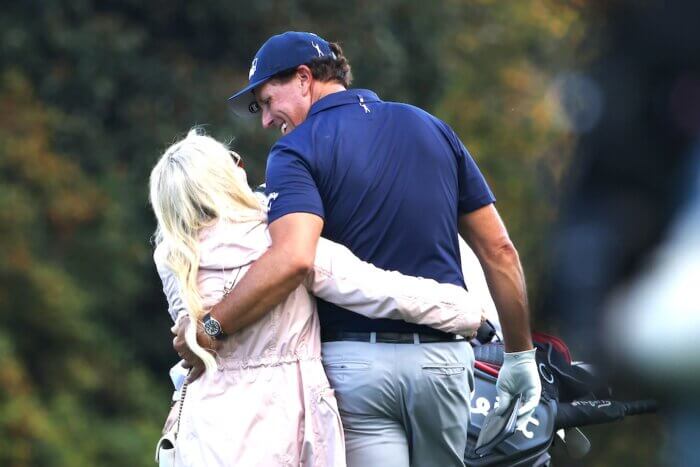
And yet Phil and Amy Mickelson walked arm in arm down the eighth fairway – as he played the Masters.
As for the tournament itself, it had its own unique drama. The weather and early sunsets meant that both the first and second rounds were spread over two days, but by the time Sunday arrived, Dustin Johnson was four clear of the field on a soft course that lacked the usual defense.
In the final round, defending champion Tiger Woods had an unforgettable second nine. He made a 10 on the par-3 12th hole and hit three balls into the water for a career-high score on one hole. He responded with birdies on five of his last six holes.
Johnson, at the top of his game, rolled to a five-stroke victory over Sungjae Im and Cameron Smith, setting the tournament scoring record at 20 under par. It was his sixth finish first or second in seven starts, with a T6 at the US Open his lowest finish in that series.
Smith became the first player in Masters history to shoot four rounds in the 1960s, but he was no match for Johnson, whose stoicism cracked during a socially distanced television interview after his victory.
“I’ve never had so much trouble coming to terms with myself,” Johnson said, wiping away tears.
Another memorable moment in a Masters like no other.
Above: The 13th hole was in full fall color for the 2020 November Masters. Photo: Augusta National via Getty Images
© 2025 Global Golf Post LLC
#November #Masters #surreal #piece #history