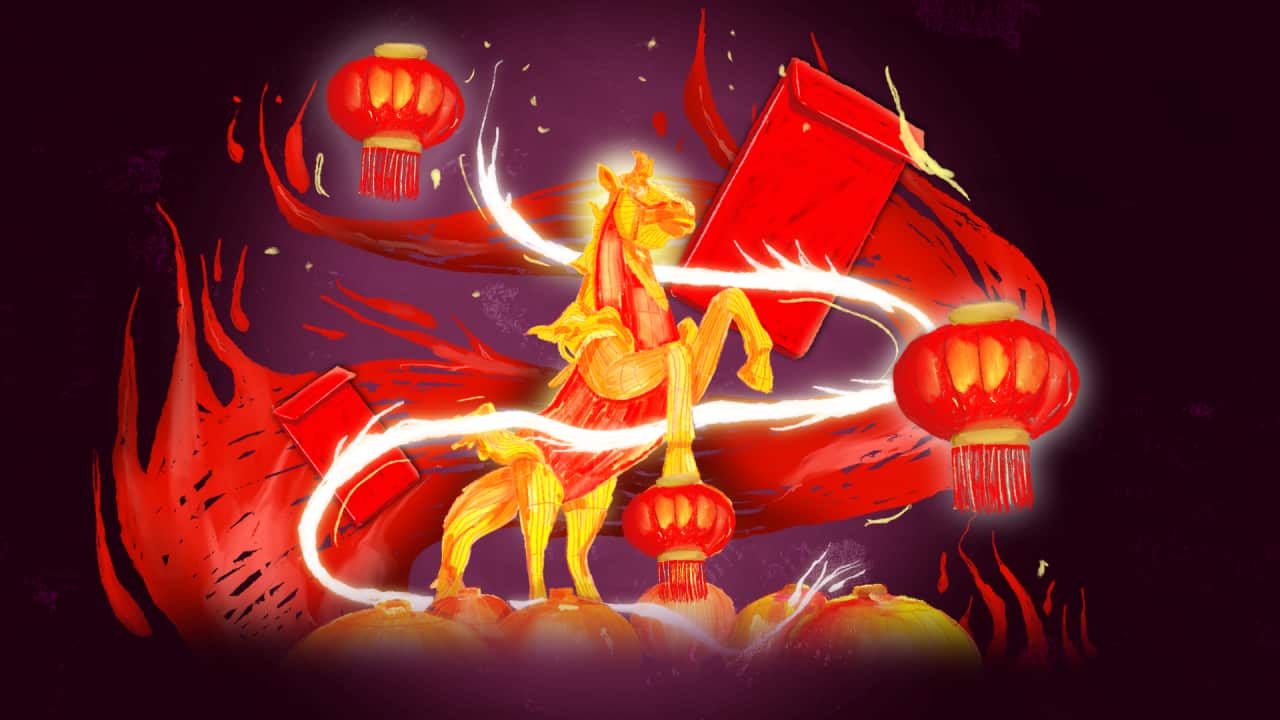

Of Lunar New Year In just a few days, the countdown will begin to gallop into the Year of the Fire Horse – seen as one of the most exciting combinations in the Chinese zodiac cycle.
The fire horse last appeared in 1966 and combines two extremely dynamic symbols in the calendar.
There are twelve animals in the zodiac and five elements – wood, fire, earth, metal and water – meaning that each combination of animals and elements only occurs once every 60 years.
“The fire is a kind of symbol for energy, haste, and the symbol for horse means energy, vitality, speed and passion,” said Fan Shengyu, associate professor at the Australian National University School of Culture, History and Language.
“It is a very special year in that 60-year cycle. It is very special,” he told SBS News.
Pan Wang, associate professor of Chinese and Asian studies at the University of New South Wales, said fire and horse represent very similar qualities.
“When you put these together, it’s like a double fire,” she told SBS News.
“That will certainly symbolize vitality, passion, this full energy and high speed, courage.”
What can you expect from the Year of the Fire Horse?
Each Chinese zodiac animal is associated with both positive and negative qualities.
For the horse, Wang said, the downside includes high temper, restlessness and impulsiveness, and difficulty restraining or restraining.
She said this year people are encouraged not to hesitate in making decisions, and to embrace the qualities of the horse.
“Basically, this is a year that rewards fearless courage and dedication and punishes indecision, hesitation or impassiveness,” she said.
“Just ride the horse and ride the momentum, and don’t hesitate too much and complete the journey.”
How will people around the world celebrate it?
This year, the Lunar New Year falls on February 17. Many celebrations will take place the night before, and the festivities will last about two weeks, although the length of the holiday varies in different countries.
Millions of people worldwide celebrate the Lunar New Year. Although it has deep roots in Chinese culture, it is observed in different and unique ways in many East and Southeast Asian communities, and may be known as Spring Festival (Chinese New Year), Seollal (Korean Lunar New Year), and Tết Nguyên Đán (Vietnamese New Year).
It is a time for families to come together and share symbolic foods, embrace traditions, exchange wishes for good luck and celebrate spring and new beginnings.
Some other common traditions include setting off fireworks and putting up decorations and symbols of the animal of the year.
In many cultures, it is considered good luck to wear red to mark the occasion, and to give red envelopes containing money as gifts.
This year, however, some may choose to wear calmer shades such as white or blue to balance the intensity of the fire horse.
“If you have too much yang, you want some yin to balance that out,” Pang said.
“You also need some water if there is too much fire.”
Firehorse lore and idioms
The fire horse has a strong meaning in many Asian cultures.
In Japan there was a decline in the birth rate in 1966. The decline is said to be related to the superstition that women born in the year of the Fire Horse have a fiery and uncontrollable temperament that would not be suitable for marriage.
“I don’t believe the majority of the younger generation will maintain this belief,” Pang said.
“These are all evolving and changing.”
There are numerous idioms related to both fire and the horse in Chinese culture, she noted, compared to many of the other zodiac animals.
Some of these include:
- Lóng mǎ jīng shén: Literally “dragon horse spirit,” this refers to powerful energy and vitality.
- Shí wàn hu| jí: Translated, this means “one hundred thousand urgent fires”. Idiomatically, it is said to indicate that something is extremely urgent.
- Mǎ dào chéng gōng: Good luck at the horse’s arrival.
- M|sh|u shìzhān: Follow the horse’s head.
- Yī mǎ dāng xiān: One horse takes the lead.
- Mǎbùtíngtí: The horse does not stop its hooves.
- Shu|hu| bùróng: Water and fire cannot coexist.
Jin Han, director of the Australia-China Institute for Arts and Culture at Western Sydney University, said horses were considered “crucial in winning battles” in ancient Chinese history.
“That is also why horses are so important for success, and we also have so many expressions in Chinese about horses,” she told SBS Chinese.
She noted the popularity of the saying “mǎ dào chéng gōng”.
“Basically this means that when a horse arrives, success is assured,” she said.
“So the year of the horse will be a year of success.”
For the latest news from SBS News, download our app And subscribe to our newsletter.
#Year #special #Year #Fire #Horse