

ISLAND OF PALMS, SOUTH CAROLINA | When Tom Fazio created the Links Course more than 40 years ago at the Wild Dunes resort, just north of Charleston, it was a revelation.
Given the freedom to build a golf course on land bordering the Atlantic Ocean long before the houses and villas began to rise from the sandy soil, Fazio’s first solo design created a layout that has fueled his rise as one of the game’s most influential and accomplished course designers.
The Links Course wound through Lowcountry live oaks and tumbled over natural dunes before emptying into the edge of the Atlantic Ocean, where the final two holes played next to the sea oats. It was immediately fascinating. The 17th and 18th holes were recognized in a coffee table book of the 500 greatest holes in the world, with the smell of salt air and sea breeze practically emanating from the pages.
“Wild Dunes was a groundbreaking project for Tom Fazio and Fazio Design,” said Bryan Bowers, who has worked with Fazio as lead designer for 27 years.

Less than a decade later, as Wild Dunes expanded and became one of the most popular vacation destinations along South Carolina’s famed coastline, Fazio and his group built the Harbor Course, a second 18-hole course that helped fill the need for tee times while providing housing locations with expansive marsh views and access to the Intracoastal Waterway.
It was admittedly a tight task, squeezing eighteen holes into a narrow piece of land that was already full of holiday homes. And when Hurricane Hugo devastated the area in 1989, both the Links Course and the Harbor Course were virtually destroyed.
The Links Course was the first to reopen and it took two years (1991) before the Harbor Course was active again. Now, 34 years later, the Harbor Course is new again, having just completed a $9 million renovation project that not only revamped the layout but also represents another step in the continued elevation of the 1,600-acre resort that is just 30 minutes from the many charms of Charleston.
“When courses were built in the 1980s by Pete Dye, Tom Fazio and Jack Nicklaus, more contours and moguls were used. Today those areas are wider and gentler.” – Bryan Bowers
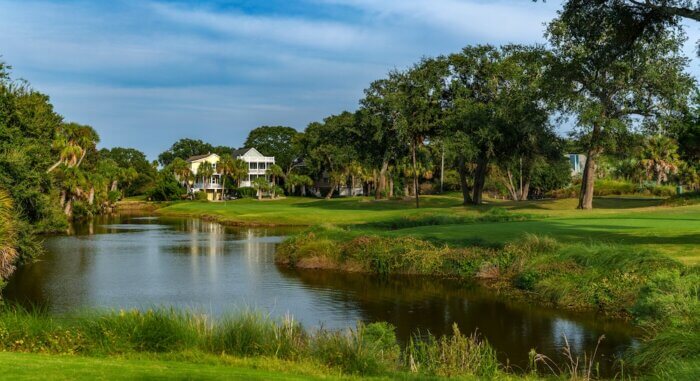
With water or marsh in play on 17 of the 18 holes, the Harbor Course plays just 6,359 yards from the back tees and features six par-3 holes in the par-70 layout. Don’t be fooled by the relatively short distance. The combination of sea breezes, some sharply defined courses and a handful of strong par-4 holes make the Harbor Course a good test for low-handicap players.
Bowers and the Fazio group widened the fairways where they could, including on a three-hole stretch mid-round that runs along the Intracoastal Waterway on what was once the island’s airstrip. Downwind holes 10, 11 and 12 are tempting, but if you’re upwind or dealing with crosswinds the difficulty changes immediately.
The par-4 17th hole, which begins with a tee shot hit diagonally across an expansive swamp and leads to an approach shot with the same swamp hugging the left side of the green, is as solid a hole as any in South Carolina’s golf-rich Lowcountry.
And the par-4 18th hole, a slightly smaller version of the 17th, provides a finish that is as demanding as it is beautiful.
It is a golf course with only 25 hectares of irrigated grass, barely half of what many courses have, and there are plenty of bunkers and waste areas that require attention.
“Because of the land and the geometry of the space, we tried to create as much wiggle room as possible,” Bowers said. “When courses were built in the 1980s by Pete Dye, Tom Fazio and Jack Nicklaus, more contours and moguls were used. Today those areas are wider and gentler.”


Water or swamp play a role on 17 of the 18 holes of the Harbor Course.
Rebuilding all 18 greens created more contours and nearly doubled the total size of the new Tifeagle putting surfaces, from 60,000 square feet to more than 110,000 square feet, dramatically improving the playability of the Harbor Course.
Add new irrigation, the relocation of some cart paths and a handful of design tweaks that have made some greens more accessible and the change is both dramatic and uplifting.
“Like any building or golf course, it needed to be updated,” said Jeff Minton, director of golf and sports at Wild Dunes. “We spent a lot of time repairing our irrigation system and the greens had become contaminated. It was definitely something that had to be done.”
Both the Links and Harbor golf courses fit comfortably within the resort, which has a luxurious feel without losing the beach atmosphere. Unlike some places that sell sparkle, Wild Dunes manages to sell a feeling as well as the amenities.
It’s a place for bike rides, beach walks and just being there to hear the palmetto trees rustling in the wind and the sound of crashing waves.
The 93-room Boardwalk Inn has a AAA Three Diamond rating, while the Sweetgrass Inn, which opened in 2021, features a spa and rooftop bar with resort views and celebrates the area’s culture.
There is no shortage of excellent dining options, including the Oystercatcher Bar & Restaurant, which serves oysters on the half shell four ways daily.
If you’re feeling like spending an afternoon or evening in Charleston, it’s just a short drive away.
But once you get to Wild Dunes, it’s hard to leave.