

“Right now I’m sitting with some of my good friends at a Brazilian barbecue in Rio de Janeiro,” he said to a dazzling backdrop of laughter and sizzling meat. “We eat and drink and enjoy a little peace in life.”
Since Ronnie Ebanks was among those friends, it was certain that everyone would have fun. Ebanks, a former jockey turned agent turned champion rider, once managed to lure the infamous homebound Bobby Frankel to Rio’s fantastic carnival.
“Next week we go to the Pellegrini,” said McPeek, referring to the Carlos Pellegrini-Internacional (G1), which will be held in Buenos Aires on December 13. “When I’m here, I keep thinking about one of my favorite trainers, Horatio Luro. He was so charismatic and he stopped more than once to enjoy life.”
McPeek often delves into “The Grand Senor,” the Luro biography written by Joe Hirsch, if only to appreciate how the profession has changed since the days of the flamboyant horseman, a worldly Argentinian who collected two Kentucky Derby (G1) trophies on his way to the Hall of Fame.
Luro was 90 when he died in 1991, and he probably wouldn’t recognize the profession today, even if some things never change. The trainer’s brain is programmed to worry 24/7. Their necks turn because they are looking over their shoulders. Bad news lurks in every stall, on every phone call.
McPeek, who has been training since 1986, earned his vacation with a 2025 season in which he collected $12.2 million in steady earnings with just 700 starters at 23 racetracks. The earnings are surpassed only by McPeek’s 2024 high, which includes a Kentucky Derby win from Mystical Daan and a Horse of the Year campaign from Thorpedo Anna . Both returned to lesser results this year, although Thorpedo Anna did more than enough to earn a division title among older fillies and mares with scores in four major stakes, including the Apple Blossom Handicap (G1) and the Personal Ensign Stakes (G1).
Kenny McPeek (far right) with Thorpedo Anna prior to her victory in the Fleur de Lis Stakes at Churchill Downs
McPeek is the first to credit the key players in his sprawling Kentucky operation. Among them is Jimmy Jerkens, who will host the show on December 6 Aqueduct racecourse when the stable rocks in the Demoiselle Stakes (G2) and the Remsen Stakes (G2) for 2-year-olds with the filly Shillings and the foal Chambersville – as long as they visit the vet.
This isn’t an exaggeration, and certainly not specific to McPeek’s promising young guns. The pre-race veterinary inspection environment has turned the training profession into an almost daily task. McPeek suffered two high-profile vet scratches during this year’s Breeders’ Cup when Mystik Dan was removed from the Breeders’ Cup Dirt Mile (G1) and Blackout time second after division leader Ted Noffey in the Breeder Future (G1). Keenelandwas forced to miss the Breeders’ Cup Juvenile (G1).
In a recent episode of his podcast on Horse Races Now, a free, informative website and app created by McPeek, the trainer offered a list of suggestions that would be taken seriously in a reasonable racing universe. In particular, the recommendations are intended to alleviate the increasing financial pressure on horse owners while maintaining the admirable intent of pre-race protocols and inspections.
For example, McPeek sees no reason not to add a practicing veterinarian to the mix of official inspecting veterinarians, which offers a more approachable perspective. He thinks it would be better if the inspections were carried out by individual veterinarians rather than by small committees. He has witnessed a number of official vets not wearing or neglecting to use something as simple as a hoof tester, while a simple foot fault can be misdiagnosed as a joint problem.
McPeek is pushing for the seven-day waiting list to be applied more widely to minor problems, saving the 14-day wait for more serious findings. He suggests that once a horse is placed on a vet list, it becomes policy that the horse is inspected in a timely manner, without unnecessary bureaucratic delay. He also reasonably calls for government agencies to pay for scans and other extraordinary diagnostics ordered by their veterinarians.
McPeek was asked if he has had any response to his wish list.
“I have no grip and I really didn’t expect that,” he said. “I’m struggling to find anyone who cares or puts pressure on it. Owners are being punished more and more. It seems that once you’re on a list it’s very difficult to get off. Even with clean x-rays and clean scans, in some cases you don’t get any relief. With some horses you’re still behind the eight ball and not sure which way to go.”
McPeek has no problem with the increased emphasis on pre-race inspections, even though implementing it can be difficult.
“They don’t trust the decisions of trainers, and even jockeys who are on the horses, in post-parade situations,” he said. ‘The rider knows how a horse is doing, and he has no intention of taking his life into his own hands – any more than he already does – when he notices that something is wrong.
“We know our horses,” McPeek added. “We’re not always right, but neither are the vets. I think they’re just so nervous when a horse breaks down that sometimes they’ll be turned away for the smallest reason. But sometimes we don’t get clear directions on what to do next.”
While Saturday’s Aqueduct runners could end a banner year, McPeek finds himself in something of a limbo with two of his other top two-year-olds: the filly Taken by the wind winner of the Pocahontas Stakes (G3) in September, and Blackout Time, the Breeders’ Cup Juvenile scratch.
“Taken by the Wind was put on the vet’s list an hour after she won the Pocahontas,” McPeek said. “We’ve x-rayed her four times since then. We found no chips, no marks, no cracks. Nothing. She’s been scanned, PET scanned – all tests. She would have been locked up and loaded for the Breeders’ Cup, but we can’t take her off the list.
“We are in a new era in uncharted territory,” McPeek said. “They are good intentions, but what I don’t like is that the dynamic of it all is very negative. It’s almost like it’s vets against riders, and riders against vets.”
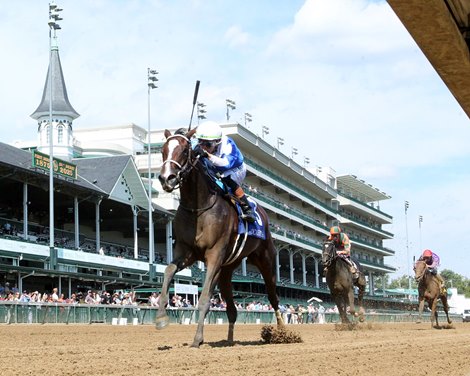
Kenny McPeek trainee Taken by the Wind wins the Pocahontas Stakes at Churchill Downs
Still, the show must go on. Horatio Luro won the Remsen Stakes twice, in 1959 with Victoria Park and in 1963 with Northern Dancer. McPeek will try to win his first Remsen with Chambersville, a son of Spinning candy owned by Shortleaf Stable, who won a fast first race at Keeneland last time. The barn may have a better chance in the Demoiselle with Shilling, a daughter of Global campaign owned by Fern Circle Stables. She won the November 6 Tempted Stakes at Aqueduct by 4 lengths.
Their trainer will observe from a distance and fuel up for what could be an eventful 2026, after two more tough acts. But that’s for later. The fact that he even took a call from a Yahoo reporter more than 6,000 miles away was beginning to irritate his fellow travelers.
“They’re interrupting me to answer the phone,” McPeek said. “Besides, I think my steak is ready.”
#McPeeks #call #common #sense #sense